You took the reins of Breguet last fall — what were your priorities?
Before officially starting in the role, we were able to set up a very beneficial transition period with my predecessor, which also allowed me to dive early into Breguet’s incredibly rich history. Even though I’ve always followed this fascinating brand, fully immersing myself in the treasures of its heritage, inventions, and products was both exhilarating and necessary to define a strategy — with the 250th anniversary as a key focus. The main driver of the celebrations is the product itself, and together with the teams, we spent a lot of time defining a different way to present and communicate about it.
How did his status as watchmaker to the navy influence Breguet's history?
Abraham-Louis Breguet was already a member of the Bureau des Longitudes when his skills earned him the title of Watchmaker to the French Royal Navy in 1815, which was quite late in his career. He went on to make marine chronometers that were synonymous with survival at sea at the time, as they were the equivalent of today’s GPS devices. This aspect is therefore an important part of the brand's history, which is why Breguet has a collection named Marine featuring some incredible timepieces. Take, for example, the Marine Tourbillon Equation Marchante 5887, a Grand Complication model combining several crafts and incorporating a perpetual calendar within an extremely slim case. This collection stands out for its amazingly complicated models reflecting the values of navigation, meaning that precision is deeply rooted in its universe, as well as for its less complex sporty-chic models.
Will the Marine collection be expanded this year and what type of customers does it mainly attract?
Its rich heritage and diverse collections ensure that Breguet is not a mono-product brand and hence appeals to several types of customers. Those looking for tradition and classicism naturally turn to the Classique collection, whose guilloché dial and offset subdials are a nod to the inimitable Breguet aesthetic. The Marine collection exudes a more assertive personality, again with very strong codes such as the fluted pattern on the caseband and the guilloché work. As part of our 250th anniversary celebrations, the Marine collection will of course have its moment of glory in the second half of the year.

What did you learn from your time at Omega that is now useful to you at Breguet?
Above all, a passion for products. I was involved in brand development for over 20 years, as well as in crossover projects and market rollouts that prove very useful in my current role. The common denominator remains a passion for watchmaking, which encompasses a quest for innovation, a desire to push boundaries and exploration of technologies that do not exist in the world of watchmaking, as well as new materials. Let's not forget that Breguet was one of the first brands to introduce silicon for the balance-spring in the early 2000s – something that was not necessarily expected from a traditional brand. We are driven by a determination to innovate for the benefit of our customers and our products, as well as to improve reliability and accuracy.
How is Breguet celebrating its 250th anniversary?
Surprisingly, not right off the bat with a Grand Complication, but instead with a seemingly simple model marking its renewal, the Classique Souscription. This is the first of nine launch events that will mark this anniversary year and celebrate Breguet's major inventions. The most iconic is the tourbillon, but he also designed the first self-winding or perpétuelle watches, the Breguet balance-spring and hands, the pare-chute shock absorber, the sympathique clock and the “thermometrograph”, as well as the first wristwatch in 1810 and the “observation chronometer”, which may be considered the ancestor of the modern chronograph, not to mention the famous No. 160 watch known as the Marie-Antoinette.
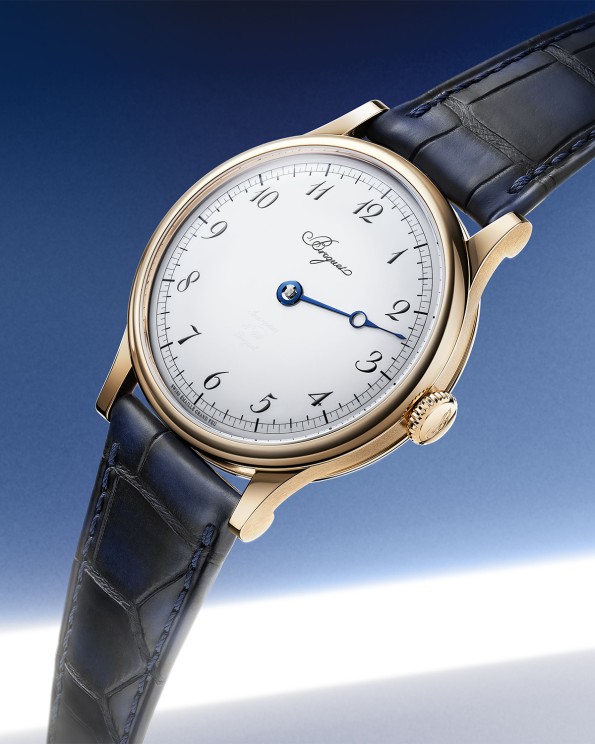
One timepiece in particular symbolizes this anniversary, the Classique Souscription 2025. What does it represent for you?
Symbolizing the brand's renewal, it is both simple and disruptive with its single hand, while featuring many details when you look at it more closely. It meant a lot in the history of Abraham-Louis Breguet and it is the first watch whose front and back are inspired by a historical model. Its appeal also lies in its duality, in the fact that it pays tribute to our heritage while embodying renewal with new codes and a new alloy: the fluted pattern has disappeared, the ergonomics of the lugs have been reinforced with a curved and contoured shape, while the domed crystal invented by Breguet has reappeared. Certain elements of this watch will serve as markers for the future. We devoted a lot of attention to the finishing operations which have all been performed in a traditional manner, such as the secret signature made using a pantograph and the very subtle finishes on all components. In addition, the new alloy makes it unique.
Does the use of new materials stem from demand from collectors and markets?
Indeed, the new gold alloy used for the Classique Souscription — Breguet Gold — responds to a certain demand from collectors to see yellow gold return to our portfolio. But we wanted it to be different. It’s inspired by the alloy used in the 1797 piece, and we were able to recreate it at the foundry of our partner Nivarox, a company within the group based in the canton of Neuchâtel and specialized in casting precious metal alloys.