Over the past fifteen years, the watchmaking industry has gone through many different phases: euphoria and crisis, mergers and acquisitions, and changing of guards. Navigating through all kinds of waters, Raymond Weil has carved out an interesting path for itself to follow – going upmarket when the time was right and adjusting the collection at its entry level when the going got tough in recent months, but always showing remarkable versatility.
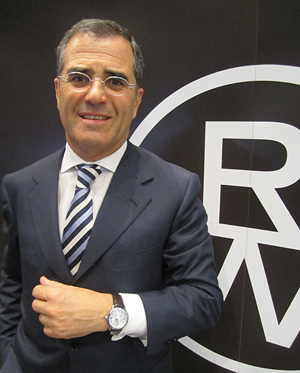
Among the best known and established independent brands, Raymond Weil likes to boast its familial ties. At the helm of the company is Olivier Bernheim, someone who is proud of the independence and eclectic nature of Raymond Weil like a mantra.
“What Raymond Weil has been doing is to be coherent and consistent with the changes in the world's market. Every fifteen years we have a new generation coming up, with more money to spend on a first watch than a couple of decades ago,” Bernheim said at Baselworld. “And it's very important to understand the aspirations of the new generation and anticipate its needs; [this is] how we can evolve.”
Selling watches and brands
“Raymond Weil is among the few brands at Baselworld that has been on the market for 35 years without interruption. When my father-in-law created the brand, there were only six Swiss watch brands alive and kicking… the others were either asleep, not yet created, or not yet re-launched. The world changed, it's only natural that we change: only 15 years ago, a watch was sold as a watch – now people sell brands that produce watches,” Bernheim explained.
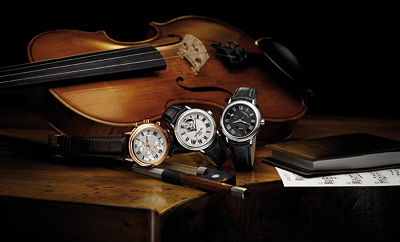
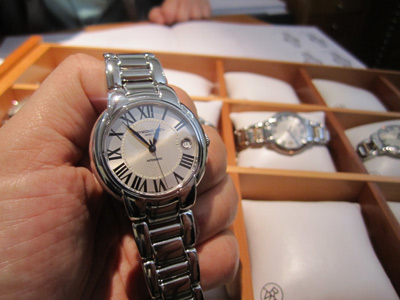
And what kind of watches does Raymond Weil have to sell to an evolving world buying the brand as much as the watch? “We managed to stay one of the strongest Swiss brands with an affordable price, a certain degree of technical expertise, quality beyond reproach, and never changing our price policy. These days we are offering two new important directions in our collection: the Maestro line, with high horology features and even women's mechanical models, ranging from US $2,200 to $ 3000– a price point the watchmaking conglomerates decided to abandon but an essential one to us and an important one for retailers in terms of selling because most people still come looking for that price range when they look for a quality watch. The other one is the biggest novelty: the launch of the new Jasmine line.”
Eric Yersin, director at Raymond Weil, underscores the significance of the new line dedicated to women. “I can say Jasmine is a synthesis of all those different feminine models we did in the past: we have put in one watch the idea of the company!” The new line is available in 29 and 36 mm case sizes, automatic or quartz, stainless steel or rose gold PVD, with or without diamonds, silver or mother of pearl dials.
The men's offerings are also solid, with a special emphasis on a certain complication. “The chronograph is a main complication very well understood by the consumer so we have a chronograph in every single one of our strongest lines,” Yersin continued. “In the Nabucco, Freelancer, Parsifal and Maestro lines we have mechanical chronographs and those four pieces are the star products.” The Maestro line, very appealing to the Chinese market with its guilloché-style dial and overall classic look, was extended by several more models, including a few with small complications and one in gold celebrating the brand's 35th anniversary.
Exceptional numbers but controlled optimism
Bernheim likes where his company is, but keeps his feet on the ground. “I have controlled optimism: optimistic because we never had such exceptional numbers; controlled because we never know the next morning if there's going to be another catastrophe.” Raymond Weil's CEO anticipates a growth problem: “With the reprise of the American market and the wild development of the Chinese market, some problems will be posed regarding production sources: who's going to manufacture all these orders, who will produce them, and where will they be produced. It'll be necessary to educate more watchmakers and workers in order to please everyone, otherwise it will be a problem.”
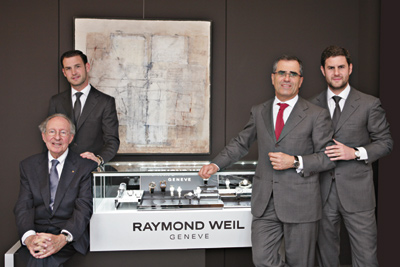
Raymond Weil's best market is the United States, but China looms on the horizon. “Our segment, from US $1,000 to $4,000, is the one with the best growth potential – with the creation of all these young professionals earning money, China is creating millions of new workers earning money and looking for a first quality watch. We are ready.”