Revue FH - 2nd July 2009
Janine Vuilleumier
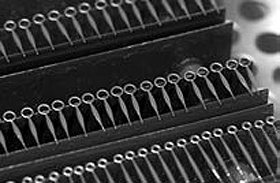
A century ago, in 1909, Universo was established following the merger of fifteen firms that decided to pool their know-how. Coinciding with difficulties it was experiencing at the time, the firm was acquired in 2000 by the Swatch Group, enabling it to develop its technology, diversify its production methods and enlarge its inventory of machines. Its 350 employees work every day to meet customer requirements.
Based in La Chaux-de-Fonds, Universo's activity occupies two sites: one in Le Crêt-du-Locle specialising in hands intended for watches assembled automatically, particularly Swatch models; the other at rue des Crêtets where hands are produced in small production runs for luxury timepieces. The firm's administrative headquarters are also located here.
Design of hands
For all types of hands, the start of the process is the same. Strips of rolled metal are purchased (brass, steel, gold, platinum, aluminium), with a thickness of between 0.10 and 0.30 mm; the width is variable. The first operation consists in cutting location holes along the entire length of the strip to ensure accurate positioning when it is passed through the different machines.
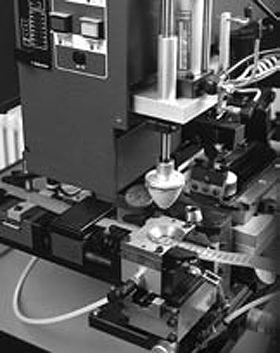
When creating hands intended for automatic assembly, all operations are carried out on the strip itself, including cutting and various processes applied to the metal (colour, application of Superluminova, etc). The hands will then be delivered on strips or cut according to customer specifications. The procedure is quite different for «artisanal» hands. After cutting, these are separated from the strip and handled individually until they are finished. Important operations include:
- gluing: the hands are aligned and glued to supports in preparation for diamond-polishing;
- diamond-polishing: by means of a perfectly honed diamond turning-tool, the hand is given a flat, rounded, faceted or grooved surface;
- parting: once diamond-polishing is complete, the hands are unglued from their support and cleaned in a variety of baths to dissolve the glue, then dried;
- electroplating: surface treatment of the hands (gilding, nickel plating or rhodium plating);
- straightening: experienced female employees wearing gloves smooth out any deformations the hands have acquired, applying a precisely measured force with the thumb and index finger;
- carding and inspection: the hands, ten pairs to a card, are aligned one by one and carefully inspected.
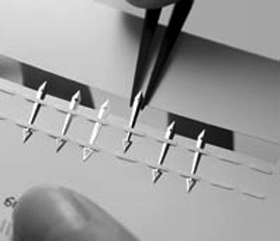
Special process: blued hands
In the blueing process for steel hands, special furnaces equipped with an extremely accurate temperature control are brought into play. A few dozen hands are heated for several minutes, leading to the formation of an oxide film. Various gradations of colour are required, however the reference is and always will be Breguet dark blue.
This department is staffed by highly specialised female employees. They know intuitively the time needed to oxidise a specific type of hand to the desired colour. If the required shade is not obtained straight away, the batch is lost in its entirety. Absolute exactitude is therefore de rigueur in this manufacturing process.
Rigorous organisation
Every stage in the production of hands calls for rigorous organisation, ensuring close supervision and compliance with delivery times (between 4 and 16 weeks, all types of products and customers included). To tell working groups apart, every employee wears overalls specific to his or her department (yellow for the gold sector, red for steel, green for individually diamond-polished hands and blue for the industrial sector). However a common bond unites everyone working in Universo workshops: meticulous attention to detail and pride in an expertise ranging from the design of mass produced components to the craftsmanship of individual, superior quality parts.
Some key figures
Universo holds around 65% of the Swiss market for the production of hands and therefore remains the undisputed leader in this field. In terms of product segmentation (gold, brass, steel), the firm is active in all areas. Approximately 70 million hands were supplied in 2007 and 80 million in 2008.