Press release
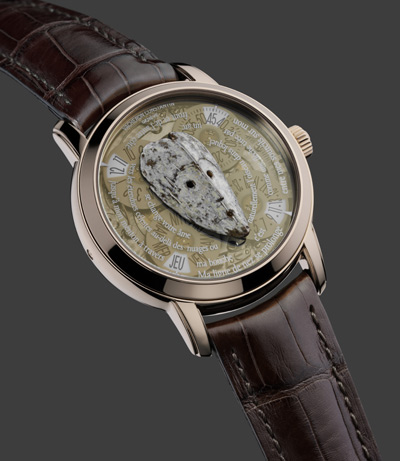
OCEANIA - INDONESIA
Facial Mask
Island of Lombok, Sasak people
Hard wood, traces of white pigments
Height: 21.5 cm
Former collection of Mathias Komor
Inv. 3320-A
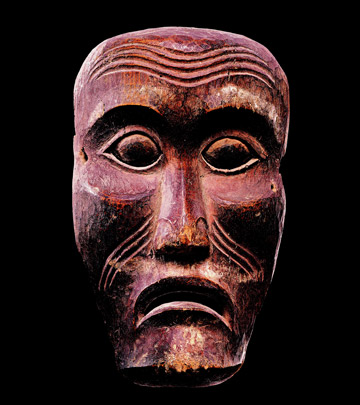
I dance the duration the wait
patience the resistance
to suffering and to evil
the slowness of the days and nights
stammerings recognition
resignation but vigilance
the hasty passage of the months
and the devouring of the months
Michel Butor
With its air of bewilderment, this mask has both realistic and geometrical features and is dominated by the large eyes. It clearly represents an old man with its sunken cheeks, dark rings under the eyebrows, and especially the wrinkles that furrow its brow and the folds between the nose and mouth. These wrinkles animate the face and help give dramatic expression to the character, which seems to raise its eyebrows and half-open its mouth in amazement. The old man was a regular character in Balinese Wayang Topeng theatre. The masked actors did not speak because they had to hold their masks between their teeth with a leather thong. It was therefore left to the narrators and singers to describe the intrigue and recount the heroes' adventures.
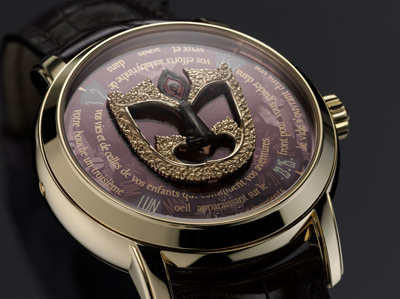
ASIA - CHINA
Zangs-‘Bag facial Mask
Tibet region, Tantric Buddhism. 16th–17th century
Partially-gilt copper, pigments
Height: 22.2 cm
Inv. 2504-168
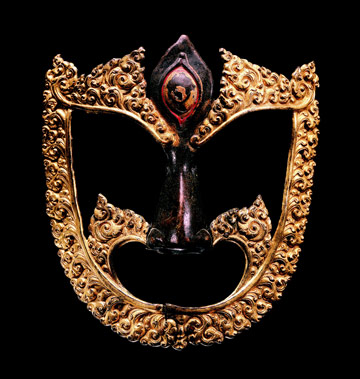
With my ornaments I surround
the emptiness opening in your eyes
and in your mouth a third
eye appearing on the forehead
to guide you in your labours
in the labyrinth of your lives
and those of your children
who continue your adventures
Michel Butor
A mystery, even a profound sacredness, seems to emanate from this half-empty mask. And yet the highly naturalistic nose reminds us that this figure with its frozen expression has a human side. The divine is expressed by the strange mandorla, positioned like a jewel on the forehead of the mask and enclosing a painted eye. A beautifully designed frieze of gold-covered arabesques and scrolls frames the empty spaces. This type of zangs-'bag mask was worn by certain monks from the dGe-lugs-pa yellow hat sect. The masks were used in dances linked to the cult of Kâlacakra (the Wheel of Time).
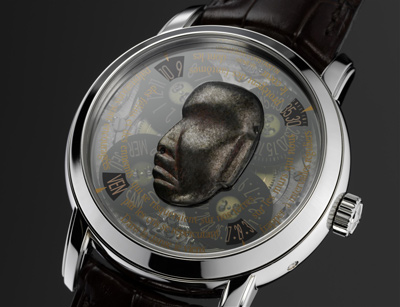
AMERICAS - MEXICO
Pendant Mask
State of Guerrero
Mezcala culture (300 – 100 BC)
Basalt
Height: 12.8 cm
Inv. 505-26
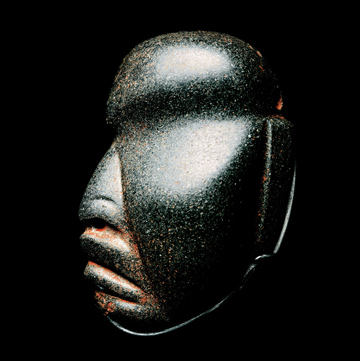
At regular intervals
during the dance I come and strike
the heart whose pulse
races at the screams
reverberating off the walls
that protect us from the ghosts
of felines and enemies
who venture onto our land
Michel Butor
Blending the influences of several cultures in a singular style, this pendant mask conveys all the artist's virtuosity. Its powerful and austere profile comprises both abstract and naturalistic features. The upper part of the face and the diagonal of the cheek are treated in a minimalist fashion; by contrast, the aquiline nose and down-turned mouth seem far more realistic. This mask belongs to the Mezcala culture. During the classical period, it was the custom of these people to bury their dead under the mud floors of their dwellings. In accordance with a ritual related to the ancestral worship of the dead, the tombs were full of small hard-stone sculptures of asexual human figures, heads, plaques decorated with faces, masks, and animal effigies.
AFRICA - GABON
Ngontang Mask
Western Gabon, Fang people
Soft wood covered with white kaolin, specks of crystallisation
Height: 31 cm
Inv. 1019-76
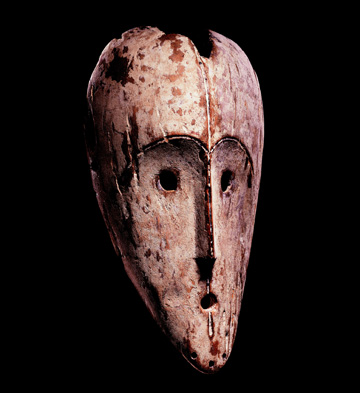
The line of my nose extending
between the eyebrows on my forehead
and on the other side to
my chin across my mouth
is like an arrow fi red
by a bow towards the celestial heights
beyond the clouds
or naturally the bird
into which your soul changes
Michel Butor
The sobriety of this white mask, with its melancholic air and o-shaped mouth, shows the sculptor's remarkable sensitivity. It is covered with white kaolin, a colour that for the Fang, as for many other African tribes, referred to the spirit of the dead. The expressive power of the face is produced by the vertical line suggesting the nose as well as the scarifications from the chin to the forehead and from which two welldefined, curved eyebrows branch out. This mask was used in a ritual dance linked to the Byeri's cult of ancestor worship. Although its use did not have any particularly religious significance, the initiated dancer had to respect certain ritual gestures and taboos. These dances were intended to protect the village from witchcraft and evil influences.
Technical Data
Reference numbers
China Mask 86070/000J-9400 for the 18K yellow gold version
Indonesia Mask 86070/000G-9399 for the 18K white gold version
Mexico Mask 86070/000P-9401 for the 950 Platinum version
Gabon Mask 86070/000R-9402 for the 5N 18K pink gold version
Calibre VC 2460 G4, self-winding mechanical
Stamped Poinçon de Genève
Thickness of movement: 3.60 mm; 6.05 mm with additional plate
Diameter of movement: 25.60 mm, or 11½ lignes
Jewelling: 27 rubies
Frequency: 28,800 vibrations/hour
Power reserve: Approx. 40 hours
Indications and functions: Displayed in 4 windows on the case rim:
- hours with dragging disc
- minutes with dragging disc
- day with semi-jumping disc
- date with semi-jumping disc
Case
China Mask: 18K yellow gold
Indonesia Mask: 18K white gold
Mexico Mask: 950 Platinum
Gabon Mask: 5N 18K pink gold
Diameter: 40 mm with sapphire crystal back
Water-resistance: 3 bar, equivalent to 30 metres
Dial: Anti-reflective sapphire crystal
Strap: Mississipiensis alligator, hand-stitched. High shiny finish, dark brown
Clasp: 18K gold or 950 platinum folding clasp. Half Maltese Cross
Limited series
2009: The third Métiers d'Art “Les Masques” set is a limited edition of 25 boxes, each containing four timepieces representing four different continents (the Americas, Asia, Africa and Oceania), for a total of 100 individual pieces.
Further information about the "Métiers d'arts" collection: click here