
There are watches that tick, others that open landscapes. The Railmaster is one of them: both an inner compass and a traveling companion. My journey (imaginary, you understand): from Northern Italy to Cefalù in Sicily, where the blue of the Tyrrhenian Sea becomes piercing against the golden cliffs.
It all starts at Milan Centrale. I bring along the Railmaster, this watch born in 1957 for railroad workers. A technical, professional watch. Today, here it is in its element for this train epic. I glance at my wrist: the small second alerts me, time is passing. It's time to head to the platform.
Journey through time
The Railmaster is part of a famous sibling group alongside the Seamaster and the Speedmaster – a trilogy of professional watches launched in 1957. A queen of the deep that will benefit from the rise of recreational diving; a speed enthusiast that will forever mark history by stepping on the lunar soil; and an ally of the railway boom. The Railmaster was intended for engineers, industrial workers, and scientists working near tracks, exposed to significant electric and magnetic fields. Its movement was protected by a soft iron Faraday cage, resistant to 1000 Gauss, an achievement compared to the then-common 60 Gauss.
Less known than its illustrious sisters, the Railmaster is nonetheless rich with a fabulous history, associated with the development of the railway. At the end of the 1950s and in the 1960s, Europe was rebuilding after the war. To support industrial growth, railway networks were modernized. Meanwhile, Italy was experiencing the golden age of the Rapidi, express trains connecting the North to southern destinations, and iconic models like the Settebello or the ETR 250 Arlecchino, symbols of progress and Italian design. Rail then embodied a certain idea of the future, that of a mobile, technical, connected Europe. Punctuality and precision became an ideal, the watch remained an essential instrument.
At the rhythm of the rail
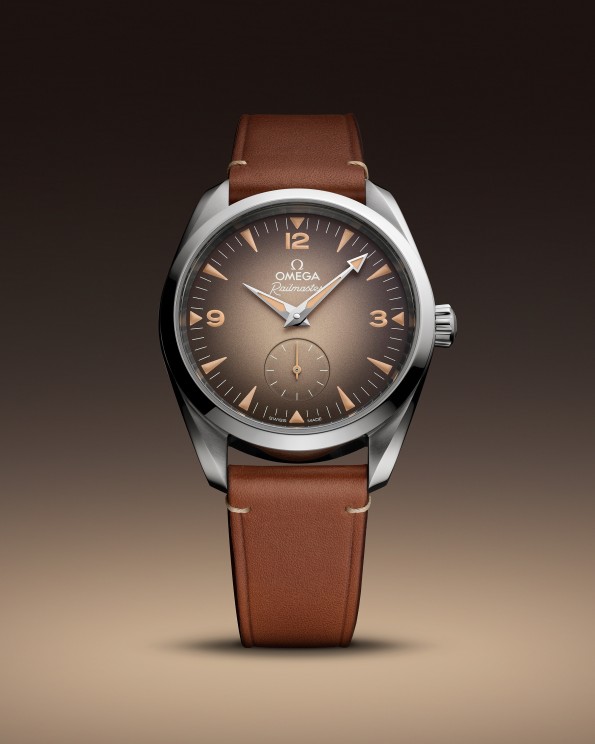
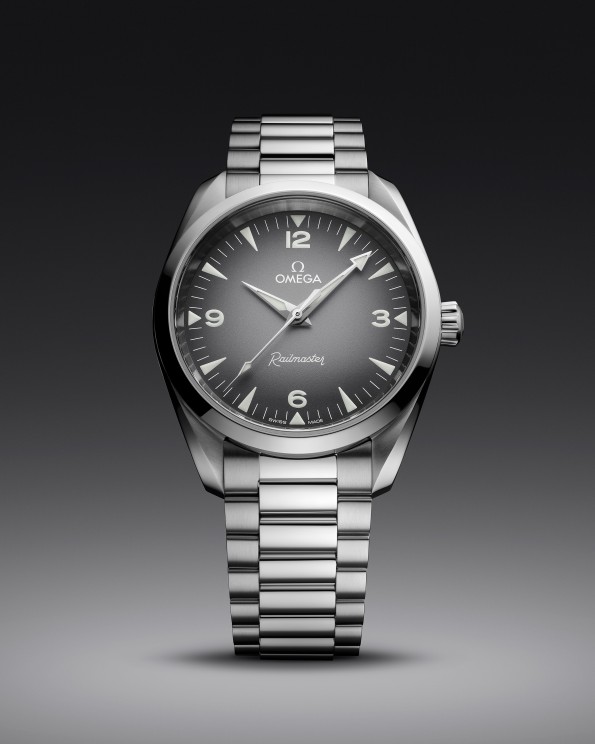
Onboard, I observe the light, filtered through the large windows, play with the surfaces of the Railmaster. On the dial, a brown gradient. No superfluous logo. No flashy complications. Just the essentials, hours, minutes. Reliability and precision. And this small second at six o’clock, so visibly indicating that the watch is working properly. Everything is readable, clear, unequivocal. Its version with a black gradient gray dial shows even more fidelity to the minimalist spirit of the original watch.
The vintage style of the Railmaster recalls the working-class heritage from which it originates. Its 38 mm steel case remains consistent with this DNA and houses a remarkably reliable movement, the Co-Axial Master Chronometer caliber 8806 or 8804 (for the small seconds version). METAS certified, it withstands 15,000 Gauss without a Faraday cage – now equipped, among other technological innovations, with a formidable ally, a silicon balance spring.

I watch the Italian landscapes pass by: Florence, Rome, Naples... Each station is a milestone. The Railmaster connects me to both the past and the present. The polished steel of its bracelet captures the southern golden reflections.
Then the ferry. And one last stop. Here we are at Cefalù. The train comes to a halt. Between sea and mountains, the sun lingers on the ochre facades. The sea laps at the rocks. The Railmaster reveals itself perfectly at ease in the raw beauty of these landscapes. Useful, solid, reliable, effortlessly beautiful. Faithful to what it has always been.