
1969. The year is not only erotic. Mechanical innovations are enjoying growing popularity. The one presented on March 3rd simultaneously in New York and Geneva would revolutionize the watchmaking world. The tremors it caused are still felt today. By unveiling the Monaco, Heuer revealed two major breakthroughs: a nearly square (38 x 40 mm) water-resistant case and an automatic chronograph movement.
The Caliber 11 stands out for its architecture. Its time-measuring module is mounted in reverse. This arrangement has direct consequences on the design of the watch — its crown is positioned on the left. Its geometry also stands out in a world of sports watches dominated entirely by the orthodoxy of the round shape.
The name of the watch draws on the passion of Jack Heuer, then the brand’s CEO, for motor racing, embodied by the fierce Grand Prix of the same name. All the aesthetic variations of the 1970s benefited from the strong personality of the original model. The quartz crisis forced the Monaco to make a pit stop, but it roared back onto the track in 1997, stronger than ever.
Three distinctive signs
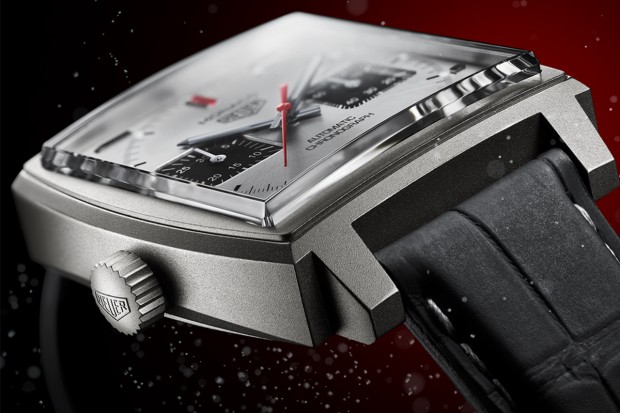
A design icon
It is impossible to talk about the TAG Heuer Monaco without mentioning its square case, now 39mm on each side. This angular geometry has imposed a new vision of sports watchmaking. Its sharp edges, polished sides, and flat surface evoke both architecture and speed. This unique shape has redefined chronograph standards, becoming a symbol of boldness. Its silhouette invites a reconsideration of masculine elegance.
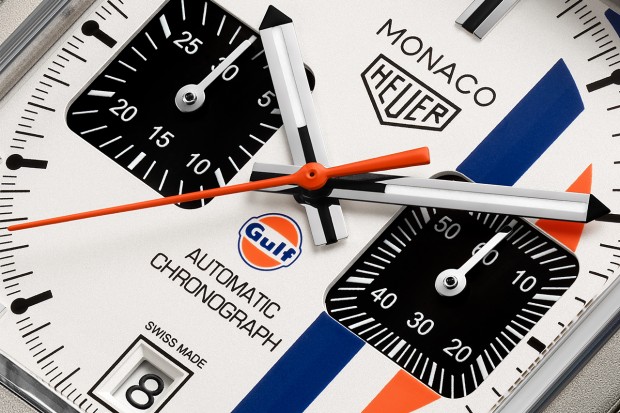
A highly legible dial
Nonconformity is also an aesthetic signature of the Monaco. Beyond its left-side crown, its dial is immediately recognizable thanks to a unique presentation of time information. Its two symmetrical subdials help create a visually striking harmony. The surrounding minute track and indices contribute to this dynamic and functional composition, regardless of the variations.
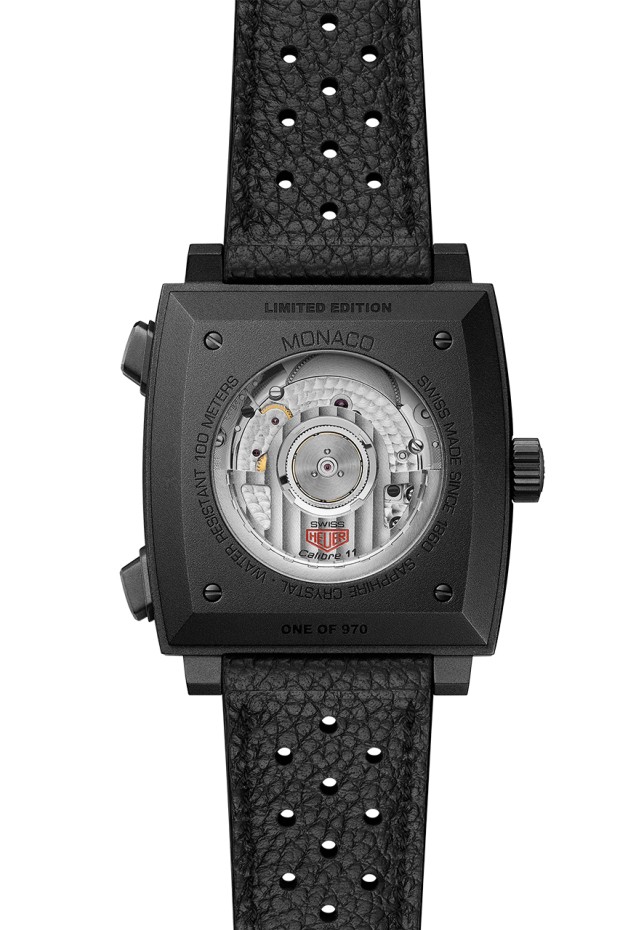
An engine of innovations
Since the advent of the Caliber 11, the first automatic movement equipped with a chronograph module, the Monaco has proven to be a fertile ground for technical experimentation. The TH20-06, with its flyback function and carbon-composite hairspring, demonstrates this constant drive for evolution, anchoring the watch in its time while envisioning its future. The 2003 Baselworld edition elevated it to star status. The Concept Watch Monaco Sixty Nine features two reversible dials. One, minimalist, displays the time with traditional hands and a small seconds subdial. The other, digital, allows timing sessions down to 1/1000th of a second.

The following year, an evolution, the V4, propelled it into a previously unknown dimension. Pulleys and toothed belts the size of a hair replaced the gears. Thirty-nine ball bearings reduce friction. Four barrels supply its energy. A 4.25-gram platinum ingot powers a linear oscillating mass. Once again, the brand demonstrates that technical and aesthetic innovation work in harmony and form the DNA of the Monaco.
In 2019, TAG Heuer further affirmed this performance-focused heritage. The Monaco was then outfitted with contemporary materials, such as titanium or carbon, and its case was refined. The Caliber Heuer 02, an evolution of the Caliber 11, significantly improved its power reserve, which reached 80 hours. The watch definitively cemented its status as a universal icon.
Aesthetically, the Monaco explores new avenues with admirable finishes and intense colors inspired by those adorning Formula 1® single-seaters. Its distinctive form conveys a uniquely powerful graphic presence.

The 2020s expand the realm of possibilities. The Monaco Skeleton (2023) allows the Caliber Heuer 02 to take center stage in design thanks to a skeletonized dial. In 2024, the Monaco once again demonstrates that it possesses all the qualities that make it a living legend. TAG Heuer elevates its iconic chronograph to a new peak of performance with the Split-Seconds Chronograph. Powered by the Caliber TH81-00, this high-frequency 5 Hz movement, housed in a titanium case, establishes itself as one of the most accomplished creations of the manufacture.

Symbolizing this perpetual quest for innovation, the Monaco Flyback Chronograph TH-Carbonspring projects the icon into the future. While retaining the famous 39mm square case, it swaps steel for forged carbon, an ultralight material. The random patterns of the composite fiber make each watch unique. Its shades of gray and black, mineral-like texture, and nearly monochrome dial give this reference an architectural, almost brutalist appearance.
Beneath this apparent simplicity lies a mechanical feat. The timepiece debuts the Caliber TH20-06, an automatic movement certified as a chronometer by the COSC. This precise movement features a flyback function, yet the true innovation lies in its beating heart. Its TH-Carbonspring oscillator, the result of ten years of research, incorporates a carbon-composite hairspring. Antimagnetic, shock-resistant, and unaffected by temperature variations, it ensures remarkable chronometric stability.

The Monaco, therefore, is not just a vintage tribute. It embodies a laboratory of expression for TAG Heuer, where tradition always goes hand in hand with innovation.
Monaco: a timeless square
Le 3 septembre dévoile la Monaco, première montre animée par un calibre chronographe automatique protégé par un boîtier carré étanche.
Dans le film Le Mans, Steve McQueen, influenceur avant bien avant l’arrivée des réseaux sociaux, place la Monaco sous les feux des projecteurs.
Des évolutions conservent les lignes du boîtier, mais sont animées par un calibre Valjoux 7736. La couronne passe alors à droite. Le cadran s’enrichit d’un troisième compteur.
TAG Heuer ressuscite la Monaco, victime à la fin des années 1970 de la crise du quartz. Toutes les itérations sont équipées de calibre automatique moderne et solide.
La tendance est au vintage. La Monaco retrouve ses atours esthétiques d’antan, et également sa couronne à gauche.