
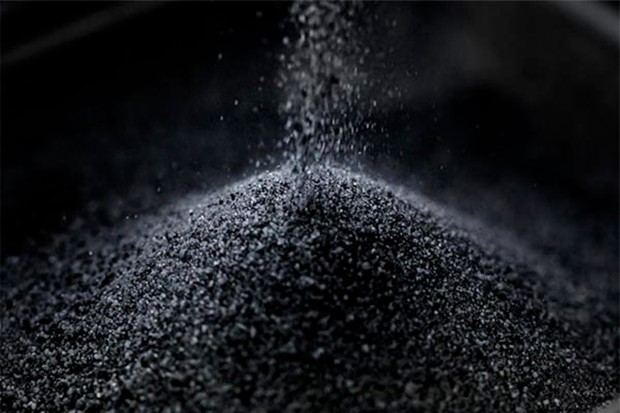
In the watchmaking world of Audemars Piguet, ceramic is far more than a technical material whose mastery borders on artistry. Made from zirconium oxide or alumina, this substance displays exceptional properties. Lightweight, hypoallergenic, unalterable, and above all scratch-resistant—with a hardness of 7 on the Mohs scale, where diamond reaches 10—ceramic stands out not only for its performance but also for its aesthetic refinement. For while its mechanical advantages are compelling, its visual brilliance is equally striking.
Ceramic offers a rare intensity, capable of receiving both a mirror polish and a deep satin finish. This duality allows the material to shape subtle contrasts, capture light, and sculpt volumes. In the production of timepieces from the Brassus manufacture, every surface becomes a field of expression, every finish a component of identity.

The manufacturing standards surrounding this ceramic are as uncompromising as the material itself. Multiple stages are required to achieve a flawless result—from the composition of the material to firing, sintering, adjustment, and the final polishing. Each step demands extreme precision, as the material tolerates no approximation. This rigor is equally evident in the pursuit of color. Now available in a wide range of stable, fade-resistant shades, ceramic expands the creative possibilities.
The Royal Oak remains the emblem of this mastery. Its angular geometry and unique architecture provide an ideal playground for such a complex material. The famous alternating finish— the brand’s signature, with its sharp vertical brushing punctuated by mirror-polished facets—takes on an entirely new dimension when applied to ceramic. The finishing work becomes almost sculptural, giving rise to graphic reliefs of striking clarity, as if carved with a scalpel.

This approach reflects Audemars Piguet’s desire to remain faithful to its heritage while looking confidently toward the future. The turning point came in 2017, when the manufacture unveiled its first Royal Oak in ceramic featuring a case and bracelet crafted entirely from this material. Since then, ceramic has become a major element in the contemporary watchmaking language of Audemars Piguet.
Three Colors: A Symbolic Triptych

Black
A color of natural elegance, black and ceramic form a duo that lacks neither presence nor depth. On a Royal Oak such as the Royal Oak Grande Complication 44 mm, this shade reveals the full power of the design. The edges appear sharper, the surfaces crisper, the contrasts more pronounced. Black absorbs the light while emphasizing the brushed and polished transitions.

White
A symbol of purity, white ceramic offers a bright and spectacular expression. The color also reveals another facet of the design. On the Royal Oak Automatic 34 mm, for instance, the volumes appear more airy, and the lines gain in finesse. Unlike black, white reflects light with softness and delicacy.

Blue
The hue gives the ceramic an almost mineral intensity. The deep reflections of cobalt blue become vibrant and transform the watch’s personality, adding a sense of contemporary sophistication. Blue also catches the light with remarkable strength, revealing a richness of nuances that shift with every angle. The Royal Oak Double Balance Wheel Openworked 41 mm, with its grande tapisserie, gains even more elegance.
Two-Tone: Strength in Unity
Ceramic takes on an entirely new dimension when the manufacture decides to pair it with a second material, such as white gold, rose gold, or steel. Many references in the 11.59 collection—for example, the Supersonnerie Minute Repeater or the Automatic Flying Tourbillon—combine metallic surfaces and ceramic elements with millimetric precision.
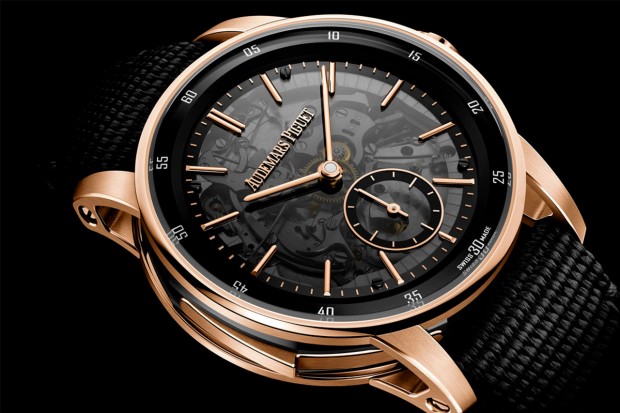
The process demands bilateral mastery. Combining two materials with different densities, tolerances, and behaviors, while maintaining structural and aesthetic harmony, remains a remarkable feat—especially given the complex architecture of the collection’s cases. The visual and tactile contrasts created give these watches their distinctive personality.

Sintering: An Improved Recipe for the Future
The Royal Oak Offshore Automatic Chronograph 43 mm stands out with its decidedly sporty look, combining black and green ceramics, enhanced by titanium elements. This variation exudes a visual power of rare intensity. Its construction showcases the manufacture’s ability to create complex timepieces. Yet, it does not rest on its laurels. On the contrary!

The combinations of colors and materials are an integral part of Audemars Piguet’s DNA. Internal research continuously expands the watchmaking vocabulary, exploring unprecedented combinations and manufacturing processes.
Polychrome ceramic thus opens up new horizons. Thanks to its aesthetic based on a striking camouflage pattern developed using SPS (Spark Plasma Sintering) technology, each case becomes a unique piece. The process involves placing ceramic powders of different colors into a circular graphite mold, which are then sintered by a powerful electric current that generates a rapid rise in temperature. The arrangement of the powders, which varies each time, ensures that every piece is one of a kind.

The resulting ceramic discs are then used to machine the case and bezel—extremely robust components that are subsequently pre-polished and pre-satin-finished. With this innovation, AP’s ceramic not only opens a new stylistic chapter but also inaugurates an exciting new era in the history of modern watch design.