
At the beginning of the 19th century, pocket watch dials were primarily made of polished metal or enamel—uniform surfaces that offered limited legibility depending on the ambient light. In 1786, Abraham-Louis Breguet adopted for his timepieces a technique derived from mechanical engraving: hand guilloché, executed on manual cam-operated lathes.
This technique permanently transformed the appearance of watches. Guilloché added depth, texture, contrast, and plays of light to the dials. It was not merely a decorative refinement, but a functional innovation.
By creating shadows, the patterns significantly improved legibility. Different guilloché zones organized information and defined spatial boundaries. Smooth, polished areas reserved for primary indications became instantly perceptible. The watch thus became both readable and sumptuous. This technique established itself as an aesthetic signature, inseparably linked to Breguet.
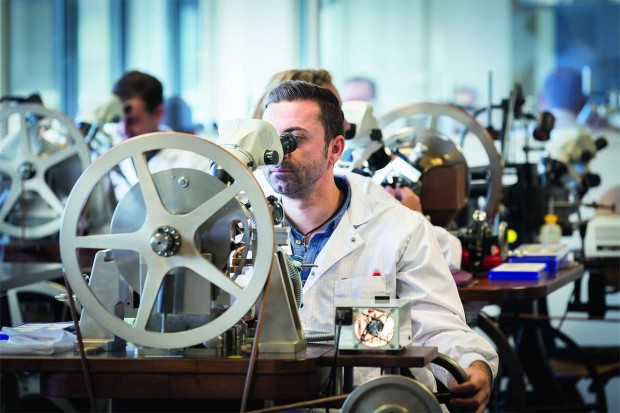
Machines and Men
Guilloché remains both a mechanical and artisanal art. It involves finely engraving the material—noble metals in the case of Breguet—to create repetitive, symmetrical patterns composed of networks of straight, curved, or broken lines. The guilloché lathe serves as the tool: one hand turns the drive crank, while the other guides the graver. The technique requires great dexterity and extensive experience to master the movement and engrave designs with precision on the order of a tenth of a millimeter.
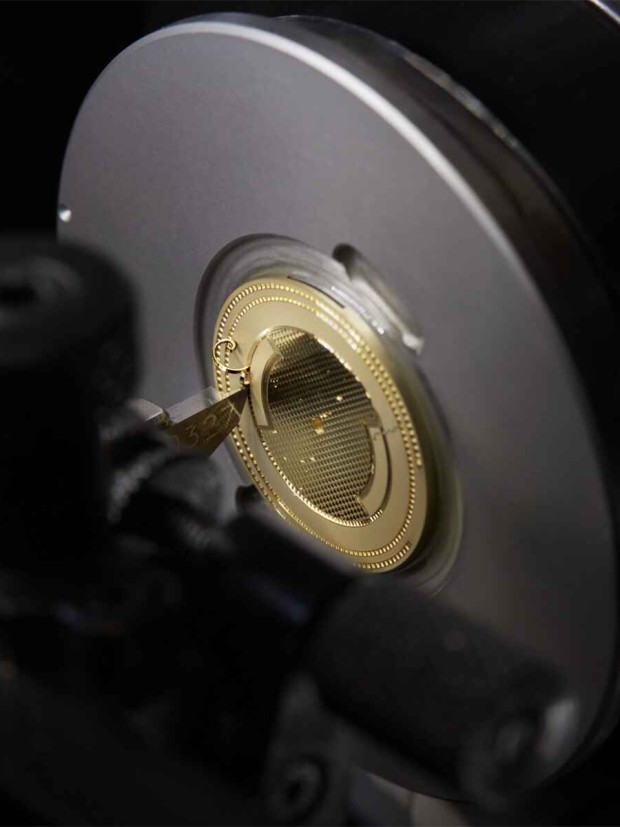
At Breguet, the pursuit of excellence is inseparable from respect for the past. To perpetuate this work of extreme precision, the Maison has made a monumental investment: the maintenance and acquisition of antique guilloché lathes, some of which are several centuries old. Far from being obsolete, these machines are treated as true treasures. A workshop entirely dedicated to their restoration ensures their survival and perfect functionality. This is not mere maintenance; it is both archaeological and artisanal work, often requiring the recreation of missing parts using techniques and methods from the past. Thanks to this dedication, nearly 30 of these machines continue today to produce, day after day, the brand’s signature ornamental patterns. Breguet does not simply preserve its heritage—it keeps it alive.

Over the decades, Breguet codified a repertoire of patterns that would become its signature. The manufacture still employs them today with an almost ritualistic reverence, instantly characterizing a dial as unmistakably “Breguet.”
An ever more creative array of patterns
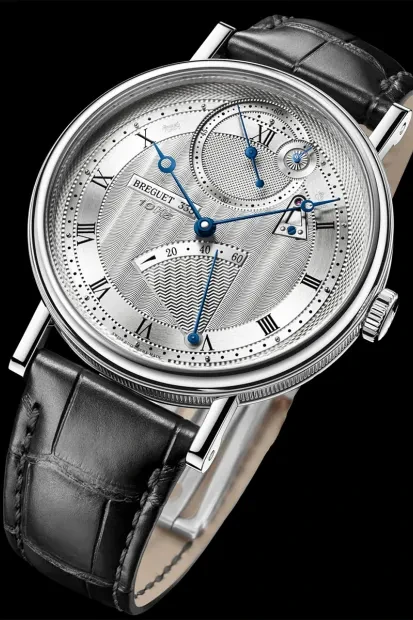
The dial of the Classique Chronométrie 7727 showcases a wide range of graphical decorations mastered by the artisan, featuring six distinct patterns: “Geneva waves” for the central area, “Clous de Paris” for the small seconds, “sunburst” for the tenth-of-a-second counter, and “chevrons” for the power reserve. The hour track is adorned with a “beaded line,” while the outer rim features a “barleycorn” motif.
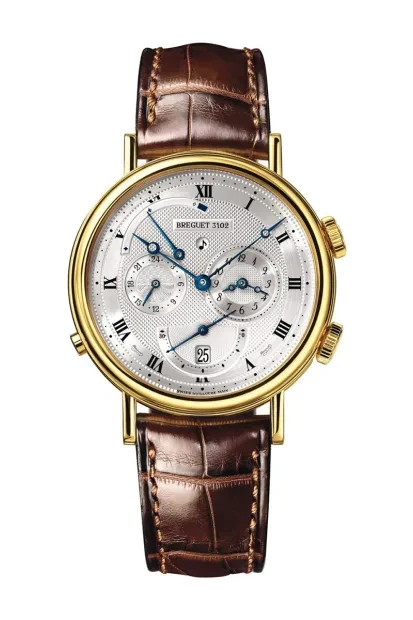
The Classique Réveil du Tsar 5707 stands as a true demonstration of the Maison’s expertise. Guilloché shapes a spectacular mosaic of seven distinct patterns. The main dial is dominated by the classic Clous de Paris, yet this iconic texture is immediately contrasted by the mirror-like effect of the circular satin finish on the hour ring, itself bordered by the precise rhythm of the Sauté Piqué on the minute track.
The subdials are no less captivating: one draws the eye with the small faceted pyramids of the Pavés de Paris, while the other creates a striking contrast by combining the dense interlacing of the Vieux Panier with the luminous dynamism of the Décor Flammé. Finally, to complete this masterpiece, the small seconds are enhanced by the delicate wave of a circular Barleycorn motif.
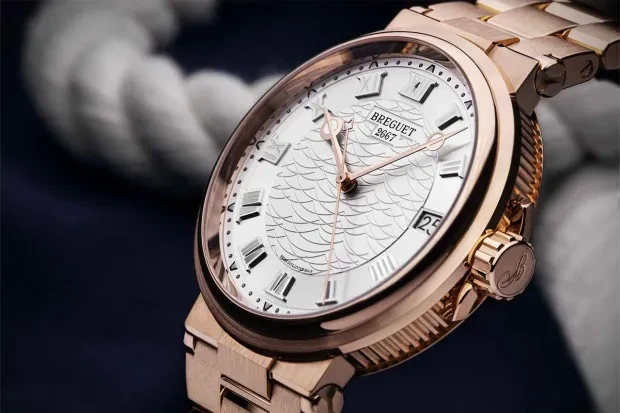
For Breguet, guilloché is also defined as “an art without limits,” alive and constantly evolving. The manufacture has thus opened a workshop dedicated to creating entirely new designs. The Marine Chronograph 5527, Marine 5517, and Marine Musical Alarm 5547 models unveiled in 2020 benefit from this innovation. This trio is adorned with a striking “wave” motif, enhancing a sporty yet sophisticated personality, firmly rooted in the maritime heritage.
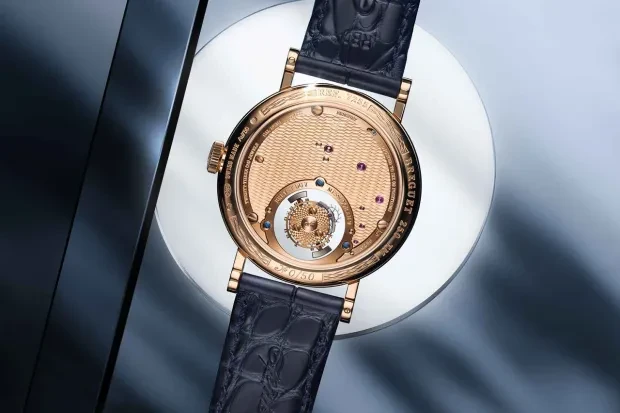
The Classique Tourbillon Sidéral 7255 not only highlighted Abraham-Louis Breguet’s invention but also ushered in a new stylistic era with the Quai de l’Horloge motif, a vibrant tribute to the historic heart of Paris. Its design draws direct inspiration from the majestic curves of the Île de la Cité and the natural elegance of the Île Saint-Louis. Circular and captivating, the decoration envelops the caseback and the support of the regulating organ, creating a hypnotic visual vortex. Linear and powerful, it extends across the entire mainplate of the calibre.
The aesthetics of the exceptional
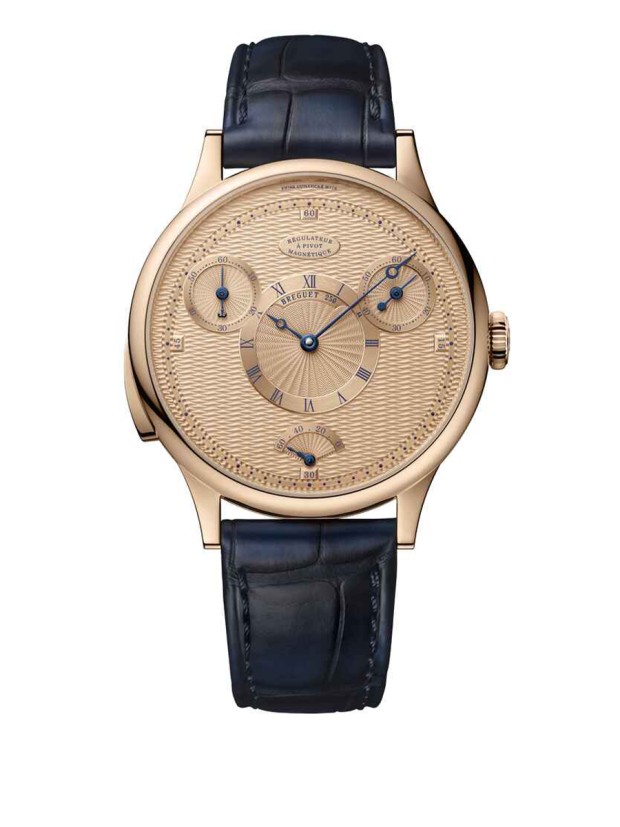
This design also flourishes on the new Classique 7225. Its 18K gold dial features hand-guilloché “Quai de l’Horloge” and “flinqué” patterns on the counters, evoking excellence. This exclusive aesthetic harmonizes perfectly with the high-frequency chronograph calibre (10 Hz) with flyback function. The watch thus stands as a paradigm of haute horlogerie, where technical innovation engages in dialogue with centuries-old heritage. The calibre, beating at 72,000 vibrations per hour, not only delivers unparalleled chronometric precision with a variation of ±1 second per day, but also contributes to the aesthetics by revealing its fine decorations through the sapphire caseback.
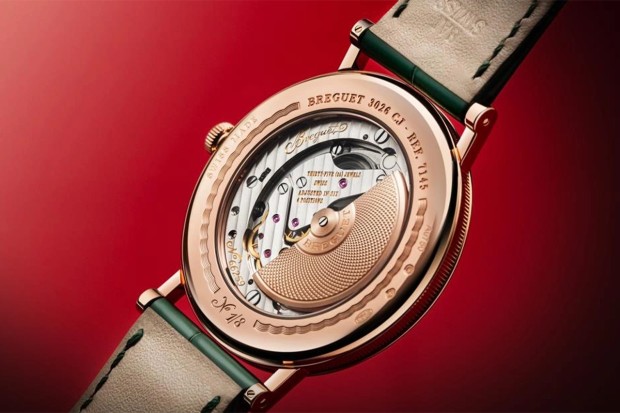
While guilloché is primarily used to decorate the dial, certain components are highlighted with this artisanal technique, enhancing the attention to semi-hidden details. The caseband of the Classique 7225 is adorned with the “Quai de l’Horloge” motif, adding an extra touch of elegance. The 22K gold oscillating weight of the limited-edition Classique 7145 Lunar New Year 2025 showcases a delicate circular Barleycorn pattern.
Ultimately, guilloché at Breguet is far more than a mere decorative technique preserved through the centuries. Originally a functional innovation aimed at enhancing legibility, it has evolved into a unique and essential aesthetic language.