
In July 2025, Hermès officially announced the expansion of its Noirmont site. An ambitious extension, designed as a contemporary riding arena–logical for a house tied to the equestrian world, in a Swiss Jura equally fond of horses. This will increase the area to 11,000 m² (compared to 4,000 today). The location will accommodate an additional hundred employees, providing a more favorable and generous workspace. "We have hired a lot in recent years," the brand specifies. "However, we choose to maintain human-sized manufactories, and do not exceed 250 employees per site," it further notes. Although, after the post-COVID boom, the watch market is suffering from the tense global geopolitical and economic context, this extension is part of a long-term strategy of investment and vertical integration.
A Step-by-Step Integration
The extension takes place on the Noirmont site which, in 2017, brought together the production of dials (Natéber acquired in 2012) and cases (Joseph Erard, acquired in 2013). With these acquisitions, La Montre Hermès then completed its integration. Since Hermès entered the watchmaking world with "Arceau," designed by Henri d'Origny in 1978, the house has woven its network of expertise and anchored its workshops in the Swiss Jura since the 2000s. Thus, Hermès has held 25% of Vaucher Manufacture Fleurier since 2006. At Noirmont, all dials are manufactured–artistic trades are entrusted to independent expert artisans. The cases, including those in titanium and precious metals, are largely made on-site. "We have the capacity to produce our cases, but we continue to collaborate with suppliers," the brand specifies. Frédéric Jenny, Hermès' industrial director, cited by Le Temps explained: "Our mission is to know how to do everything, not to do everything." Additionally, the composite cases of the H08 are produced externally, then the finishing is applied at Noirmont. Finally, the assembly and the leather workshop for Hermès bracelets are located in Brügg (near Biel).
The Art of Time According to Hermès
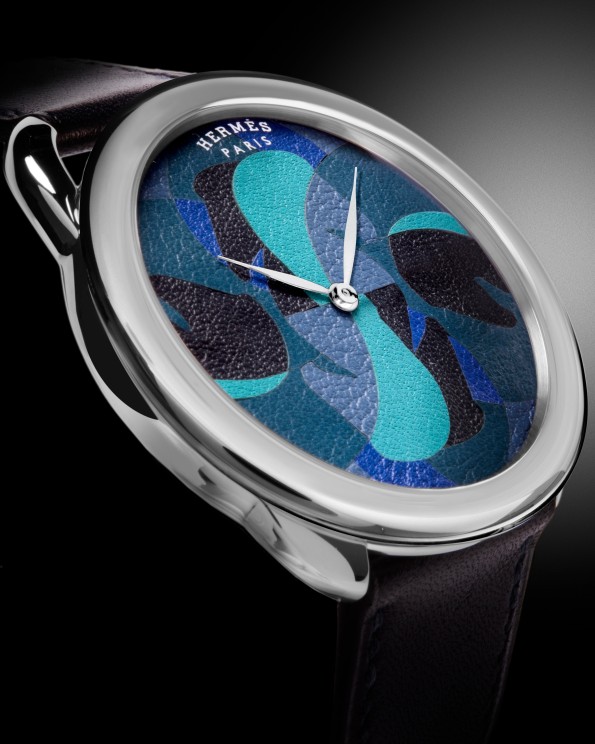
This approach allows Hermès to control quality, maintain agility, and respect its style. For over 40 years, the house has shaped a unique aesthetic of form. It also cultivates a poetic vision of time. This approach is expressed through a wide range of segments, also exploring exceptional horological areas such as artistic crafts and complications. At Hermès, technique never takes precedence over intention. The mechanism serves the story, the gesture, the emotion. The watches fit into a coherent universe. This is evidenced by the so-called "singular" complications: Le temps suspendu, which interrupts the movement of the hands with a simple press; L'heure masquée, which reveals the time on demand; L'heure impatiente, which makes waiting a promise; Le temps voyageur, which lets time travel the world; L'heure de la lune, which upends the traditional codes of the moon phase complication. Narrative watchmaking complications, which have become immediately recognizable signatures of a style.
This industrial model, Hermès manages it in coherence with its distribution. The watches are mainly sold in Hermès boutiques. A strategic choice that allows a fine understanding of demand, tailor-made support in a coherent Hermès universe, a controlled narrative. Each object, each watch, extends the house's imagination. The diversity of the ranges –from accessible quartz to exceptional pieces- nourishes this ambition.
Today, watchmaking still represents a modest part of Hermès' overall turnover, also marked by the sector's slowdown. But it asserts its place, slowly, surely and consistently. The expansion of Noirmont illustrates long-term growth, human-sized, rooted, and responsible. Because with Hermès, time makes sense.