
In astronomy, perfection has no residence. The Earth is not perfectly round, ellipses are not regular, and time is a variable that stretches or contracts. Humans have tried to discipline this joyful mathematical carnival, but to no avail: there can be no flow of time that remains eternally the same, with fixed days, months, and years across the millennia. Attempts to tame the evolution of astronomical cycles into an immutable framework are therefore doomed to fail. Humanity’s omnipotent vanity crashes against a cosmic reality that will always elude it.
A bridge between sidereal and conventional time.
Yet, this cosmic reality is not that of our daily lives. The universe is observed on the scale of billions of years. Our everyday life, on the scale of hours. Between the two lies a vast void into which watchmakers have tried, with great effort, to insert a tool attempting to bridge, on one hand, sidereal time and, on the other, civil time. A wobbly bridge, never perfectly straight, patched together by as many emperors as mathematicians, which has been called a “calendar.” Not without a touch of vanity, some have even called it “perpetual.” An oxymoron by nature. But no matter: this “Perpetual Calendar,” or QP, inspires watchmakers and serves as the foundation for regulating our mechanical daily life.
Mechanical poetry
It is probably its inherently uncontrollable nature that makes the QP so fascinating. Engineering feats are required to get as close as possible to a goal that is viscerally unattainable. But it doesn’t matter: the endeavor is a form of poetry. No one truly needs a date accurate until 2100 or 2400. The “perpetual” watch does not exist any more than the “perpetual” calendar, yet they drive watchmakers to reach heights of complication with infinite ingenuity—heights that many have been scaled by Patek Philippe.
Its display
Contrary to popular belief, the QP is not required to display all calendar indications (day, date, month, year, leap years). But the ones it does show must be accurate. A QP could be limited to displaying “Tuesday the 5th,” rather than “Tuesday, February 5, 2023, the third year of the leap year cycle.” The QP is not expected to be exhaustive, but it must be precise.

Its invention
The QP is by no means a recent invention. One of the first perpetual calendars was that of the second version of the astronomical clock of Strasbourg Cathedral, completed in 1574 by the Swiss Isaac Habrecht (1544–1620) with the collaboration of his compatriot Dasypodius (1532–1601). The QP is 450 years old!

Patek Philippe, the pioneer
In the 19th century, watches were worn as sautoirs, pendants, or pocket watches, but not yet on the wrist. In 1898, Patek Philippe designed a perpetual calendar movement for a ladies’ pendant watch. In 1925, this movement was adapted for a wristwatch (ref. 97 975), a world first of its kind, combining day, month, date, and moon phases. Patek Philippe created several unique pieces of this nature before embarking on series production. This production began in 1941 with the perpetual calendar chronograph ref. 1518, followed a year later by ref. 1526 without chronograph, with around 210 pieces produced—a very significant quantity for the time.

A style that takes shape
During the 1980s, Patek Philippe’s QP production increased. The scale was no longer hundreds of pieces per reference, but thousands. The manufacture’s style became more refined. Two apertures at 12 o’clock display the day and month, while the date is indicated by a hand. This is particularly visible on ref. 3970, which replaced Lemania-based calibres with in-house movements (the reference later became 5970). The same applied to refs. 1518 and 2499, which at the time used Valjoux bases.
The trend would never reverse. Today, all Patek Philippe QP calibres are 100% in-house. Moreover, these creations have drawn inspiration from one another. For example, the 5970 was inspired by the 2499. Heritage and historical continuity are key elements in understanding Patek Philippe QPs. There are never abrupt breaks, only evolutions.
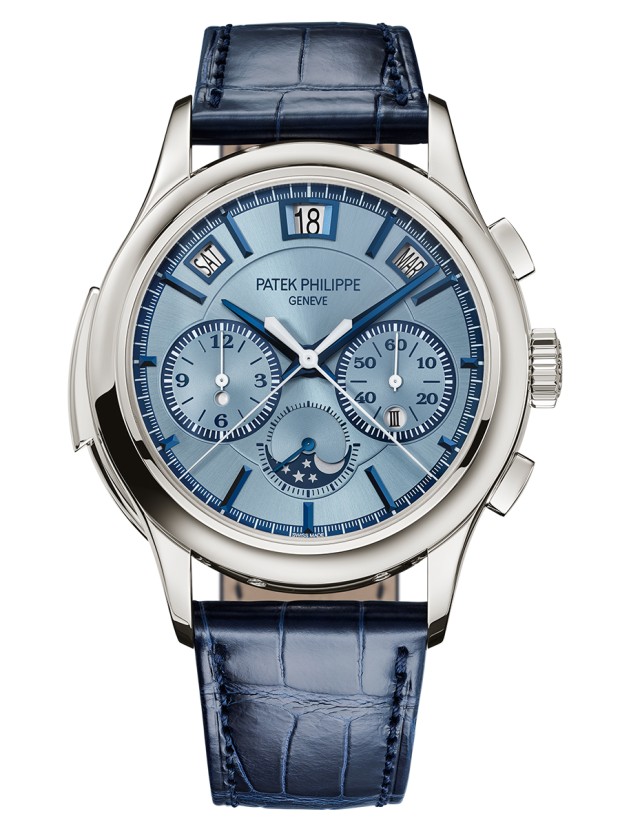
Furthermore, Patek Philippe’s distinctive approach is to frequently pair its QP with a chronograph. These two complications are the most delicate to design. It is through their combination that Patek Philippe seeks to demonstrate its expertise. This choice has greatly influenced the aesthetic direction of the maison’s QPs.
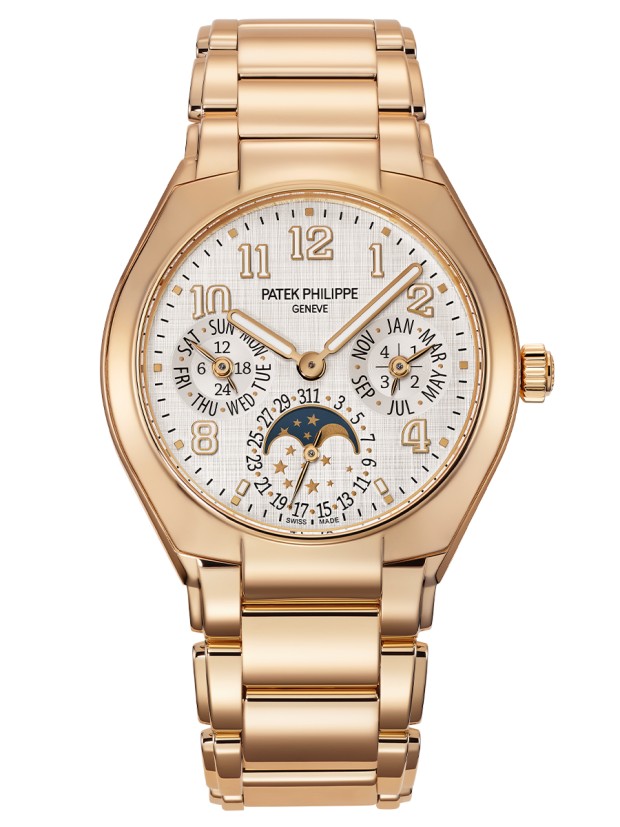
The balance between apertures and subdials is essential. It is even the key to understanding almost all Patek Philippe QPs. It guides the choice of diameters (most often 40 mm), scales, rehauts, proportions, and layouts. Around this choreography of subdials and apertures, other information is arranged when necessary. In 2011, ref. 5270 featured a leap year indicator at 4:30 and a moon phase integrated within the date subdial. In 2022, Patek Philippe introduced the first watch combining the Annual Calendar with the Travel Time display system. As of 2025, Patek Philippe offers 31 QPs.
Which Calendars Are We Talking About?

5236P In-Line Perpetual Calendar

Interview with Thierry Stern, President of Patek Philippe