Audemars Piguet has successively unveiled three new models demonstrating commitment not only to watchmaking, but also to the aesthetic and technical aspects of new shapes and materials that continue its tradition of innovation. Three powerful timepieces to be read in the light of a centuries-old genealogy.
Certain word associations are self-evident. Audemars Piguet conjures up thoughts of Le Brassus, independence, family values, Royal Oak, complications and innovation. Yet to stop there would be to miss the point, for the brand is as much about form as substance. Connoisseurs will have noted its spectacular success over the past 15 years, notably thanks to major developments in ceramics and gold alloys, as well as to techniques such as Frosted Gold, not to mention the ongoing aesthetic work that has given rise to cases as varied as the Royal Oak Concept or, more recently, the Code 11.59 by Audemars Piguet.
These fundamentals of Audemars Piguet R&D have recently been supported by three new products. For alloys, sand gold. For shapes, the Royal Oak Mini. The [RE]Master02, on the other hand, merges these two dimensions to create an asymmetrical model in sand gold.

THE CHALLENGES OF A NEW ALLOY
Developing a new alloy is never easy. Because of their composition (75% gold, 25% other metals), 18K gold alloys are more durable than pure gold, as the addition of different metals makes them harder and more resistant to deformation. But add too much copper, and it becomes sensitive to humidity. Too much silver, and it can oxidize.
The four golds on the market (yellow, red, pink and white) already cover a wide range of tones that need to be skillfully complemented, not to mention the need to develop an equivalent galvanic tone for the movement exterior. In addition, each new alloy has a significant impact on foundries. Finally, each of them reacts differently to the finishing processes on which Audemars Piguet makes no compromises. All in all, it’s a 360° obstacle course for the Manufacture and its partners.

SAND GOLD, THE FIFTH ELEMENT
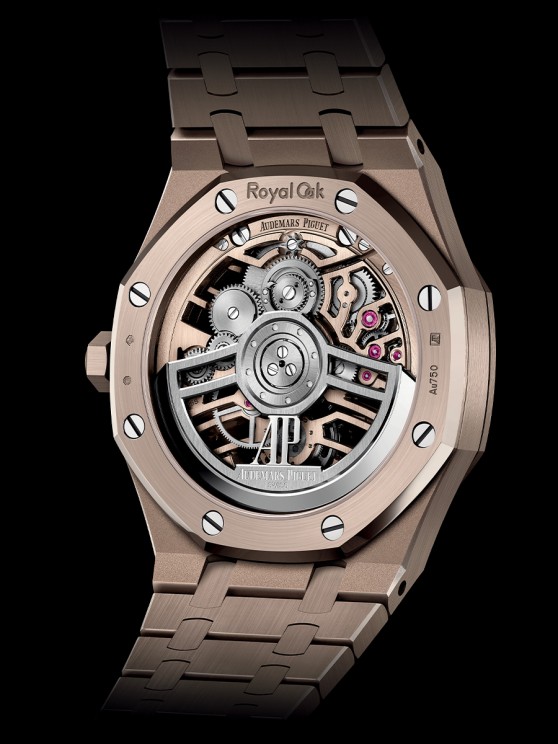
Sand gold contains palladium and copper for a warm effect. The proportions remain a closely guarded formula. Oscillating between white and pink gold, it offers a subtle variation in color according to the light. What’s more, its resistance to fading makes it long-lasting.
Introduced on the 41mm Royal Oak Selfwinding Flying Tourbillon Openworked, it is complemented by a sand gold shade obtained by galvanic treatment to embellish the flange as well as the openworked bridges and mainplate of Caliber 2972, visible on both sides of the watch.
This article is an excerpt from the upcoming GMT XXL World Magazine, debuting at Geneva Watch Days August 29th. Pre-order your copy here.