
Less is more. The adage is repeated so often ad nauseam that it is better to keep one’s distance from it to hope to make an impact at a formal dinner. Except it is often associated with the dial: according to the maxim, the most beautiful dial would be the most pared down. But what if one applied this less is more… to design methods? In short, what if one dispensed with CNC machines, computers, to return to the jeweler’s saw, the grinder, and the pencil? Less machines, more hands?
The idea may seem crazy, given that the technical advances of the last 30 years have allowed colossal gains in precision—both in finishing and in the movement. But this leads to forgetting that these technological skills are based on a craft, an eye, a manual know-how, which themselves are disappearing. In short: if a maker no longer knows how to make a movement, the CNC will not do it for them.
The conclusion of Karl-Friedrich Scheufele, founding president of Chronométrie Ferdinand Berthoud, imposes itself: these manual skills must be preserved while human beings still possess them. This is the project of the Naissance d'une Montre, third chapter. The simplest to summarize: make a watch entirely by hand. But the most difficult to do, by far.
Men and machines
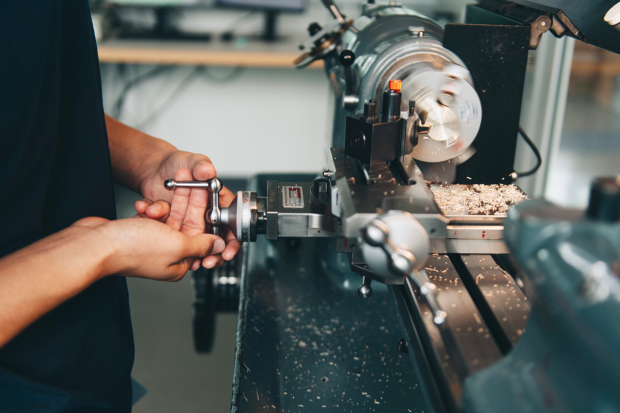
Declaring that one dispenses with modern machines is one thing, having old machines is another. Chronométrie Ferdinand Berthoud scoured the network of its partners to recover certain machines that no manufacture has used for 25 years.
Forgotten stocks, hidden storerooms, and even watchmaking flea markets were tapped to get hold, in particular, of a 1960 Schaublin lathe dedicated to circular components. It is a one-axis lathe. Let us recall that current CNC machines operate on 5 axes! The same approach was taken for a 1960 SIP marking machine, dedicated to boring, milling, drilling, grinding, and tapping operations on various components: balances, levers, plates, wheel trains, bridges, and springs.

Unique piece
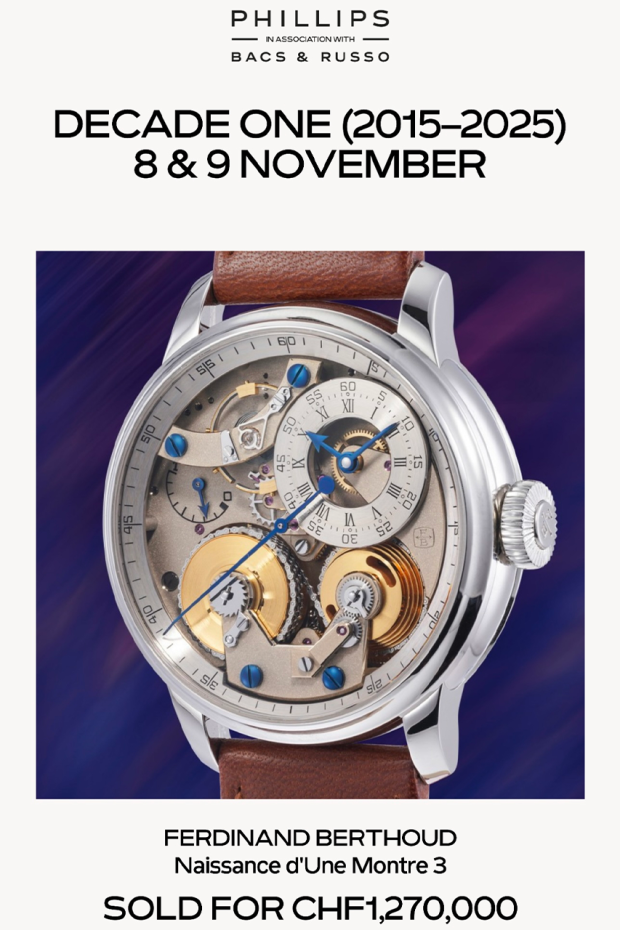
The 44 mm diameter and 13 mm thick case features curved flanks, a fluted and engraved crown, a domed crystal, a concave bezel, and welded lugs. Inspired by the Ferdinand Berthoud Astronomical Watch No. 3, these shapes are particularly difficult to achieve using manual tools. To meet these challenges, solutions were found within the Chopard group, which brings together the know-how of many trades. Certain processes, such as lost-wax casting used in jewelry, as well as turning, milling, and tapping typical of micromechanics, allowed the House to mobilize its internal expertise to produce the most complex shapes.
Once the raw piece is obtained, the manual finishing takes over: reworking, deburring, and polishing. Some components, such as the lugs, are then welded, before manual decoration (engraving and stamping). This is also the first timepiece from Chronométrie Ferdinand Berthoud whose entire movement is visible from the dial side.
Between 1 and 2 o’clock, the hours and minutes are displayed on an openworked counter, revealing the essential components of the caliber: the barrel and chain-fusée; the bimetallic balance; a circular balance bridge supporting the shock absorber, adorned with two diamond endstones, one at the front, the other at the back of the movement, similar to those of the Astronomical Watch No. 3; as well as a 50-hour power reserve indicator engraved on the plate.
Only one question remains: will there be an NM4?

© Phillips
A watch and numbers
80: the number of artisans involved in the project
6: the number of years required for the project carried out from A to Z
11,000: the number of hours spent on NM3
11: the number of pieces that will be produced, probably until 2031 (two pieces per year)
1,270,000 CHF: the price of the very first piece sold at Phillips on November 8, 2025