
The past is given an exorbitant privilege. People want to attribute the indisputable, the irrefutable to it, when it is merely exchanges, controversies, and rewritings. The gallop of time is too rapid for the observer to freeze its movement once and for all in hindsight.
Yet, this exegesis is precisely what watch brands engage in, seeking simple answers to eminently complex questions. The tourbillon is proof of this. While it is indisputable that Abraham-Louis Breguet conceptualized it in 1801 - a patent formally attests to it - it is not said that the idea was the subject of concomitant exchanges with John Arnold. The same goes for the second pusher for zero-resetting the chronograph: it is commonly attributed to Breitling but was probably not invented in the strict sense.
The weight of words: neither automatic, much less oscillating
These arguments also concern the most decisive invention of the modern watch: its automatic winding. In this quest, the way the request is formulated is important, as the word "automatic" is contemporary. One must therefore question history in search of a "perpetual" watch, according to the 18th-century lexicon. As specified by Breguet, whose literature is authoritative for this period since it is the only one perfectly preserved at the Breguet Museum.
Next, the nature of the winding mechanism must be examined. For everyone agrees that it is indeed a mass - and this is still the case today - but its rotation can either be complete or partial.
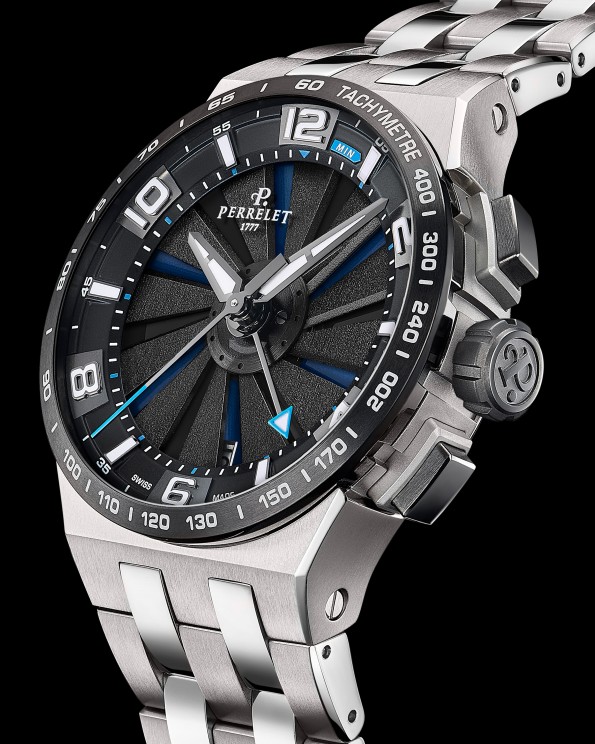
This distinction is essential. Indeed, a mass that rotates 360° completes a full revolution and should therefore be called "rotative." Conversely, a mass that only makes short back-and-forth movements over a small arc is, by definition, simply "oscillating" (literally, "that which goes back and forth from a mean position by a movement of going and coming"). The problem is that, nowadays, the two definitions have been reversed. People commonly call an "oscillating mass" the one that in fact makes a full 360° revolution by itself. A principle defined by a word...which means exactly the opposite.
The misunderstanding is therefore major. And its historical implications are very real. Because the invention of the "360° mass," the one all horology uses today, seems to be shared between a certain Hubert Sarton, Liège watchmaker, and Abraham-Louis Perrelet (and, not to oversimplify, within a Leroy watch). The matter probably plays out around 1777. In any case, from this disputed heritage, there are no watches. Only writings. And they are always subject to controversy.
The Breguet case
Meanwhile, Breguet is also working on the subject. The watchmaker has left no dated notes on his research. He simply states, in the 1790s, that he had been working on the perpetual watch "for 25 years," which places us at the same junction as Sarton and Perrelet, around 1775. The mist only thickens. Yet, factually, neither Sarton nor Perrelet have left watches that would physically attest to their work. On the other hand, the Breguet house still possesses in its museum the Breguet 1/8/82, completed in August 1782 - implying it was started around...1777!
Ultimately, this will be the only date around which one can reasonably anchor the invention of the perpetual watch, today called "automatic." Who is the author? The question is poorly posed because, ultimately, this brilliant invention probably has two close parents (Sarton or Perrelet for the 360° rotative mass) and Breguet for the oscillating mass on an arc. By itself, this invention by Breguet was also much more suited for pocket watches of the time, while Sarton and Perrelet's idea eventually found its ideal use in the 20th century with the generalization of the wristwatch.