
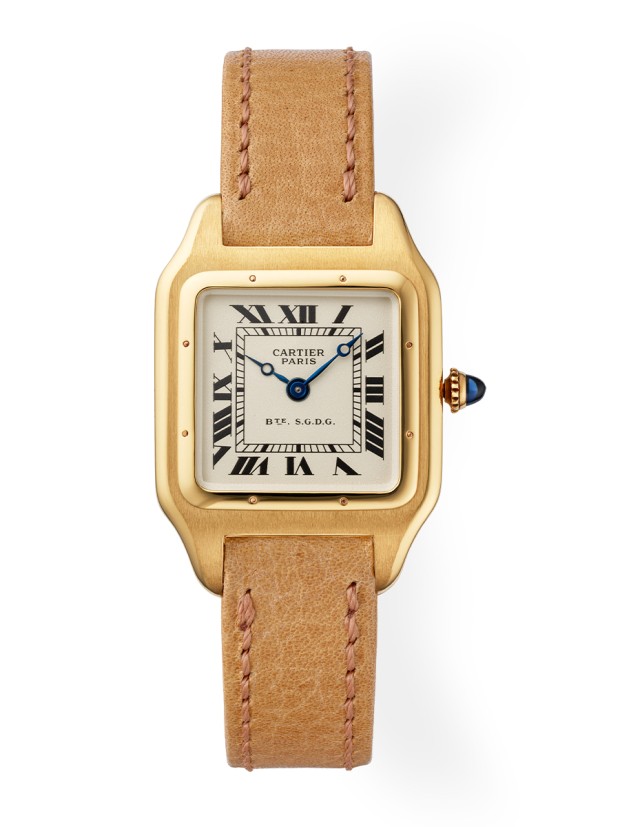
The birth of a watch that changes the gesture
We are at the beginning of the 20th century. The Brazilian aviator and heroic figure of the pioneering spirit, Alberto Santos-Dumont, flies through the skies. But at the controls of his airplane, he cannot let go of the levers and consult his pocket watch. He then consults Louis Cartier, who invents the solution for him in 1904: a square watch worn on the wrist.
It is a revolution! Because it must be remembered that at that time, a watch was hidden at the bottom of a pocket, only taken out to be consulted with a quick glance. With the Santos, it becomes a fully assumed and displayed object. The first true modern wristwatch is born, and with it, a new relationship with time.
This boldness does not emerge from nowhere. It is inscribed in the Haussmannian Paris of the time, with its geometric layouts and radiating avenues. Cartier chooses the square in a world of round watches. He rounds its corners with symmetrical bevels, converges the lugs toward the strap to create movement. Every detail counts. The rivets that fix the bezel to the case? Rather than hiding them, Cartier exposes them. The useful becomes beautiful, the functional turns into an aesthetic signature. The watch transforms from a functional tool into a true object of style. From its commercialization in 1911, the Santos is a success.
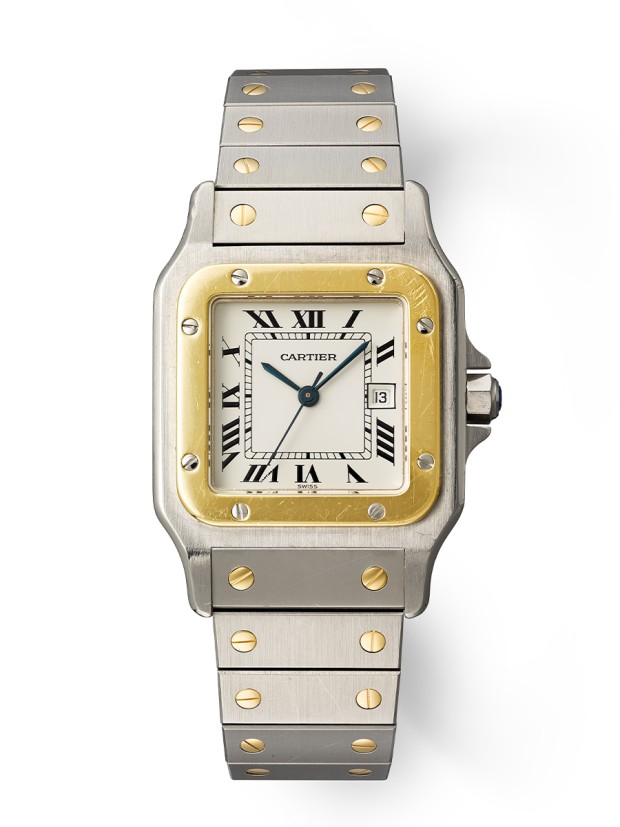
A design that does not age but adapts over time
In 1978, the Santos reappears boldly. Cartier dares to combine gold and steel for the first time. An unprecedented, sophisticated fusion, where polishing and satin finishing create contrasts, echoed by the visible rivets. This version anchors the Santos in the aesthetics of its time while reinforcing its identity.
Then come the decades of maturity, during which the Cartier model traverses the years without ever betraying itself.
In 1987, the curved Santos polishes its lines, rounds its shapes, and adjusts its size. For its 100th anniversary in 2004, Cartier creates the "Santos 100". Then comes the major redesign of 2018: Cartier’s Creative Studios completely redraw it. The result? A more fluid, more ergonomic watch, yet still profoundly itself. The bezel is refined to better smooth the transition between the case and the strap. The ergonomics are fully realized, the watch is entirely designed to fit the wrist perfectly. The Santos incorporates the "QuickSwitch" system, allowing the strap to be changed with a simple gesture thanks to an invisible mechanism, as well as the "SmartLink" to adjust the length of the same strap without any tools. Two patented innovations make the Santos a modular and customizable watch, adapting to the wearer rather than the other way around.
1904 - Louis Cartier creates the Santos for Alberto Santos-Dumont. The first modern watch designed to be worn on the wrist. A watchmaking revolution that will change everything.
1911 - Commercialization of the Santos. In a world of round pocket watches, Cartier screws a square watch onto the wrist. Immediate success.
1978 - The Santos returns with a gold and steel bracelet, an unprecedented fusion invented by Cartier. The visible screws, the raised bezel, the sculpted bracelet: the Santos asserts its style.
1987 - Arrival of the curved Santos. Polished curves, rounded shapes, adjusted size. The watch adapts to the era without losing any of its DNA.

2004 - For the centenary of the Santos, Cartier creates the Santos 100. A large-format tribute to the icon.
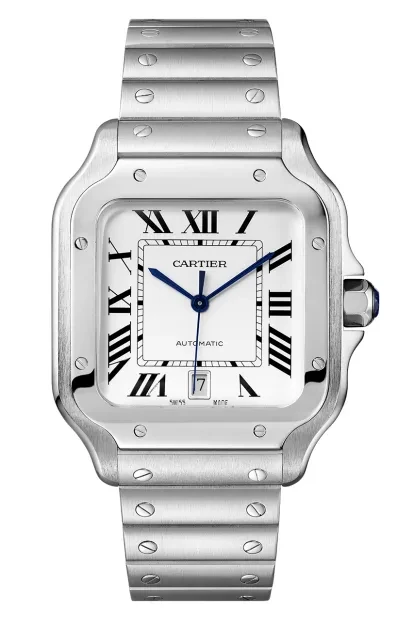
2018 - Major redesign. Bezel redrawn for synergy between case and bracelet. "QuickSwitch" and "SmartLink" innovations developed by Cartier. A new era.
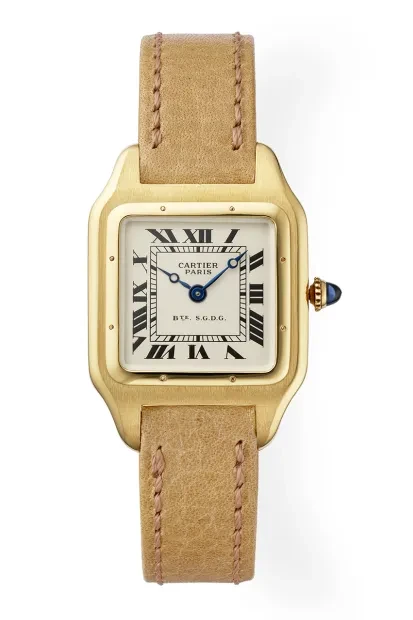
2019 - Launch of the Santos-Dumont with a high-efficiency quartz movement offering six years of autonomy.
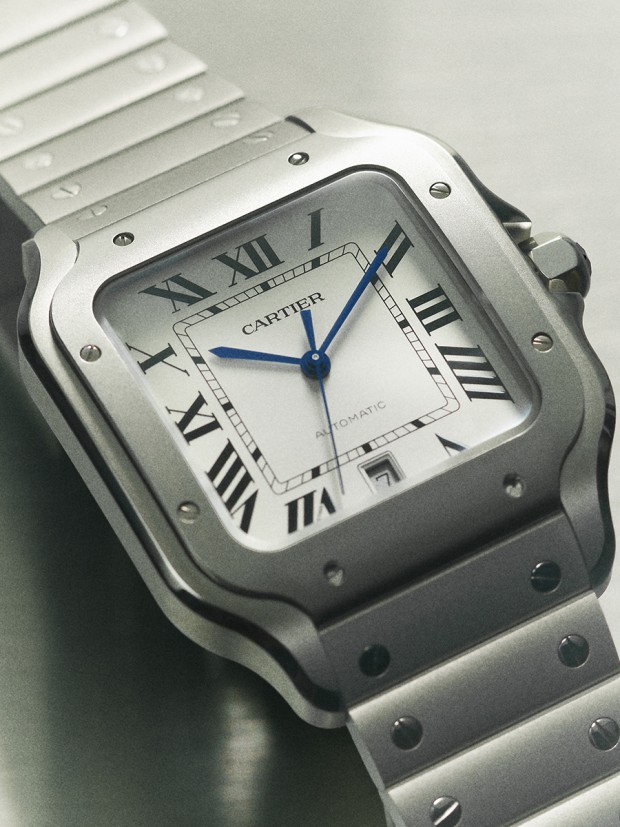
2025, between material and luminescence
At the end of this year, Cartier explores two territories with two new Santos watches, each asserting its own singularity.
On one side, the titanium Santos. The house remains faithful to the design of its icon while forging it in a new material: it is the first Santos entirely in titanium. The result? A watch that is drastically lighter, thanks to this titanium being 43% lighter than steel. With a micro-blasted matte finish, this new kind of Santos adopts a uniform anthracite tone for an almost industrial visual proposition. It retains its iconic references intact with its opaline dial, blued hands, "railway" minute track, and black Roman numeral indices. A faceted black synthetic spinel adorns the 7-sided winding crown. Cartier makes a strong choice here: the Santos steps out of its usual halo to expose itself to raw material, transforming its appearance to the touch and on the wrist.
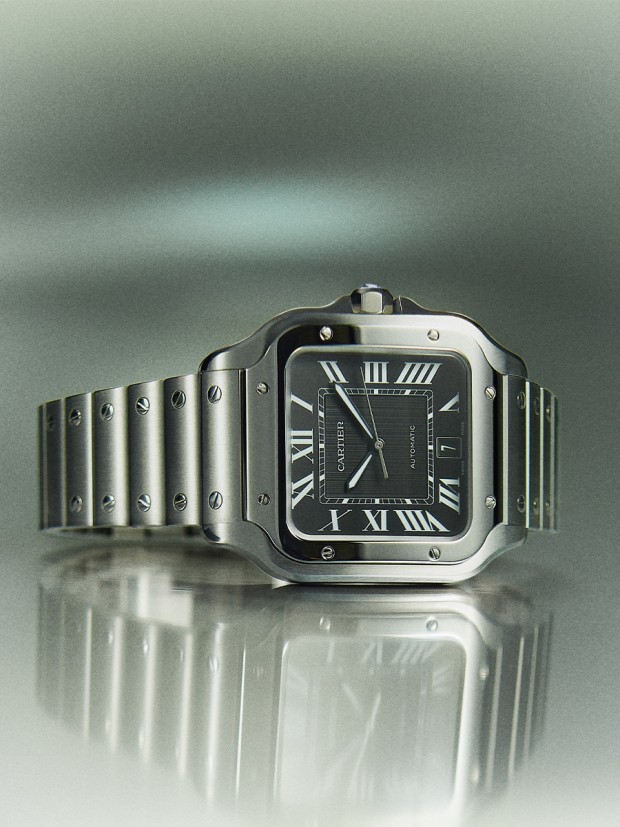
On the other side, the large Santos with a black dial and SuperLuminova® hands. Here, the spirit of adventure is displayed boldly on a more graphic canvas. The all-steel dial is marked by a white railway track and hands coated with fluorescent green SuperLuminova®. The dial finishes – half satin, half sunburst – create a striking contrast. This same contrast recalls the original functional aspect of the Santos: immediate readability, clear markers, clear architecture. The heptagonal crown set with a faceted blue synthetic spinel adds a touch of Cartier-made color.
Beneath this iconic design beats a heart entirely developed in-house by Cartier. The 1847 MC movement ensures water resistance up to 100 meters, magnetic resistance up to 1200 Gauss, and accuracy guaranteed between -3 and +7 seconds per day. These performances prove that the Santos is not just a design icon; it is also a practical watch made to live and endure the years with the same reliability as its predecessors.

What Cartier is redesigning today is neither nostalgia nor reinvention. In 1904, it was about Alberto Santos-Dumont, who dreamed of conquering the sky, being able to read the time in mid-flight. In 2025, it is about accompanying a daily life in motion, demanding and multifaceted. The Santos remains a streamlined watch, but it carries within it a century of discreet innovations, intelligently integrated. And perhaps that is the true strength of this watch: it does not age, it matures. Each generation finds its place in it; each era projects its style onto it. And yet, it never loses itself; it remains undeniably a Santos. This fidelity to a strong identity while embracing evolution makes it much more than an iconic watch. It becomes a witness to the passage of time, a companion that navigates trends without ever getting lost in them. The Santos continues to soar toward new horizons. And clearly, it has not finished surprising us.