
It imposed itself with such obviousness that it is hardly questioned anymore. Yet Bvlgari’s Tubogas bracelet has no true equivalent, neither in its history, nor in its design, nor in its technical construction. And it is precisely this last aspect, its manufacturing technique, that tends to remain in the shadows. Under the assumption that we are primarily dealing with high jewelry, attention is often focused on the stones, their setting and carat weight, without truly considering the bracelet itself or the remarkable technical complexity of its assembly.
But before delving into the heart of the Tubogas technique, one must return to its roots, to its history. It is within this historical context that the key to its construction can be found, and it is anything but ordinary. While certain watchmaking icons assert their concept in an explicit and immediately legible way, such as Jaeger-LeCoultre’s Reverso, a watch that quite literally flips over on itself, little attention is paid to the origin of the word Tubogas. And for good reason: it has nothing to do with the world of jewelry or watchmaking. Tubogas is an Italian contraction referring to a gas pipeline, evoking the image of a tube, hardly, in the collective imagination, a symbol of elegance or Italian artisanal know-how. And yet, it is precisely there that Bvlgari’s creative minds found their inspiration.


Roaring Years, Before and After
The 1920s and 1930s were decades of liberation, of both morals and mindsets, emerging in reaction to the rigid military discipline imposed by the First World War. It was during this period that some of the boldest designs in watchmaking and jewelry came into being. One naturally thinks of the gas-pipeline inspiration behind Tubogas, but also of Cartier’s Tank, whose design was famously inspired by armored vehicles. These creations were, in fact, both preceded and followed by other daring expressions, such as the Baignoire (1906), with its explicit departure from traditional forms, or the Crash (1967), evocative of a watch distorted by an accident.
Brands like Corum later carried this spirit forward, notably with the Rolls-Royce watch introduced in 1976, which drew directly from the distinctive lines of the iconic British sedan’s grille.
This gas-pipeline inspiration gave the Tubogas its distinctive shape. It then had to be given substance. Today, only around twenty people worldwide are said to master its manufacturing secrets, as Bvlgari told Le Figaro in 2024.
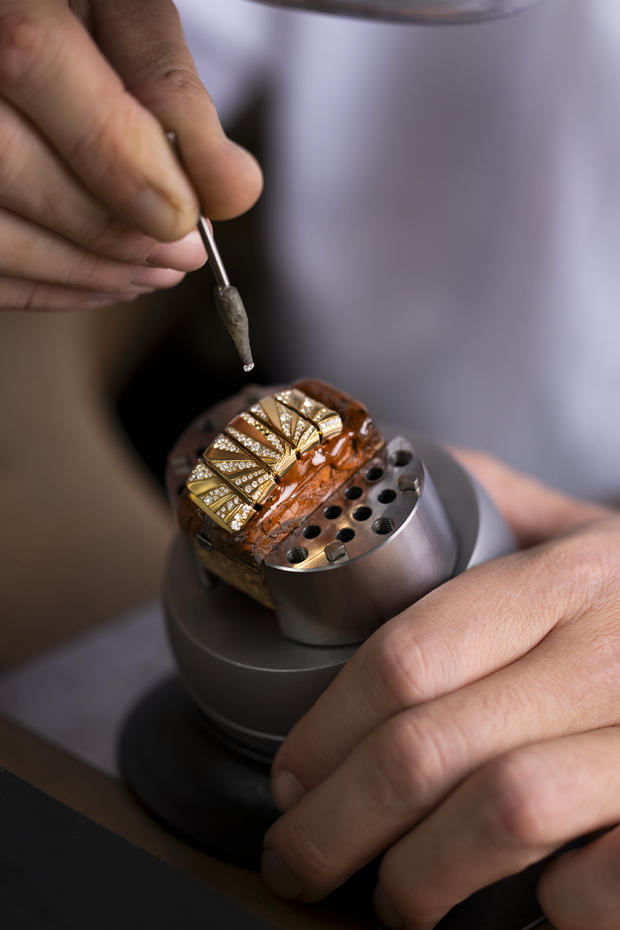
The complexity of the Tubogas lies in its constraints: it must be hollow, flexible, and reveal nothing of the process by which it is made. To achieve this, the Maison’s artisans work around a wooden core, the very soul of the jewel, around which gold wire is carefully wound. A single wire, or several, in yellow, pink, or red gold: whatever the combination, they must interlock perfectly, in complete unity and without the slightest gap, until the core is removed. Once freed from this internal support, the structure must hold on its own, as no soldering is permitted in the construction of a Tubogas.
A Watchmaking and Jewelry Complication
The complex construction of the Tubogas cuff is only the first step. Over the course of a century, Bvlgari has further enriched its profile by incorporating gemstones—and even watch movements, into its design. The challenges thus become exponential: beyond the original work on gold, stones must be set onto the delicate gold wires, requiring the integration of prongs, while cavities must also be created to house a watch caliber. This movement must remain fully accessible and operational, allowing for regular servicing.
It is here that Bvlgari’s savoir-faire is expressed in all its splendor. The Maison uniquely embodies both the jeweler and the watchmaker, rooted in Rome while drawing on Swiss expertise for its watchmaking operations. Very few houses master these two disciplines to such an equal degree and none do so with such strong historical anchors on both sides of the Alps as Bvlgari.

The Family Grows
At LVMH Watch Week, the Maison unveiled a new Tubogas Manchette, further proof, if any were needed, that a creation presented during a watch week fully belongs within the realm of watchmaking. The Tubogas Manchette is powered by the automatic Lady Solotempo BVS100 movement, first introduced last year in the Serpenti Seduttori and Serpenti Tubogas collections. Displaying hours, minutes, and seconds, this caliber brings together the art of watchmaking and a distinctly Italian sense of elegance.
With a diameter of just 19 mm and a thickness of 3.9 mm, and composed of 102 components delivering a 50-hour power reserve, this caliber weighs a mere 5 grams. It is housed within a Tubogas Manchette that revisits an archival model from 1974, borrowing the bold geometry of the original with its square dial and wide, single-turn Tubogas bracelet.
The Maison has envisioned a true chromatic symphony, composed of citrines, rubellites, peridots, amethysts, topazes, and spessartites. Nearly 12 carats of diamonds sparkle along the spirals. A watchmaking and jewelry extravaganza fully commensurate with Bvlgari’s perfectly mastered Roman exuberance.

Did You Know?
The new Tubogas Manchette preserves its iconic embrace while introducing a new technique: each ring is individually shaped and polished before being meticulously assembled onto a titanium strip. This modular construction allows the pattern to flow seamlessly along the bracelet, while preserving the flexibility and fluidity that define the Tubogas.