With the H1 launched in 2012, HYT has created a watch that overcomes the force of gravity and indicates the time with a liquid. This year the hydro mecanics adventure continues with the new H1 Azo Project.
The basis of the H1
The idea that led to the H1 was simple and consisted of two flexible reservoirs fixed to each end of a capillary. In one was an aqueous liquid filled with fluorescein, and in the other, a transparent viscous liquid. To keep them separate: the repulsive force of the molecules in each liquid, with a meniscus to mark the boundary between the two.
The two reservoirs are located at 06:00. While the first compresses, the second expands, and the other way round, resulting in the movement of the liquid in the capillary. As the hours go by, the fluorescent liquid advances. The meniscus, in the shape of a half moon, marks the breaking point with the other fluid in the tube, indicating the time. At 18:00, the fluorescent liquid comes back to its original position, going backwards. The secret that gets the reservoirs going? Two bellows made of a highly resistant, flexible electro-deposited alloy, each driven by a piston. This hydro system is activated by a mechanical movement.
Orchestrated by Jean-François Mojon and his Chronode SA team, the mechanical movement is situated in the upper part of the watch, and propels a cam, which pushes the piston and activates the bellows.
The main challenge lay in finding an interface between the mechanical movement and the hydro system in a closed, waterproof circuit – a task further complicated by the limited space available to house them both. They had to be assembled separately to keep them independent, and then made to operate simultaneously. This is a highly delicate modular integration, which involves other constraints, such as the installation of the dial in two parts, through the sides.
The H1 Azo Project
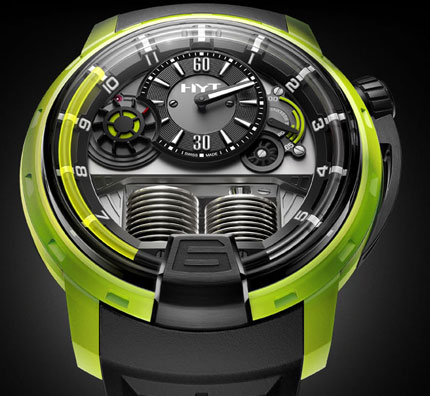
The yellow polyepoxyde case of the watch is 48.8mm. The screw-lock crown, crown guards and metal dome at 6:00 are in titanium DLC. The watch is protected by a cambered sapphire crystal glass with anti-reflective coating on the inside and screw-down sapphire on the back. It is water-resistant to 100 meters.
The black unstructured dial shows grey indexes & numerals, and a grey minute hand. The regulator is situated at 12:00, the small seconds wheel at 09:30 and the power-reserve indicator at 02:30.
The mechanical hand-wound movement is an exclusive HYT calibre whose functions are retrograde fluid hours, minutes and seconds. It offers a 65-hour power reserve. The bridges are hand-chamfered and adorned with côtes de Genève.
The H1 Azo Project is equipped with a rubber strap and Titanium black DLC pin buckle.
The idea that led to the H1 was simple and consisted of two flexible reservoirs fixed to each end of a capillary. In one was an aqueous liquid filled with fluorescein, and in the other, a transparent viscous liquid. To keep them separate: the repulsive force of the molecules in each liquid, with a meniscus to mark the boundary between the two.
The two reservoirs are located at 06:00. While the first compresses, the second expands, and the other way round, resulting in the movement of the liquid in the capillary. As the hours go by, the fluorescent liquid advances. The meniscus, in the shape of a half moon, marks the breaking point with the other fluid in the tube, indicating the time. At 18:00, the fluorescent liquid comes back to its original position, going backwards. The secret that gets the reservoirs going? Two bellows made of a highly resistant, flexible electro-deposited alloy, each driven by a piston. This hydro system is activated by a mechanical movement.
Orchestrated by Jean-François Mojon and his Chronode SA team, the mechanical movement is situated in the upper part of the watch, and propels a cam, which pushes the piston and activates the bellows.
The main challenge lay in finding an interface between the mechanical movement and the hydro system in a closed, waterproof circuit – a task further complicated by the limited space available to house them both. They had to be assembled separately to keep them independent, and then made to operate simultaneously. This is a highly delicate modular integration, which involves other constraints, such as the installation of the dial in two parts, through the sides.
The H1 Azo Project
The yellow polyepoxyde case of the watch is 48.8mm. The screw-lock crown, crown guards and metal dome at 6:00 are in titanium DLC. The watch is protected by a cambered sapphire crystal glass with anti-reflective coating on the inside and screw-down sapphire on the back. It is water-resistant to 100 meters.
The black unstructured dial shows grey indexes & numerals, and a grey minute hand. The regulator is situated at 12:00, the small seconds wheel at 09:30 and the power-reserve indicator at 02:30.
The mechanical hand-wound movement is an exclusive HYT calibre whose functions are retrograde fluid hours, minutes and seconds. It offers a 65-hour power reserve. The bridges are hand-chamfered and adorned with côtes de Genève.
The H1 Azo Project is equipped with a rubber strap and Titanium black DLC pin buckle.
Featured brand