Press release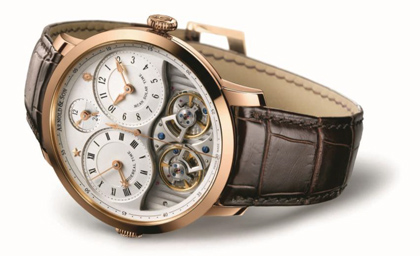
The new Instrument Collection from Arnold & Son was inspired by the timepieces produced during the second part of John Arnold's life and later, following his death, by his son, John Roger. This was a period when the Arnolds dedicated themselves exclusively to the quest for absolute precision and a solution to the problem of determining longitude accurately and reliably on the high seas. So successful were they, and of such high quality their products, that within the space of a few years they had established themselves as suppliers of choice to the Royal Navy and to some of the most distinguished mariners and explorers of their day. Ultimately, they helped ensure that Britannia really did rule the waves.
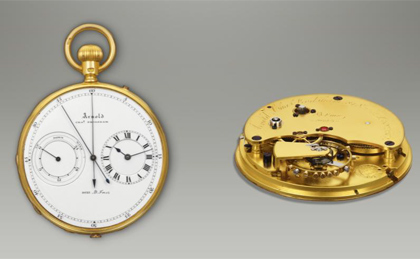
All watches from the Instrument Collection host brand new manufacture movements, which have been developed, designed and manufactured entirely at the brand's workshops in La Chaux-de-Fonds. The design of these new movements clearly shows the influence of the pocket watches and marine chronometers developed and crafted by John Arnold and his son.
Typical of the Instrument Collection's design is the off-centre position of the hours and minutes indication. The second hand takes centre stage and dominates the dial, thus perfectly showcasing the down-to-the-second precision needed by marine navigators to determine longitude. This dial layout also creates space for the display of other complications without one overlapping the others, making the dial much more legible.
The other stylistic features that define the new timepieces are pure, timeless lines and a discreet – almost austere – case. Viewed from the side, the housing is stepped and tapers from top to bottom, the widest section accommodating the extra-large glass and dial with the lower part narrowing to fit snugly on the wrist.
DBS Equation Sidereal
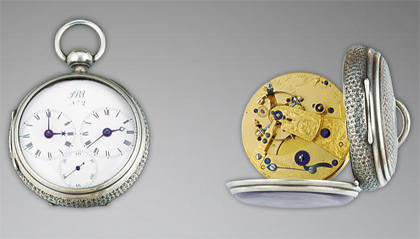
The Instrument DBS Equation Sidereal is a tribute to two watches (Nos. 1 and 2) made by John Roger Arnold that showed mean solar and sidereal time on two separate subdials. The movements of these two watches, made between 1796 and 1799, represented the state of the art in the micromechanics of their time.
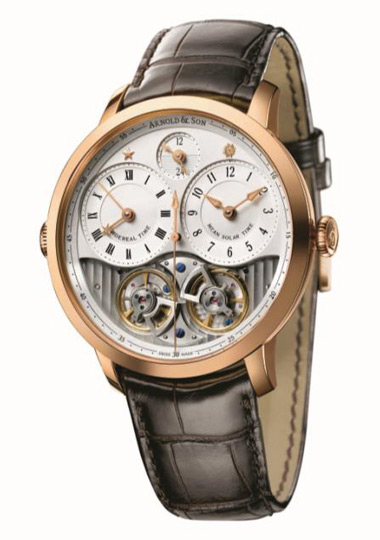
The initials DBS stand for the watch's two major complications, “double balance” and “sidereal time”. It features the newly developed manufacture A&S1311 calibre. The DBS Equation Sidereal has a perfectly symmetrical arrangement of the bridges, barrels and gear trains. The symmetry is continued on the dial side, where the two adjacent balance cocks create a harmonious circle. Sidereal time is displayed on the left subdial and mean solar time on the right. In addition, a subdial at 12 o'clock indicates the equation of both times on a 24-hour basis, which allows the user to measure the difference between mean solar time and sidereal time and to ascertain whether the time in both zones is a.m. or p.m. The watch has a long central permanent seconds hand (for mean solar time).
Creating a precise sidereal time display is a tall order. Simply adding a second gear train to a standard movement showing mean solar time is not a viable solution because a mean sidereal day is about 23 hours, 56 minutes, 4.091 seconds, which is not a round fraction of the 24 hours in a mean solar day. This means it is virtually impossible to obtain the correct rotation speed using gears. To guarantee the kind of precision demanded by Arnold & Son, the only choice was to create a movement with the correct rotation speed from the start: in other words a movement specifically for sidereal time. The answer was a totally new movement with a double barrel/gear train and double balance/escapement running at different speeds that enables the watch to display mean solar time and mean sidereal time simultaneously. This technical solution has the additional advantage that neither of the two indications saps energy from the other. Watches with a double balance and escapement are extremely rare and have almost disappeared, so it is with some pride that Arnold & Son have revived the tradition.
DBG Equation GMT
The Instrument DBS GMT embodies the perfect traveller's watch. The initials stand for the watch's two major complications, “double balance” and “GMT”. It features the newly developed manufacture A&S1209 calibre.
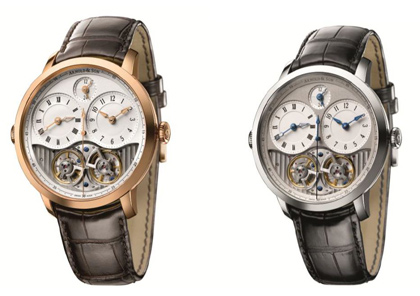
A masterpiece of perfect symmetry, the Instrument DBG Equation GMT features two separate time displays, each driven by its own barrel and gear train with its own escapement and balance. This highly unusual technical specification permits the two displays to be set independently of each other. Although it is a standard feature of watches displaying two or more time zones for the hour hands to be set to different times, being able to set the minute hand as well opens up other possibilities. It means, for instance, that the display can be set to show the precise time in zones that differ from Greenwich Mean Time by a fraction of an hour, such as a quarter or a half. In addition, a subdial at 12 o'clock shows the equation of the two time zones on a 24-hour basis. This enables the wearer to see the time difference between the two zones and also to ascertain whether it is day or night in the second zone. Both time zones share a common permanent seconds in the shape of the long slender hand emanating from the centre of the dial, which is a hallmark feature of the new Arnold & Son's Instrument collection.
Watches with a double barrel and escapement have a tradition going back many years in horology but are rarely found today. The principle is ideally suited to the Arnold & Son's instrument line because a separate barrel/gear train and balance/escapement enable the watch to house different complications without having one influencing the accuracy of the other by draining its energy. It is therefore perfectly adapted to be used for a second time zone, as in the DBG Equation GMT.
The two mainsprings are both wound using the crown on the right. However, the time in each of the two selected time zones is set using its own crown, which ensures that neither of the zones is moved or changed inadvertently.
TBR
With the unmistakable design cues that define the Instrument Collection, the TBR is a masterpiece of reduced simplicity. The initials stand for the watch's two complications, true beat and retrograde. While the time is displayed in an off-centre subdial– a hallmark of the entire Instrument Collection – the two complications occupy the middle of the dial and command the front of the stage.
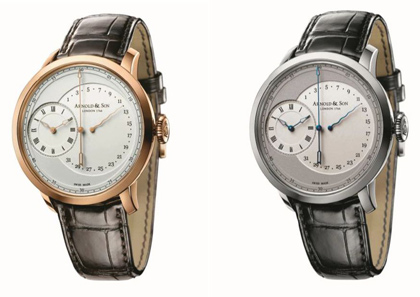
Dominating the face of the watch is the central true beat – or dead beat – seconds. The true beat seconds – a hark-back to the precision required by navigators on the high seas – is a rarely found complication these days, and its combination with an automatic winding system calls for enormous technical expertise. In the TBR it was made possible by a worldwide patented system comprising a sophisticated double wheel, an oscillating pinion and a pallet mechanism. This complex solution calls for virtually microscopic precision (to tolerances of a micron, or one thousandth of a millimetre) and the key parts are made using state-of-the-art LIGA fabrication technology. LIGA is a German acronym that stands for Lithographie, Galvanoformung, Abformung – lithography, electroplating and moulding – and describes the sequence of processes used to produce metal parts made of nickel and nickel phosphorus.
The “R” of TBR – retrograde – is a description of the watch's second complication, the date display. A slim, undulating hand advances a day at a time until it reaches 31. At midnight on the 31st, the hand springs back (hence retrograde) smartly to 1, in other words to the first of the next month, and the process commences all over again.
The TBR's retrograde mechanism is extremely sophisticated and features patented dents sans jeu (literally, teeth without play – or gaps), which ensure that the date hand advances cleanly and precisely. These components can only be produced using the complex LIGA fabrication technology described above. Also worth noting is the fact that the retrograde date can be set using the crown, which is considerably more demanding than having an additional pushpiece.
Main technical characteristics
DBS Equation Sidereal
Calibre: A&S1311
Exclusive Arnold & Son mechanical movement, hand-wound, 42 jewels, diameter 35 mm, thickness 3.9 mm, power reserve 40 h, 21'600 vibrations/h
Functions: local hours, minutes, and seconds, sidereal hours and minutes, local time 24 h indicator, sidereal time 24 h indicator
Movement decoration: nickel-silver movement, rhodium treated with Haute Horlogerie finishing:
manually chamfered bridges and polished edges, fine circular graining and
Côtes de Genève, blued screws
Dial colour: silvery-white and silvery opaline
Case: 18-carat rose gold, diameter 44 mm, cambered sapphire with anti-reflective coating on both sides, case back see-through sapphire, water-resistant to
30 m
Strap: Hand-stitched brown alligator leather
References: 1DSAP.W01A.C120P 18-carat rose gold case
DBG Equation GMT
Calibre: A&S1209
Exclusive Arnold & Son mechanical movement, hand-wound, 42 jewels, diameter 35 mm, thickness 3.9 mm, power reserve 40 h, 21'600 vibrations/h
Functions: local hours, minutes and seconds, GMT hours and minutes, local time 24 h indicator, GMT 24 h indicator
Movement decoration: nickel-silver movement, rhodium treated with Haute Horlogerie finishing:
manually chamfered bridges and polished edges, fine circular graining and
Côtes de Genève, blued screws
Dial colour: silvery-white and silvery opaline or light-grey and silvery opaline
Case: 18-carat rose gold or stainless steel, diameter 44 mm, cambered sapphire with anti-reflective coating on both sides, case back see-through sapphire, water-resistant to 30 m
Strap: Hand-stitched brown or black alligator leather
References: 1DGAP.W01A.C120P 18-carat rose gold case 1DGAS.S01A.C121S Stainless steel case
TBR
Calibre: A&S6008
Exclusive Arnold & Son mechanical movement, self-winding, ceramic ball bearing, 34 jewels, diameter 30.4 mm, thickness 7.79 mm, power reserve 45 h, 28'800 vibrations/h, stop seconds
Functions: hours, minutes, true beat seconds, retrograde date
Movement decoration: 18-carat rose gold case model:
rhodium treated with Haute Horlogerie finishing: manually chamfered
bridges with polished edges, fine circular graining and Côtes de Genève
rayonnantes, brushed and skeletonised rotor, blued screws
Stainless steel case model:
NAC grey treated, with Haute Horlogerie finishing: manually chamfered
bridges with polished edges, fine circular graining and Côtes de Genève
rayonnantes, brushed and skeletonised rotor, mirror-polished screws
Dial colour: silvery-white and silvery opaline or light-grey and silvery opaline
Case: 18-carat rose gold or stainless steel, diameter 44 mm, cambered sapphire with anti-reflective coating on both sides, case back see-through sapphire, water-resistant to 30 m
Strap: Hand-stitched brown or black alligator leather
References: 1ARAP.W01A.C120P 18-carat rose gold case 1ARAS.S01A.C121S Stainless steel case