
Finding one’s way around Patek Philippe or Rolex reference numbers is already a complicated affair but nothing compared with the effort required to gain a true understanding of Breguet’s legacy to watchmaking. This is a man whose inventions and discoveries are so numerous, even the smallest detail of his work is replete with history, anecdotes and technique.
“Breguet belonged to the Age of Enlightenment. His was a watchmaking without limits, without obstacles,” says Emmanuel Breguet in a recent and excellent podcast from the Manufacture. “Intellectually unafraid, he quick-marched watchmaking into the neoclassical style.”
Part of a long line
The Tradition Tourbillon 7047 springs from this. Like its predecessors, it is an instalment in a continuing story. Breguet’s mind was never still and even though the fundamentals of his style – for example the hands, the guillochage or the fluting - are well-established, it remains a work in progress.
Breguet constructed his watches as he did his business and personal relations: step by step, showing great resolve but also infinite precaution. Seen from afar, that is from our current point in time, we imagine a slow and linear progression. If, however, we adopt a different perspective, that of Breguet’s lifetime (as theorised by François Hartog in his regimes of historicity), we measure the profoundly original, occasionally transgressive nature of his work.
A new interpretation
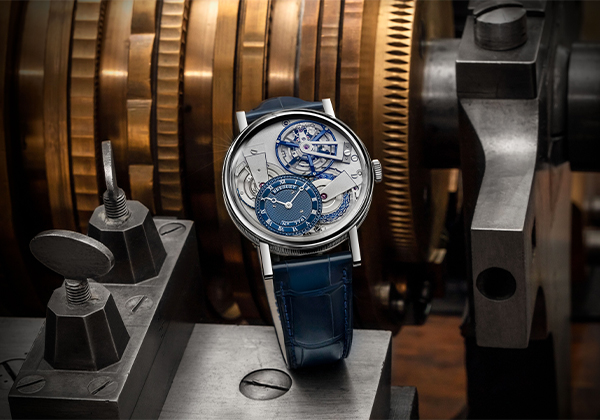
There is nothing veritably new about the “new” 7040. The first iteration dates from 2010. The Tradition collection was itself fairly recent, having been introduced in 2005, and the 7047 was an important milestone whose highly demonstrative movement had clearly been created with absolute chronometry in mind, evidenced by the presence of two organs whose purpose is precisely that: the tourbillon (patented by Breguet) and the fusee-and-chain which delivers an even amount of torque to the regulator.
Such a complex regulating system may appear to be in contradiction with the origins of the Tradition collection, which looks to the souscription (“subscription”) watches which Breguet devised as supremely simple timepieces. A brochure published in 1797 describes them thus: “The price of the watches will be 600 livres; one-quarter of this sum will be paid when subscribing; the construction will not suffer any delay and deliveries will be made by order of subscription (…). They are distinguished by their simplicity and by a configuration that protects the escapement from the most serious incidents, even if the watch were dropped. The going train, escapement and regulator, the heat and cold compensator are so openly positioned and so easy to grasp that the attentive observer can see at a glance (…) the harmonious workmanship and the reliability of its functions.”

A step to the right
This translates into the aesthetic of the Tradition 7047. Though relatively commonplace today, the off-centre hours and minutes dial was a rarity in Breguet’s workshop, seen only on certain specific pieces such as the N° 955, 1106 or 2292 à tact watches (by a trick of history, the first à tact watches in Breguet’s ledgers were souscription watches). Small seconds and complications were always off-centre but hours and minutes were almost invariably central.
The movement in the 7040 has been rotated clockwise one hour, with the tourbillon at 1 o’clock rather than 12 and the dial moving from 6 to 7 o’clock. As simple as it may seem, there are technical subtleties involved when rotating the movement 30 degrees to the right while maintaining the crown at 3 o’clock.
One of the distinctions of contemporary watchmaking is the symmetrical positioning of the movement’s various organs. For the 7040 to conform, the fusee and chain would have had to operate a corresponding rotation to the right. Instead, the fusee is at 5 o’clock and the chain, around the barrel, is at 9 o’clock. The result is undeniably harmonious but contrary to expectations. Should we dismiss this as a small twist of geometry? A subtlety of interest only to collectors? Not at all. This type of almost imperceptible detail reminds us that Breguet is not a classical but a neoclassical watchmaker who assimilates the codes of an era to then transform and offer them new horizons.
In this respect, surprisingly perhaps, a Breguet has more in common with an MB&F Legacy Machine or a H. Moser & Cie. than a Patek Philippe Calatrava. More than two centuries ago, Breguet was sowing the seeds of a subtly disruptive aesthetic, the fruit of which is now being reaped by watchmaking’s new guard.