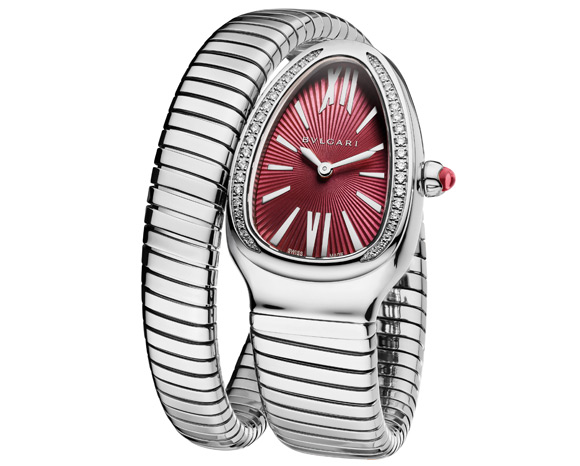
In 2016, Bulgari reinterprets one of its symbols, the Tubogas bracelet.
Two executions of the Tubogas bracelet are offered: one has the radiant gleam of polished steel, the other plays on the combination of shimmering chrome and gold reflections.
Thus named in reference to the modernistic, industrial aesthetic of the flexible piping featured in sports car exhaust manifolds during the Art Deco period, the first supple Bulgari jewellery models appeared in 1932. The jeweller soon afterwards also created a distinctively styled watch, whose bracelet sensuously wrapping itself twice around the wrist is the key asset of the new timepieces. It testifies to a specific Bulgari technical skill that consists in assembling gold or steel ribbon-like strips with clean-cut rounded contours around a core spring, without any soldering.
In 1962, when filming scenes for Cleopatra, Elizabeth Taylor had to be careful to remove her favourite gold watch with its diamond-paved snake’s head and tail.
Ever since, popular enthusiasm has remained intact for this unique watch...unique, but never uniform, since Bulgari regularly renews the interpretation of these models.
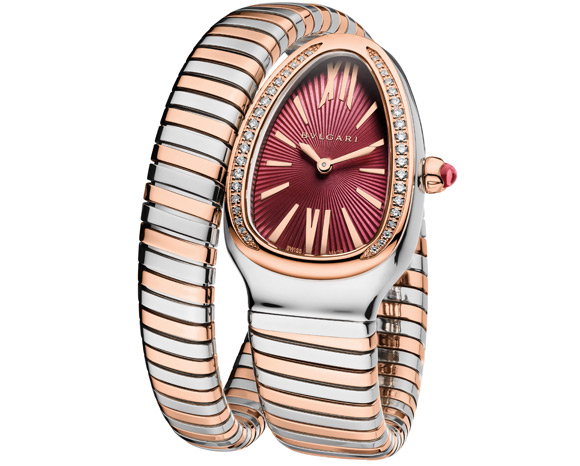
The two new models come in a 35mm steel or 18-kt pink gold and steel curved case set with brilliant-cut diamonds. The crown is set with a cabochon-cut pink rubellite. The violet lacquered dial with sunburst guilloche treatment carries large indexes and Roman numerals at 12 o'clock and 6 o'clock. More than a simple bracelet, the one-row steel or 18-kt pink gold and steel bracelet (according to the model) is a main feature of the watch.
The hour and minutes hands are powered by a quartz movement, Bulgari customised, and adorned with the brand's logo.