
Although he prefers to stay out of the limelight, Pim Koeslag has always been pleasant and attentive, even when you catch him at a bustling and chaotic watch fair. Pim Koeslag is the brains behind the manufacture movements of Frederique Constant, and he also worked for Atelier de Monaco. Like Aletta and Peter Stas, founders of the brand to which he remained faithful for over a quarter of a century, Pim Koeslag is from the Netherlands. And he recently returned to his native country, taking over as head of Christiaan van der Klaauw (CVDK), probably the world’s premier specialist in astronomical complications.
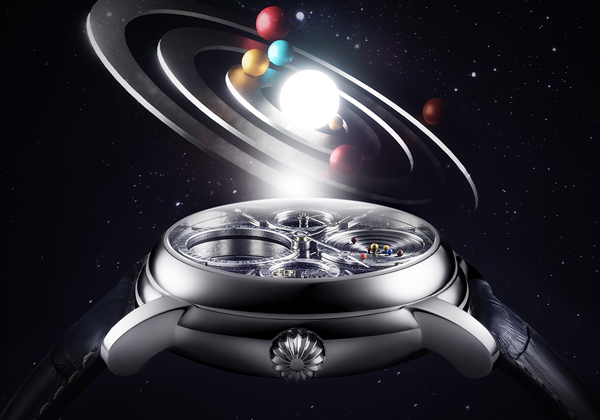
Why the long introduction? Because, for a brief moment, Pim Koeslag had one foot in CVDK and the other still in Geneva, with Frederique Constant. And during this transition period, he came up with something of a crazy idea: to combine the savoir-faire of both maisons in one single, unique piece, to be auctioned off at Only Watch. The result is the Classics Planetarium Tourbillon Manufacture.
Best of both worlds
The name gives a clue to what’s inside the case, but it doesn’t give everything away. For Only Watch, both brands ventured outside their respective comfort zones, signing off on a number of “firsts” engineered to attract collectors – and higher bids.
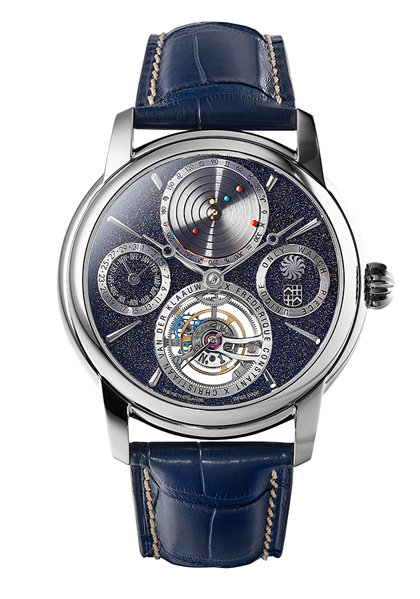
At first sight, the watch seems like a good fit for the Frederique Constant Classics collection – but only at first glance. The recently revised aesthetic codes are present, with a slimmed-down case, a reworked profile and more modern hour markers. But the diameter is unusual: 42 mm is not part of Frederique Constant’s horological vernacular. Nor is the case material: solid platinum. Even before you look at the complications, the watch is sending out some strong signals.
100% hand-finished movement
A cursory glance at the movement confirms the high-end impression: it is entirely hand-finished. This is not something we’ve come to expect from Frederique Constant, which has always focused on accessible Swiss Made watchmaking luxury. And yet this is clearly a step towards the kind of excellence we would find at an independent workshop. Using traditional tools, two watchmakers spent weeks meticulously finishing each component: a cabron file for bevelling, a hammer and punch for hammering, and 9-micron abrasive paper for the bridge and base of the tourbillon cage. A bridge alone requires two to three days’ work.
The circular graining is executed manually, the sides are brushed by hand, and all the components are decorated on both sides – even in places where the decoration is unlikely ever to be seen. The polished screws, worked with diamond paste to produce a high mirror finish, stand out against the zinc plate, appearing silvery or black as they catch the light. The movement contains about forty of these screws, each of which requires approximately 40 minutes to be polished and bevelled by hand.
The planetarium
The FC-988 calibre is a worthy recipient of this high-quality treatment. It drives two main features: the Frederique Constant manufacture tourbillon at 6 o’clock, and the CVDK planetarium at 12 o’clock. Pim Koeslag is the undisputed master of this complication, having produced his first more than 40 years ago, in 1982, for a clock. In 1999 he miniaturised it for a wristwatch, and has continued to refine his design ever since.
The heliocentric planetarium comprises six mobile discs in the same plane, each bearing a planet that rotates at the astronomically correct rate: 88 days for Mercury, 225 days for Venus, 365 days for Earth, 687 days for Mars, 12 years for Jupiter and 29 years for Saturn. This tour de force of realism means that some of the discs move incredibly slowly. You’ll have to wait nearly 30 years, for example, to see Saturn, the farthest planet from the sun in this recreation, perform one full rotation around the dial.
A constellation of “firsts”
This watch is Frederique Constant’s first to feature an aventurine dial, the first to have a planetarium, and the first to display days and months using hands on a dedicated subdial. And Van der Klaauw has never before paired a planetarium with a tourbillon. It’s safe to say that the planets really have aligned for this stellar creation.