To celebrate its 225th anniversary, Girard-Perregaux presents the pinkgold Esmeralda Tourbillon, inspired by the Tourbillon with Three Gold Bridges pocket chronometer that won the gold medal at the Universal Exhibition in Paris in 1889.
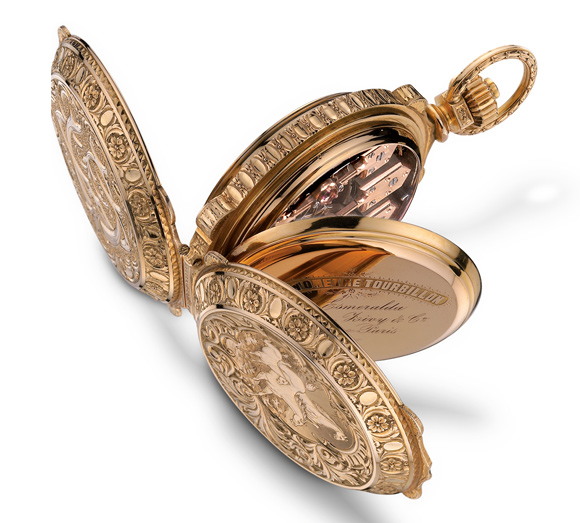
Since founding his Manufacture and the development of the first Tourbillon with Three Bridges in 1860, Constant Girard had been on the verge of watchmaking perfection. In designing a benchmark caliber featuring a unique layout, Constant Girard-Perregaux immediately distinguished himself by inventing the concept of dramatizing mechanics. He succeeded in giving the tourbillon an artistic dimension, which was previously considered to be a purely technical mechanism.
In 1867, this almost minimalist layout won its first timekeeping award from the Neuchâtel Observatory and most likely enabled Girard-Perregaux, once the layout had been patented in 1884, to create the Tourbillon with Three Gold Bridges complication, an utterly unique signature. The Tourbillon with Three Bridges caliber is the oldest watch movement still in production, since its overall layout has remained unchanged since its introduction in 1860.
The Esmeralda Tourbillon succeeds to the 27 Tourbillons with Three Bridges registered with the Neuchâtel Observatory by Girard-Perregaux from 1865 to 1911.
Its 18-carat pink-gold case measuring 44 mm in diameter houses the Tourbillon with Three Bridges mechanical caliber with automatic winding reference GP09400. This large 16-ligne movement, developed and manufactured in-house, takes up the entire case-band and, especially in this instance, features a 14.3 mm diameter tourbillon carriage and a 10.5 mm diameter balance wheel.

The unidirectional automatic winding system developed by Girard-Perregaux breaks new ground by now calling on a rotor that is positioned concentrically under the barrel rather than on the outer edge. Thanks to this ingenious construction, the watchmakers were able increase the diameter of the barrel drum and therefore lengthen the spring to give the piece a power reserve of at least 60 hours, compared to 48 hours previously.
This tourbillon watch features a carriage boasting refined lines and the lyre shape of which adopts the form developed by Constant Girard-Perregaux. It is worn on a black alligator strap, fastened to the wrist by a pink-gold triple folding clasp.