
In today’s watch circles, the tourbillon is standard fare, with an accepted position (at 6 o’clock) and rotation (in one minute) inside a (wrist)watch. Seventy-five years ago, however, a tourbillon was a rare beast whose one benefit of increased precision was of interest only to the handful of brands taking part in Observatory timing trials, such as Patek Philippe and Vacheron Constantin (Geneva) or Omega (Kew-Teddington, Geneva and Neuchâtel). Additionally, the tourbillon was a sign of horological distinction to which only the most serious (and wealthy) collectors could aspire. The likes of Henry Graves Jr. and James Ward Packard. The highly specialised skills required to make a tourbillon were more often than not those of independent master watchmakers whom brands would occasionally commission.
For all these reasons, series production of a tourbillon, even in limited numbers, was a rare and therefore remarkable event. Jaeger-LeCoultre did so 75 years ago, in 1946, with a movement whose name few remember: Calibre Jaeger-LeCoultre 170.
A precursor
Calibre 170 is remarkable on several counts, starting with the fact that 26 (27 including the prototype) were made. This is an astonishingly large number – more than half the amount produced by Breguet father and son in 25 years. Calibre 170 was in production between 1946 and 1954. By way of comparison, Omega made just 12 of its 30 I calibres (a 30 mm tourbillon movement for a wristwatch) in 1947.
Calibre Jaeger-LeCoultre 170 was intended solely for pocket watches and was fitted in a Tourbillon Chronometer for entry in Observatory trials. In 1948 it took first place at the Neuchâtel Observatory Competition. These were hard-fought competitions and brands, none more than Ulysse Nardin with its marine chronometers, were prepared to make significant investments if this would bring them closer to a coveted first prize.
Something old, something new
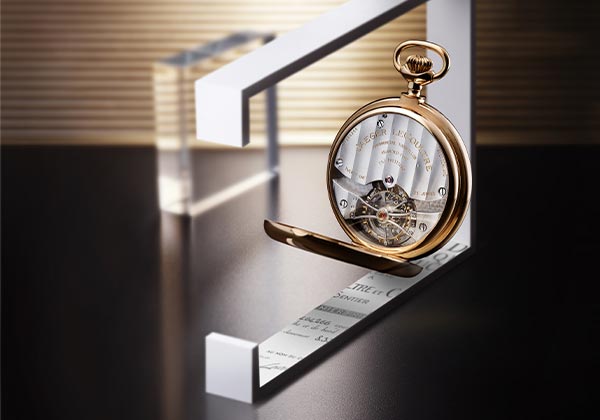
The movement’s technical specifications are typical of its era, though not without innovation. Characteristically for that time, it was fitted in a pocket watch with a conventional vertical architecture, with the barrel at 12 o’clock and the tourbillon at 6 o’clock driving an off-centre small seconds display. The entire construction was visible through the hinged “officer” back of a gold case wound by an onion crown inside the bow. Its dimensions were also of the day, coming in at a generous 49.72 mm diameter.
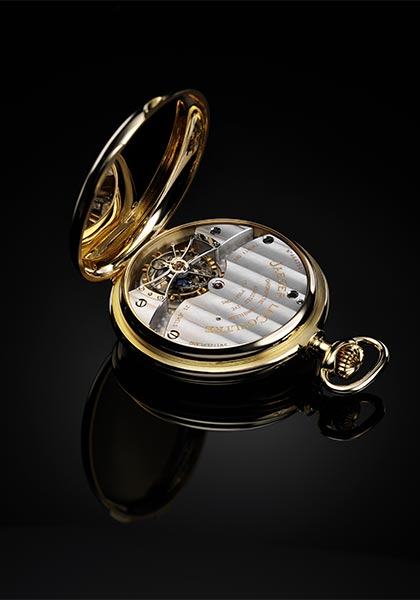
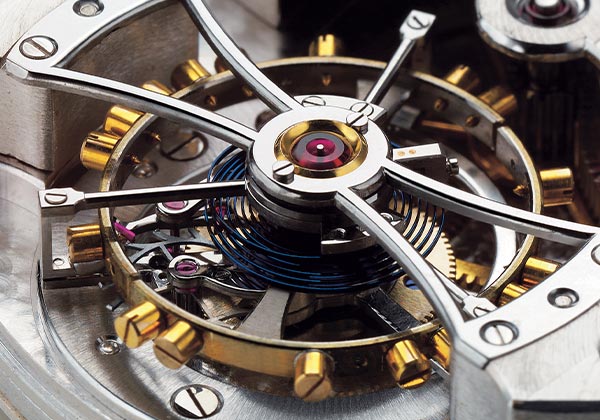
It was modern in its use of a large half-plate which, from a distance, echoes the distinctive three-quarter plate of German movements and shows that Jaeger-LeCoultre intended this to be a robust calibre. The tourbillon itself is particularly airy, despite the twenty timing screws around the balance rim (as was traditional at that time). The top bridge is especially elegant, with a rounded profile that easily stands comparison with the level of finish one would expect today.
The end of an era
Still considered to be Jaeger-LeCoultre’s first “in-house” tourbillon, Calibre 170 went on to a distinguished career during the 1950s that included other Observatory prizes. Later decades (the 60s, 70s and 80s) would get the better of this eminent complication, not just at Jaeger-LeCoultre but throughout virtually the entire watch industry. It did, however, make a relatively rapid comeback at the Le Sentier firm with the introduction, in 1993, of Calibre 828, one of the first non-round tourbillon movements for a wristwatch. That wristwatch being… the Reverso, of course. A new chapter was about to begin.