Introducing two Julien Coudray 1518 collections.
Each model was produced in a strictly limited series; including some personalized unique pieces. It bore a name preceded by a date, the last two digits of which represented the number of pieces produced for each version: yellow gold, red gold, white gold and platinum.
Manufactura 1528
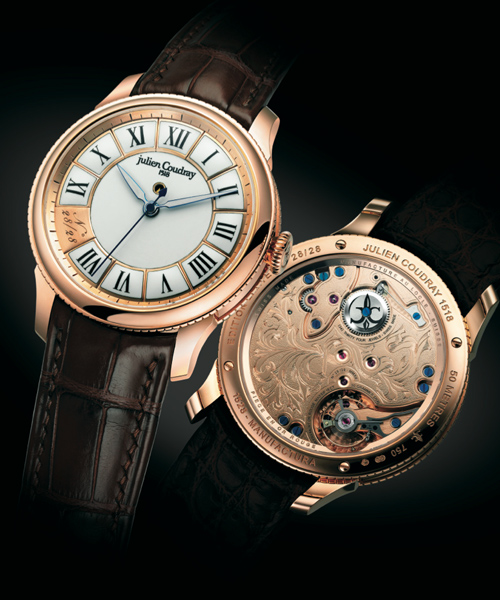 This model aims to reinvent a classic: a "three-hands" manual winding watch indicating the hour, minute and seconds. These are supplemented by an uncommon function: a service indicator. In a discreet window at 12 o'clock, the enameled gold oil drop symbol will appear after four years in operation, when the watch must be serviced.
The fully redesigned movement is equipped with an exclusive escapement – developed, made and set in-house – whose frequency (28,800 vibrations/hour) makes for high precision. Each of the main movement parts has been machined from solid gold (of three different grades: yellow gold, red gold and palladium white gold) and from solid Pt 950 platinum, a material never previously worked in this way in the field of watchmaking. These components were then decorated by hand, as were the bridges visible via the sapphire case-back, the finely hand-engraved pattern on which was inspired by the repertoire of the Renaissance decorative arts.
The pattern on the dial is a modern interpretation of Renaissance church bell tower clocks. It was made from grand feu enamel, on a champlevé gold base with enamel backing, a technique requiring the enamel powder to be melted at over 800°C.
Competentia 1515
This model, whose movement is made entirely from solid gold or platinum, is equipped with a power reserve indicator, a service indicator, a day/night indicator and a one-minute tourbillon. Despite the complication level, this calibre does not exceed 5 millimetres in height, to ensure that the watch remains comfortable to wear, though adorned with a dial comprising eleven enamel parts. This model also has a service indicator where an enamelled gold oil drop symbol appears after four years in operation, when the timepiece must be serviced.
The decoration of the central disc of this dial employs the subtle technique of plique-à-jour enamelling, so as to show glimpses of all the refinements of the movement decoration. To achieve this effect, transparent enamel is delicately laid onto a gold structure, before being fired in a furnace at over 800°C. The peripheral indexes, a modern vision of 16th Century clocks, are made from enamel and gold.
Manufactura 1528
This model aims to reinvent a classic: a "three-hands" manual winding watch indicating the hour, minute and seconds. These are supplemented by an uncommon function: a service indicator. In a discreet window at 12 o'clock, the enameled gold oil drop symbol will appear after four years in operation, when the watch must be serviced.The fully redesigned movement is equipped with an exclusive escapement – developed, made and set in-house – whose frequency (28,800 vibrations/hour) makes for high precision. Each of the main movement parts has been machined from solid gold (of three different grades: yellow gold, red gold and palladium white gold) and from solid Pt 950 platinum, a material never previously worked in this way in the field of watchmaking. These components were then decorated by hand, as were the bridges visible via the sapphire case-back, the finely hand-engraved pattern on which was inspired by the repertoire of the Renaissance decorative arts.
The pattern on the dial is a modern interpretation of Renaissance church bell tower clocks. It was made from grand feu enamel, on a champlevé gold base with enamel backing, a technique requiring the enamel powder to be melted at over 800°C.
Competentia 1515
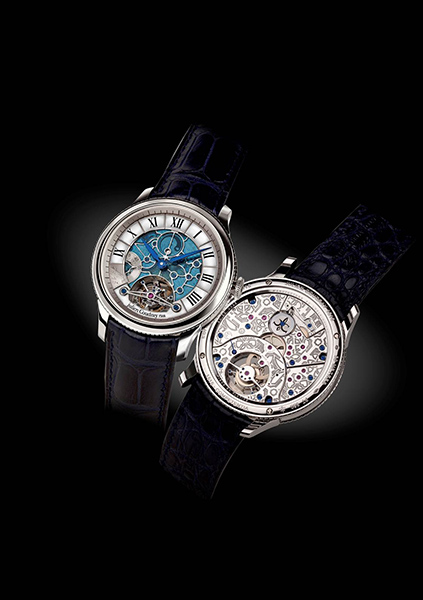
Collection Competentia 1515. © Julien Coudray 1518
This model, whose movement is made entirely from solid gold or platinum, is equipped with a power reserve indicator, a service indicator, a day/night indicator and a one-minute tourbillon. Despite the complication level, this calibre does not exceed 5 millimetres in height, to ensure that the watch remains comfortable to wear, though adorned with a dial comprising eleven enamel parts. This model also has a service indicator where an enamelled gold oil drop symbol appears after four years in operation, when the timepiece must be serviced.
The decoration of the central disc of this dial employs the subtle technique of plique-à-jour enamelling, so as to show glimpses of all the refinements of the movement decoration. To achieve this effect, transparent enamel is delicately laid onto a gold structure, before being fired in a furnace at over 800°C. The peripheral indexes, a modern vision of 16th Century clocks, are made from enamel and gold.