Like family birthdays, watch industry anniversaries are a good time to rediscover forgotten anecdotes. The 60th anniversary of the TAG Heuer Carrera is no exception. Sixty years is both very young in watchmaking and very old in the world of chronographs.
The models born during this period are iconic in at least three ways. First, because they testify to a technical and societal turning point, at which the chronograph is deserting its primary (and often professional) function and finding its place on the wrist of fine watch lovers – whether or not they are professional drivers. Secondly, because the chronographs born in the 1960s have experienced a revolution: the transition from hand-wound to automatic-winding chronograph. And thirdly, because they are timepieces based on chronometry (precision timing), an art that was swept away in the 1970s and 80s by quartz movements that were as affordable as they were accurate…
The TAG Heuer Carrera has survived all of this along with many other events – including the transformation of the Heuer company into TAG Heuer, and the arrival of younger siblings that have inevitably shaken things up somewhat, including the TAG Heuer Monaco. In the end, across its 60 years of existence, the timepiece has experienced only a brief 12-year hiatus between 1984 and 1996.
The TAG Heuer Carrera is a well-born and well-named watch. The Carrera Panamericana race that inspired its moniker would have been all but forgotten – as only five editions were held – if TAG Heuer’s creation did not bear its name! It is also a model that was remarkably worn back in the day by Jack Heuer himself, who understood the power of what we now call marketing and ambassadors. He gave one to every new driver of the Ferrari racing team – that Heuer partnered from 1971 onwards –including Niki Lauda and Jo Siffert. To flatter their egos, he made them wear the solid gold 1158 version originally designed to celebrate the company’s listing on the Swiss stock exchange. Mick Jagger also owned a Carrera, Reference 1153.

Well designed right from the start
Fame is not enough if a product is not well designed from the start, as is undeniably the case with the TAG Heuer Carrera. As early as 1963, its acrylic glass was fitted with a tension ring that freed up space on the dial. The 1/5th scale was placed on the flange, outside the hour-markers, resulting in a model with cleaner lines and more legible displays.
Similarly, the first models were of the panda variety (with black counters on a white background) or else reverse panda: everything was designed for legibility. Efficiency followed closely, with the 1969 introduction of the first automatic chronograph movement. The very first batch of this Reference 1153 bore the mention “Chronomatic” that was short-lived as consumers did not understand its meaning. It was therefore replaced by the more explicit “Automatic Chronograph” appearing on the lower half of the dial.
It would however be unfair to reduce the TAG Heuer Carrera to its early glory years. The timepiece has also often served as a technological platform on which TAG Heuer has shaped the future. Prime examples include the Carrera equipped with Calibre 1887 in 2010 and which gave rise to the Calibre Heuer 01 Manufacture in 2015; the Carrera Pendulum Concept (also in 2010 and featuring magnets used to regulate its movement); the Carrera “Tête de Vipère” Tourbillon Chronometer Chronograph in 2018; and the Carrera Heuer 02T Nanograph with carbon balance spring in 2019.
2023 vintage
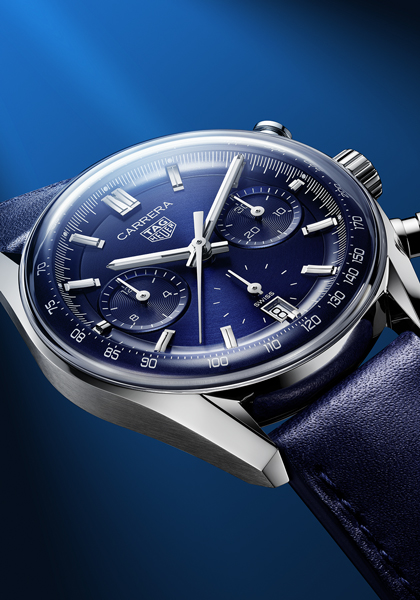
In January, TAG Heuer kicked off the 60th anniversary festivities with a first (600-piece) limited edition, a reinterpretation of a highly prized panda reference from the late 1960s (ref. 2447 SN), powered by a hand-wound Valjoux movement. TAG Heuer is now announcing three sets of new models honoring this renowned representative of fine Swiss Made mechanics. The first, simply named TAG Heuer Carrera Chronograph, comes in a modest 39mm diameter reflecting its historical nature as well as providing a contemporary unisex size.
Its steel case is topped by a domed sapphire crystal known as a “glassbox”, which evokes the geometry of 1970s hesalite glass. Today’s sapphire crystal is based on the principle of harmonious and non-distorting curvature of the glass and case. The inner bezel ring and hour-markers are likewise curved. In keeping with Jack Heuer’s original intent, this development is more than merely aesthetic, as it also means the tachymeter scale can be read from a wider range of angles. The pushers have also been redesigned to provide more accurate control of the chronograph.
This reference is available in two variations with a blue dial or a sleeker black and silver-toned “reverse panda” interpretation. Each is equipped with a new TH20-00 movement, an evolved version of the Calibre Heuer 02, which features a new bidirectional winding system ensuring 80 hours of power reserve. A third version rounds out the trio, housing the new COSC-certified in-house Calibre TH20-09 with tourbillon, visible at 6 o’clock inside a case that has been increased to 42mm for the occasion.
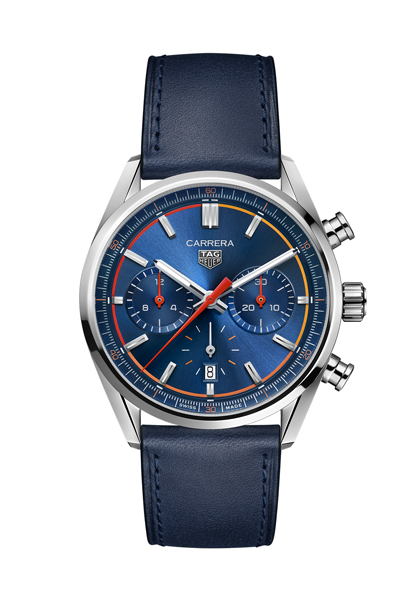
At the same time, two new, more colorful and dynamic references are being introduced, both in 42mm steel cases. Their distinctive feature lies in their blue or black dial, adorned with an orange-gradient rim and recalling the speedometers of classic racing cars. Their racing spirit is driven by in-house Calibre Heuer 02.
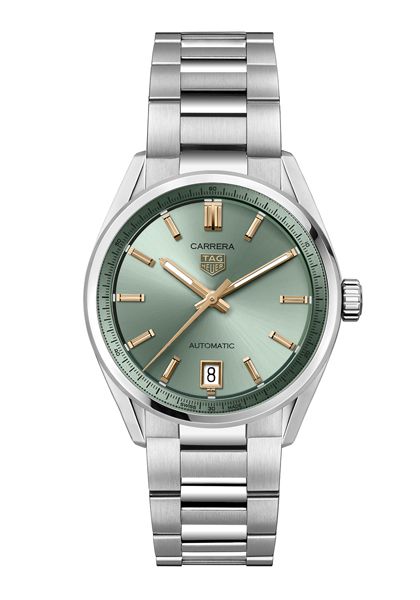
Finally, the 36mm TAG Heuer Carrera Date is now available with a choice of four colorful dials: blue, opaline, fuchsia and green. A cheeky and dynamic date-display model which has switched for the occasion from Calibre 5 to Calibre 7, thus moving from a 38-hour to 56-hour power reserve.
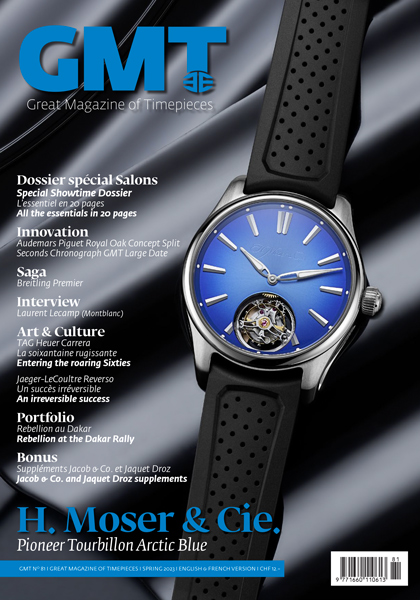
As a WorldTempus reader, we are delighted to offer you the latest digital version of this GMT magazine that you can download here.