

A symbol of clear skies and distant lands, turquoise - with shades ranging from pure blue to tender green, opaque yet also translucent - has captivated since… prehistory. It is one of the oldest ornamental stones, used in Ancient Egypt as well as throughout the Middle and Far East. Indigenous peoples of North America employed it as a ceremonial stone and as currency - traditional uses that still resonate today, making turquoise a natural fit for jewelry with an ethnic aesthetic.
Watchmakers Love Turquoise
Hard-stone dials enjoyed particular prominence during the 1960s - especially thanks to brands such as Piaget, a true reference in the field, but also Baume & Mercier, among others.
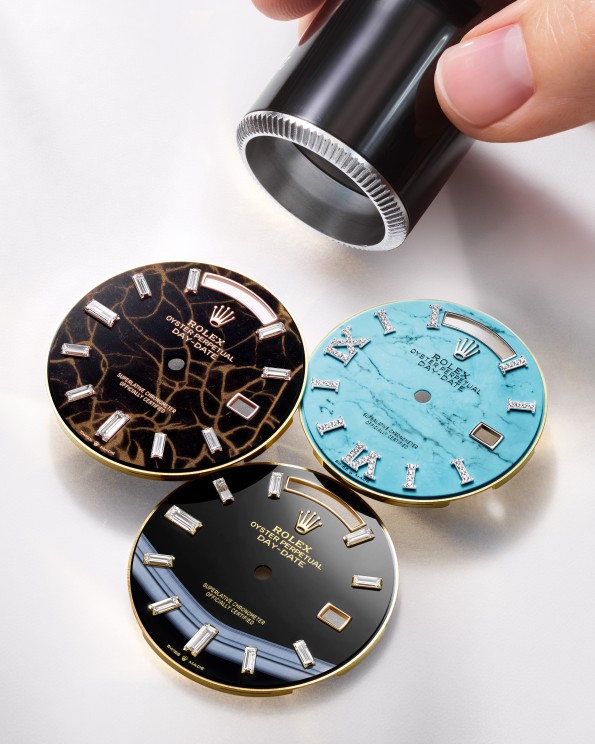
Since then, the trend for ornamental - or hard-stone - dials has come and gone. And returned often enough that we can safely say it’s here to stay! Among these stones, turquoise radiates with particularly vivid charm. Rolex, Chopard, and Audemars Piguet use it in its genuine form, combining the raw beauty of the material with technical mastery. H. Moser gave it pride of place in its Pop Collection, presented in April 2025.
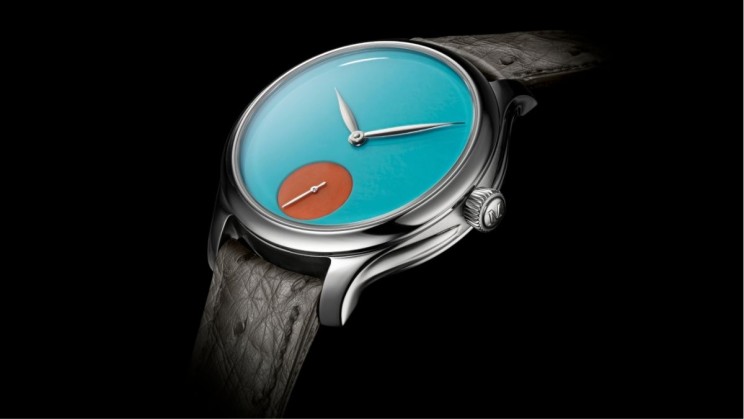
In recent years, however, this color has also established itself - fresh and distinctive - on lacquered or treated dials. Rolex, a pioneer of bold colors with its “Stella” dials of the 1970s, has revived this audacity in certain Day-Date 36 models, including a highly coveted turquoise version. Patek Philippe caused a sensation with the Nautilus 5711/1A-018 “Tiffany” in 2021, now an absolute icon. Among other brands won over by these sky-and-sea shades are Omega with its Seamaster Aqua Terra in 38 mm and 41 mm, Tudor with the Black Bay Chrono “Flamingo Blue,” and Breitling with the Endurance Pro IRONMAN® 70.3® World Championship 2025 edition in Breitlight®.
Does the Most Beautiful Turquoise Come From the Sky?
Belonging to the phosphate family, turquoise is born from rock, composed of copper, aluminum, and water. It only forms in particularly arid regions where water interacts with copper. Its name comes from the French pierre turque (“Turkish stone”), though it was once exported from Iran, most likely transiting through Turkey.
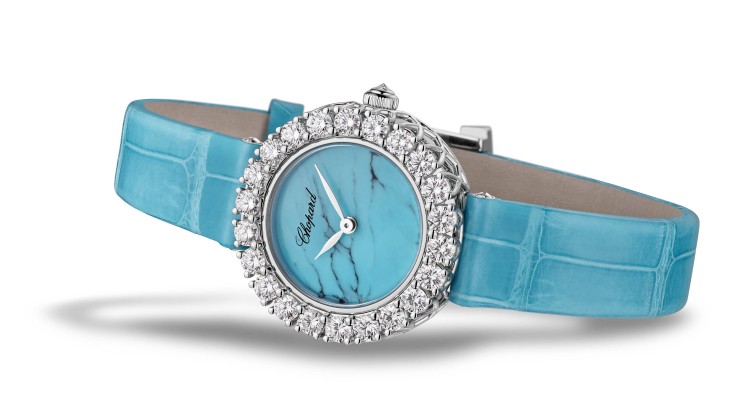
The most sought-after stones display an intense sky-blue hue, uniform, with no green tones or dark veins. Historically, such turquoise has come from Iran. Those from Arizona, more greenish and often veined, reveal a different kind of charm - often at a more accessible price point.
Indeed, the price of turquoise varies widely depending on origin, color intensity, and the absence of matrix - the marbled veins, remnants of surrounding rock during formation. The less matrix, the higher the perceived quality. Yet some brands appreciate the extra aesthetic personality of matrix and even highlight it, as Rolex does.
A Beauty to Be Treasured
With only modest hardness (5 to 6 on the Mohs scale), turquoise demands a delicate touch. Especially since fitting it onto the limited space of a dial requires thinning it down to the minimum. To overcome fragility, some turquoise is impregnated with wax or resin, which reinforces durability and intensifies its color.
Like all prized stones, turquoise is also subject to many imitations: chrysocolla, howlite, or reconstituted turquoise (a resin mixed with turquoise powder), the latter being very common in jewelry thanks to its lack of imperfections.


