
"Such a collection is exceptional, in terms of its breadth, diversity, and the very complete vision it offers," appreciates Estelle Fallet, curator at the Musée d'Art et d'Histoire. "J.-A. Horngacher," says Etienne Blyelle, "was an indispensable specialist, author of theoretical treatises and a private autobiography, who also dispensed much of his knowledge orally." Today, the formidable collection assembled by this extraordinary man is making the beauty of mechanical music a thing of the past.
A box abandoned at the flea market
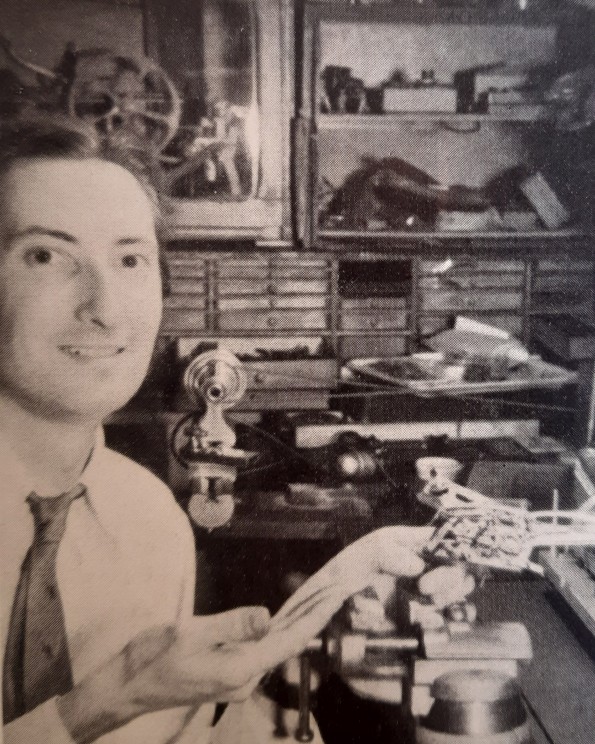
Very interested in mechanisms, little Jacques-Antoine found an old music box movement in Plainpalais - a place already renowned at the time for its flea market, which is still very popular today. How it worked intrigued him. In 1939, at the age of 10, he built a carillon from bicycle bells. When the boy was 12, an aunt attentive to his budding passion gave him his first music box - "a trigger" comments Estelle Fallet, "unfortunately associated some time later with the death of his mother". Highly intelligent, Jacques-Antoine excelled in mathematics, as well as in solving rebus and bon mots. His understanding of mechanics and his dexterity took him all the way to watchmaking school - where he presented a music box, which was rejected on the grounds that "it's not watchmaking". All his life, he defended the fact that these two specialties belonged to the same art. In 2020, seven years after his death, the inclusion of watchmaking and art mechanics on the Representative List of the Intangible Cultural Heritage of Humanity proved him right. "This recognition would certainly have given him a great deal of satisfaction," says Estelle Fallet.
A passionate, scientific approach
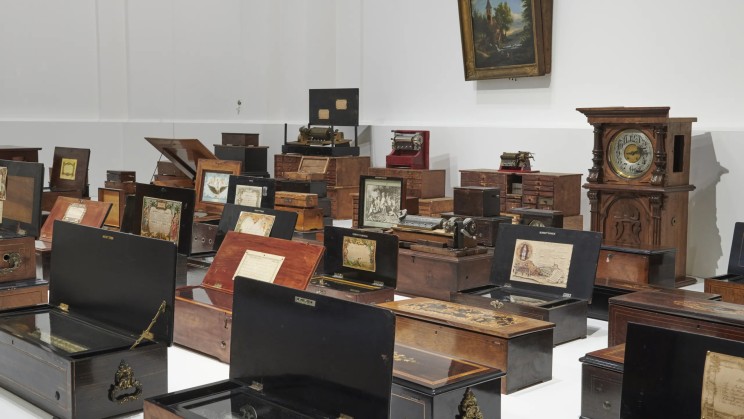
An internationally recognized expert, J.-A. Horngacher has produced an important classification of music boxes of all kinds, "from the very first movements with stacked blade systems, then flat-combed blades, and finally with a volume amplified by a disc, to perforated paper" continues the specialist. "He organized his collection like a museum curator, with a professional approach. Of course, at the time, the principles of conservation and restoration were not yet applied as they are today - the current approach dates from the 1970s - and he tinkered a little to make the boxes work," she smiles. Perhaps marked by the death of his mother, he had also developed an affective relationship with these objects, to which he attributed the names of people around him.
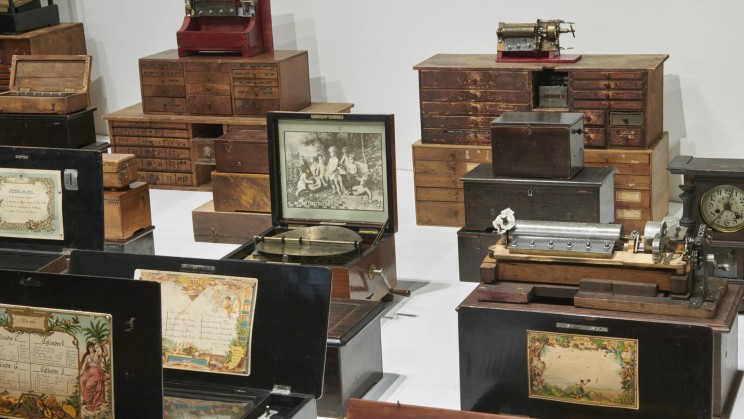
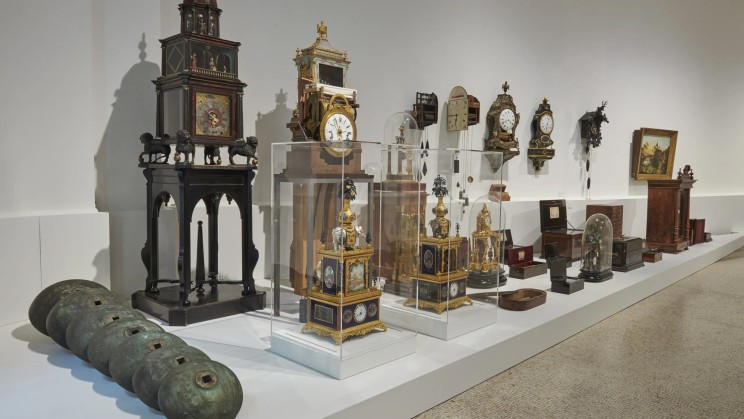
J.-A. Horngacher bequeathed a total of 135 music boxes, exhibited in their entirety at Geneva's Musée d'Art et d'Histoire until August 17, 2025. Alongside them, chimes from St. Peter's Cathedral, clocks, a dozen of the museum's own music boxes and even a cuckoo clock illustrate the richness of mechanical music. Since his bequest in 2013, a meticulous restoration project has been carried out. Each piece has been cleaned, and fifteen or so play melodies in his honor - melodies that can be heard during demonstrations in the museum's diary and on its website, thanks to an audioguide.
A history engraved in the heart of Geneva
And why have these pieces been entrusted to the Geneva museum, rather than to the equally renowned Musée d'automates et de boîtes à musique in Sainte-Croix? "Because J.A. Horngacher was himself from Geneva, but also because the music box was born here. It made double sense to him," explains the curator. Indeed, the principle of the music box with comb or keyboard was born in 1795, thanks to Antoine Favre, a watchmaker in the City of Calvin. "Somewhat by chance, perhaps inadvertently, he discovered the sound properties of vibrating blades. This discovery was also part of a constant quest to vary watchmaking products," she continues. Production began in the 1800-1820s, and peaked around 1860, reaching around 13,000 pieces and employing around a thousand people in the town. The principle was first applied in small formats, then expanded to include boxes for public places such as railway stations, where a coin was used to pass the time with music. I still remember the one at Le Locle station in the 1980s," recalls Estelle Fallet. "It's also interesting to note that the development of the music box is the reverse of that of watchmaking, since the latter was born in large volumes and then gradually miniaturized."
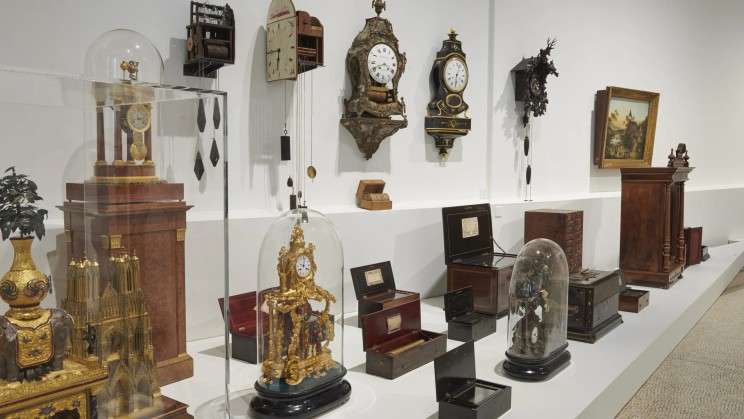
In short, two fascinating stories to discover at the Musée d'Art et d'Histoire: that of a Geneva collector who transformed his childhood passion into a heritage treasure, and that of a mechanical art that makes the past sing.
"Mechanical Music " until August 17, 2025
Tuesday - Sunday 11am-6pm, Thursdays 12pm-9pm
Guided tours and music box demonstrations according to calendar