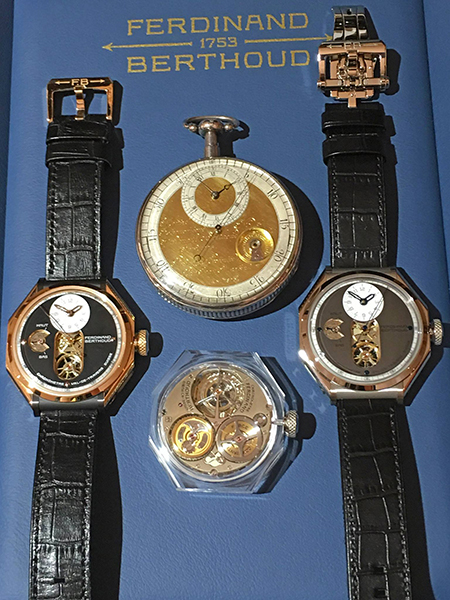
They have so many things in common that it would take too long to list them. Ferdinand Berthoud and Louis Moinet had such similar careers that, at first glance, it’s easy to confuse the two. Their lives overlapped considerably – 1727–1807 for the former and 1768–1853 for the latter. Berthoud was born in Neuchâtel, where the Ateliers Louis Moinet are now located. They both travelled, Moinet in Italy, Switzerland and then to Paris, where Berthoud set himself up in 1745, and where Moinet later died. They both reached a very respectable age: Berthoud died at 80, Moinet at 85.
During their lifetimes, they each wrote a seminal treatise on watchmaking: Berthoud the “Essai sur l’horlogerie” and Moinet his “Traité d’horlogerie”. And both of them were known to the great and the good of their time. Berthoud rubbed shoulders with Louis XV and Napoleon, while Moinet’s client list included Napoleon, Thomas Jefferson, James Monroe and Maréchal Murat.
Generation gap
Nevertheless, Moinet and Berthoud never worked directly together, unlike Breguet and Arnold, for instance, and there is no evidence that they ever met. Berthoud was 40 years older than Moinet, and seems to have been his precursor on many occasions, having taken marine chronometers to a level of excellence never seen before.
Moinet probably drew inspiration from Berthoud’s work, which he cited extensively in his Treatise, before comprehensively taking it down. A sense of rivalry between them is implicit, but never stated openly. In his Treatise, Moinet wrote about the older watchmaker: “Progress in horology has meant that his work now shows its age, and several parts of it have now been rendered obsolete. Our work will replace the books of Berthoud and older authors.”
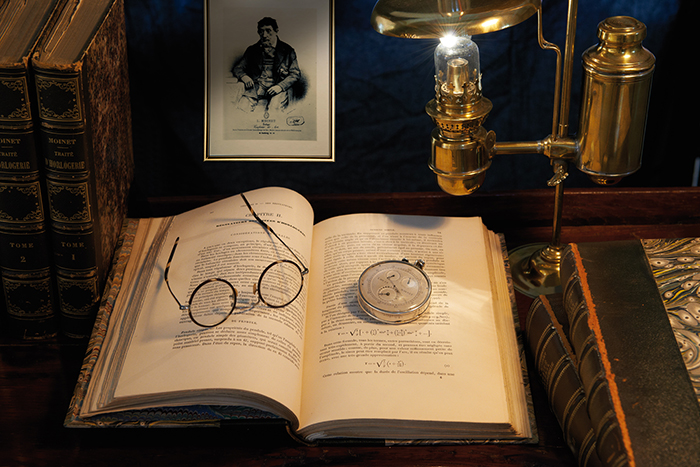
A respected artist and a horological specialist
Other points of divergence are clear in their work. Moinet was a complete artist. He studied painting, sculpture and engraving during his lengthy stay in Italy, learning directly from Rome’s greatest masters. On his return, he taught at the prestigious Beaux-Arts in Paris. He also developed a thorough knowledge of astronomy, physics and chemistry.
Berthoud was more of a specialist, becoming an eminent figure in horology, with a particular focus on marine chronometers, with which he is chiefly associated today. His single-mindedness won him many awards and titles: Horologist to the King (1770), Fellow of the Royal Society (1764) and a member of the Institute of France (1795).
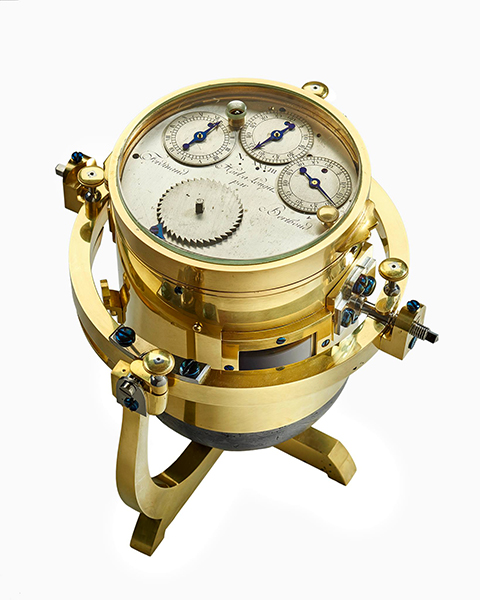
Berthoud also worked hard to make his work more widely known. He drafted several articles for Diderot’s Encyclopaedia, as well as a book entitled: “The art of operating and adjusting clocks and watches for those who have no horological knowledge”, which was published in 1759. Berthoud was also one of the most prolific horological authors of all time, with more than 4,000 published pages and 120 engraved plates to his name.
Career or way of life?
At the same time, Berthoud was also punctilious about registering his inventions by means of official “covers” deposited with the Academy of Science, which were the precursors of today’s patents. His diligence was rewarded with the recognition of posterity for many of his inventions and also, more pragmatically, royal grants that enabled him to continue his work.
Moinet, on the other hand, cultivated a certain reserve where his craft was concerned, and remained fiercely suspicious of high-volume watch production and complacency. He deplored “the negligent work of several high-volume manufactures or factories, which are the death of art and artists.” Rigorous to a fault, he railed against horological fashions, mechanical artifice and lack of research: “That which enchants at first glance does not always stand the test of time.” Moinet lived for his art, but discreetly, without any official seals, patents or other legal recognition for his work, which is why it remains so difficult today to effectively circumscribe his achievements.
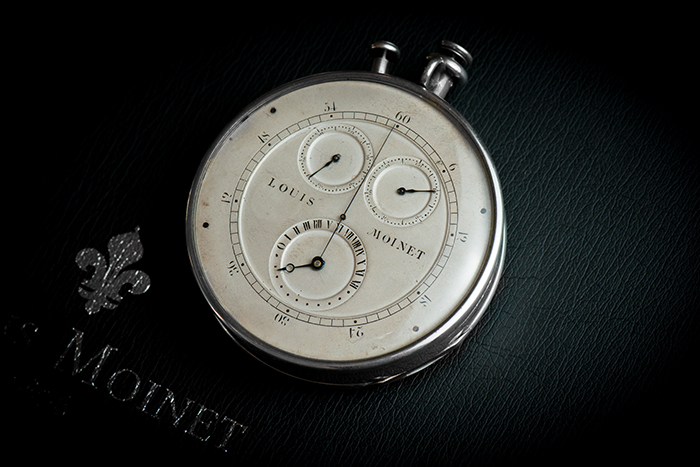
Berthoud was eventually able to live off the proceeds of his royal chronometry business, which he had calculated to perfection. Moinet, however, died penniless and alone, having invested all his personal fortune (and energy) in publishing his Horological Treatise. He also died in relative obscurity. It was not until 150 years later, when his Counter of Thirds was rediscovered and formally acknowledged as the first chronograph in history (1816), that his name emerged once again from the shadows. Today, Berthoud and Moinet are united by the wonderful work of the watch companies that bear their names, and which continue to bring recognition to the work of the men who inspired them. .