Revue FH - 13 September 2012
Each year the industry's umbrella organisation, the Employers' Federation of the Swiss Watch Industry (CP), prepares statistics on events affecting the health of employees. Surveyed firms can therefore compare their results with sector averages. The latter are also an excellent barometer for comparisons with other economic sectors.
These statistics generate six results known as «safety indices»: the rate of absenteeism due to industrial sickness or accidents and the frequency of cases falling into this category are two of the most important indices to come under close scrutiny. Then – a first for 2011 – two similar indices are established for non-industrial accidents. Lastly, the two final indices relate to insurance premiums for industrial accidents and sickness and non-industrial accidents.
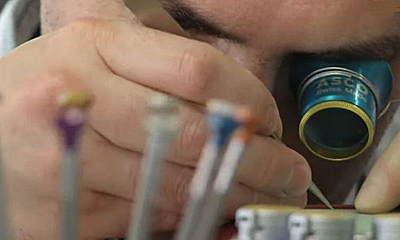
For industrial cases, while the rate of absenteeism was already very low in 2010, the relevant index in 2011 shows a further significant decline (nearly 12%). Compared to 2009, a less than good year following economic upheaval, the reduction is almost 20%. In terms of the number of hours lost, this means that the level has fallen to below one hour (0.983 of an hour) per thousand hours worked. This is the lowest rate in the twelve years of existence of the statistics. In terms of the number of cases, i.e. in absolute figures, this represents 0.0311 of an accident or industrial illness per thousand hours worked. An employee in the sector would therefore be at risk of a (minor) accident at his workplace only once in 19 years. For 2011, the three most common accidents listed are cuts (27%), falls and slips (22%) and hand injuries (21%).
These excellent results show that firms in the sector are aware of the risks and are taking preventive measures very seriously. It should be noted however that among small and very small firms the frequency of accidents increased by 24%, whereas in recent years the number of claims had fallen into line with the very low rate of large entities.
Due to the relative newness of the statistics, the inventory of non-industrial accidents for the year 2011 yielded results that are only partially usable. These are in part biased, since many firms kept no internal records on this subject and therefore had to rely on memory. Nonetheless, even though they remain low, the figures show a rate of absenteeism higher than that for industrial accidents, namely 4.4545 hours per thousand hours worked. In terms of the frequency of cases recorded, the study reveals a figure of 0.0646 per thousand hours worked, i.e. more than twice the number of cases generated for industrial causes.
With respect to insurance premiums, the finding for industrial cases is the same as in 2010: rates have increased for small firms but have remained stable for large companies. This disparity is to be regretted and one can only hope that the gap narrows in the future, particularly since there is a time-lag between the years taken into account for setting premiums and the recent situation. In terms of non-industrial accidents, premiums have remained stable or have fallen slightly.