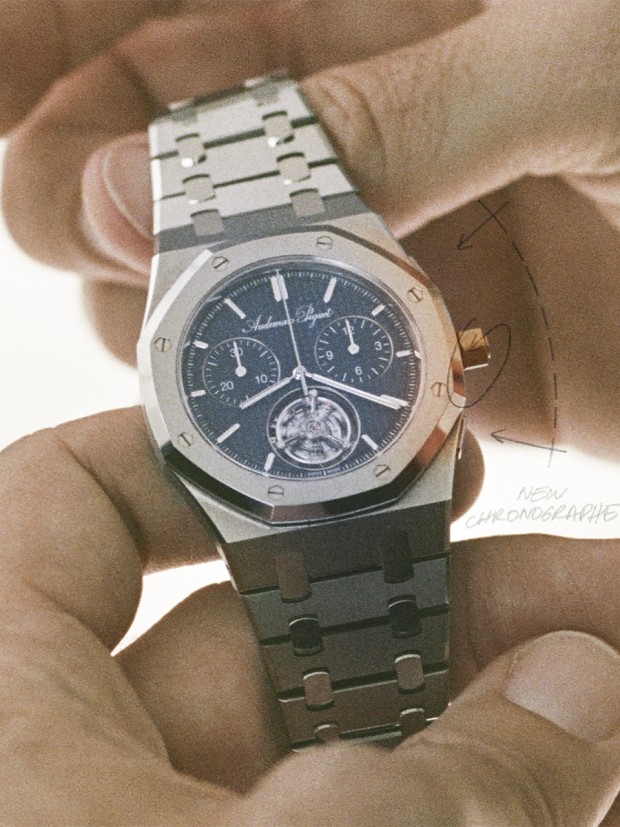
Some established notions seem so deeply carved in the marble of history that we no longer think to question them. One of these is that the watch is a technical product with its own specific requirements: its weight, its precision, its ergonomics, its user manual. In short, it is something to take or leave, since, as it stands, watchmakers can do no more.
Push, pull
That is, of course, false. The watch exists to serve its user — just like a car, a wallet, a sofa, or a smartphone. A watch is not a sacred object, nor is it mysterious. Everything that hinders its proper use by its owner should be open to questioning — without taboo or limitation.
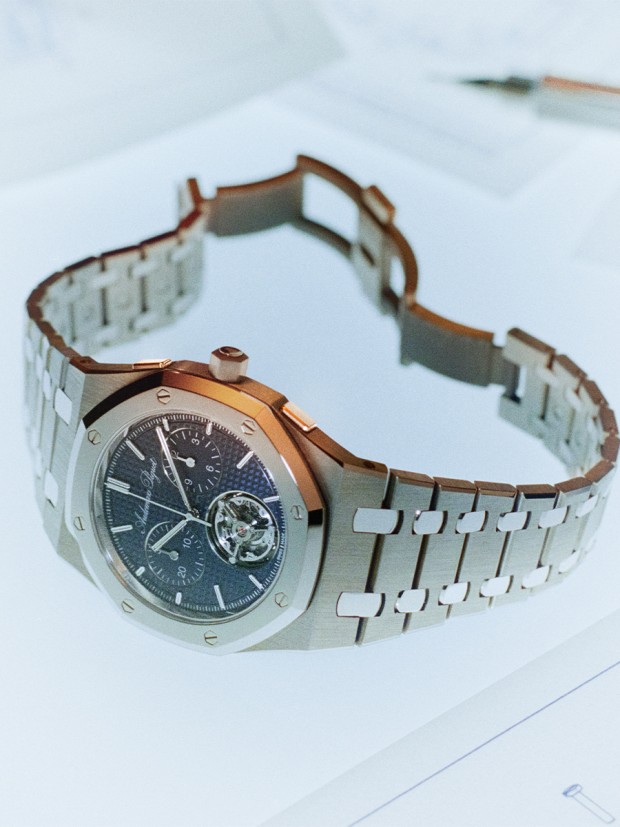
This is precisely the challenge undertaken by Audemars Piguet’s RD#5. The piece is being released as part of the brand’s 150th anniversary celebrations. Only 150 pieces will be made. Yet, far from being a purely theoretical research project, it actually offers solutions that can be industrialized.
One of the standout aspects of the RD#5 is the feel of its pushers. The goal here is not to fix a problem (the current pushers work perfectly well!) but rather to see whether they can be optimized according to two factors: reducing the length of their travel (in millimeters) and the pressure (in kilograms) required to activate the function associated with them.

Correct, soften
The usual pressure is 1.5 kilograms, with a travel of one millimeter. The question is not whether that is little or much, but rather whether these values can be reduced to approach those of a smartphone button — an element we interact with far more often than the pushers of a chronograph.
Audemars Piguet’s answer: yes. And with sound reasoning — the chronographs of the 1950s and 1960s already had a much softer feel than those we know today. It is therefore time to revisit the concept and push it further.
For the RD#5 chronograph, AP has chosen to use a column wheel, “which helps reduce idle travel, rather than a shuttle, which is easier to industrialize but harder to press and has a longer idle stroke,” explains Giulio Papi, Director of Watchmaking Development. For the chronograph’s reset function, AP replaced the hammer with a rack, and the heart with a pinion — resulting, in the process, in a sevenfold improvement in energy efficiency.

More Comfort
The ergonomic optimization of the RD#5 did not stop at the pushers. The piece was also designed to fit into a 39 mm case — not only the historical size of the original Royal Oak Jumbo (1972), but also the format favored by collectors.
It also offers a three-day power reserve, another comfort feature associated with “weekend-proof” watches. Finally, it is crafted from titanium combined with BMG (Bulk Metallic Glass). Discovered in the 1960s, BMGs are alloys that, when rapidly cooled, share several properties with glass, such as robustness and amorphism. Composed of more than 50% palladium, the BMG developed by Audemars Piguet offers high resistance to wear and corrosion, along with a bright, reflective finish. First introduced in 2021 on the Royal Oak “Jumbo” Extra-Thin Only Watch, this material officially joined the collection in 2023.
On the back, the movement is fully visible thanks to a peripheral rotor — “a feature we hadn’t seen at AP for about ten years,” notes Giulio Papi. Unfortunately, one might add, the only brand that had made systematic use of it (Carl F. Bucherer) has since closed its doors — and no one has significantly carried the torch… until now?

Clever
The little extra
A family in gold