Many moons ago, my first foray into the watchmaking world was actually working for a watch brand doing factory visits. Over my tenure at the company, I gave the two-hour tour to watch collectors, journalists, politicians, actors and actresses, and even a princess! To see their eyes light up in amazement and astonishment at all the work that went into a wristwatch was a joy to behold.
Fast forward 20 years (oh my goodness, am I that old?) and a long career as a watch journalist, and I have lost count of the manufactures I have visited. Many of them I have seen several times, but there was one that I had never had the opportunity to visit and that was Richard Mille. So, when an invitation to discover the Maison’s movement-making facilities arrived in my inbox, I jumped at the chance.
Les Breuleux in the Jura Mountains
It takes a whole day to visit Richard Mille’s facilities. Composed of Horométrie S.A, Guenat S.A Montres Valgine (GMV), and ProArt I and II, these different entities, with their 210 employees, combine the company’s expertise to develop, produce, test, and distribute Richard Mille watches worldwide.
Guenat S.A Montres Valgine (GMV)
To start with a little history, Guenat S.A Montres Valgine (GMV) is where the brand was born. In 1900, Ali Guenat became the owner of a small watchmaking enterprise, starting a family tradition that is now in its third generation. Ali’s grandson Dominique Guenat entered the company in 1986 and took over the reins in 1991. In 1999 Dominique and his good friend Richard Mille decided to join forces to create a brand, and the rest, as they say, is history. Today, GMV is under the responsibility of Yves Mathys, who has been part of the Richard Mille adventure since the very beginning and, therefore, knows the brand inside and out. All the watches produced are assembled and controlled here.
ProArt I and II
This 3,000m2, state-of-the-art facility was opened in April 2013 and manufactures the iconic Richard Mille cases, as well as a number of movement components, including baseplates, bridges, screws, and some wheels. ProArt II followed in 2018 with a further 2,500m2 extension to the ProArt I building. It is here that you will find the technical offices of the case and movement engineers, the R&D team, and the artistic direction department. The building was designed by the architect Chavannes and was the first in the region to use a geothermal heating and cooling system.
It is in ProArt II that our visit begins around a large conference table with the different department heads that come together in the development of each and every watch. Our case study is the RM 88, an automatic winding tourbillon Smiley that is highly recognizable thanks to its famous yellow smiley face feature that gave the watch its name. The Richard Mille R&D and development teams share the joys and challenges of bringing such an ambitious project to life.
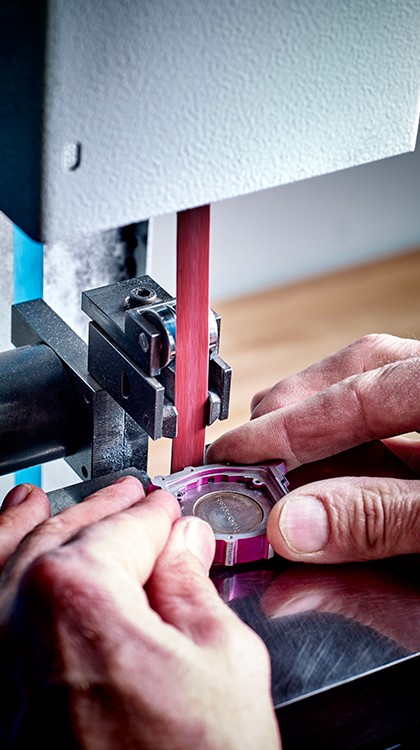
From R&D, we follow the watchmaking process, step by step, starting with the machining of the cases and individual components. It is only thanks to this in-house know-how that the brand can make such small series. Since the launch of its in-house movement in 2014, the company makes over 15 calibres, equipping 60% of its production, while the remaining 40% is provided by Vaucher Manufacture and APLL. The technology does not stop here, Richard Mille’s high-tech case materials, including grade 5 titanium, Carbon TPT®, carbon nanotubes, and ceramics are also developed and machined in-house, and there is a gem-setting workshop here too.
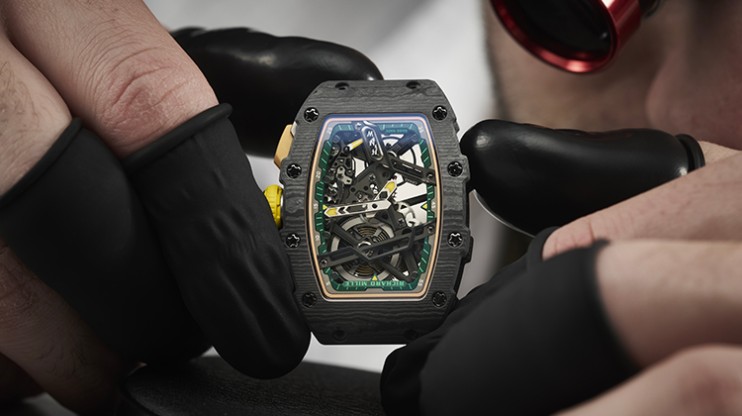
Even though most watch manufactures have the same machines and processes, what really stands out at Richard Mille is the attention to detail and the insane level of testing and quality control. Just to give you an idea, 30% to 40% of components are rejected as they don’t meet the extremely high standards demanded by the Maison. Richard Mille watches are built to be worn – however complicated they are inside – and the perfect case in point is Rafael Nadal, who wears his Richard Mille to work! Need I say more?
After visiting almost every watch manufacture in Switzerland, it is still possible to still be impressed and amazed, but that is perhaps what makes Richard Mille the powerhouse that it is, its ability to surprise!