
Some creations require time for reflection, time to get accustomed to them. To discover their subtleties. To understand their movement. To grasp their historical continuity. This is not the case with the 32 ("an internal code name we kept", smiles Gautier Massonneau, co-founder). Few creations - new movement, new design - have the ability to instantly assert themselves with the force of the obvious. A short, striking, slightly puzzling name - as always with Trilobe - but it carries a product that, from its first seconds, hits the mark with formidable precision.
An already operational manufacture
Yet, the turn taken could have been more delicate. For three years, Trilobe has been quietly working on establishing a French production site, less than an hour from Place Vendôme. Because the French house, which already designs, conceives, and assembles all its pieces in Paris, did not previously control the central link, that of the production of its components. The old refrain of the "renaissance of French watchmaking," on which almost all French brands have faltered for the past 25 years.
Thus, Trilobe did not announce its internal manufacture project but implemented it first, then communicated it. In a building close to 1000 m², the brand has installed a functional machine park (for a year). It produces its bridges, its main plates, a certain number of turned parts, essentially the movement. About ten employees have been recruited. They complement the twenty already present at Opéra, in the heart of Paris.
Prime number
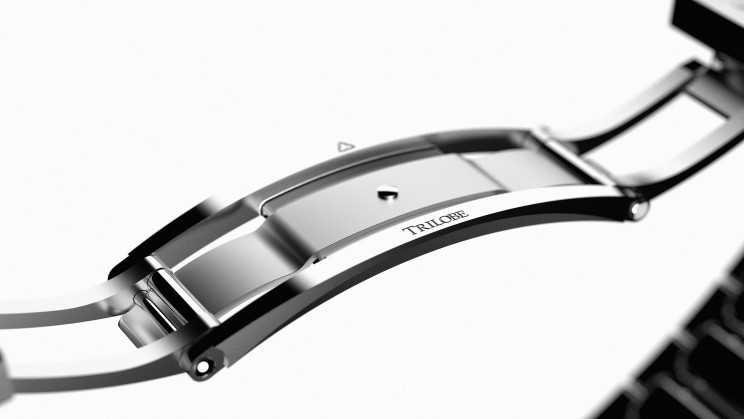
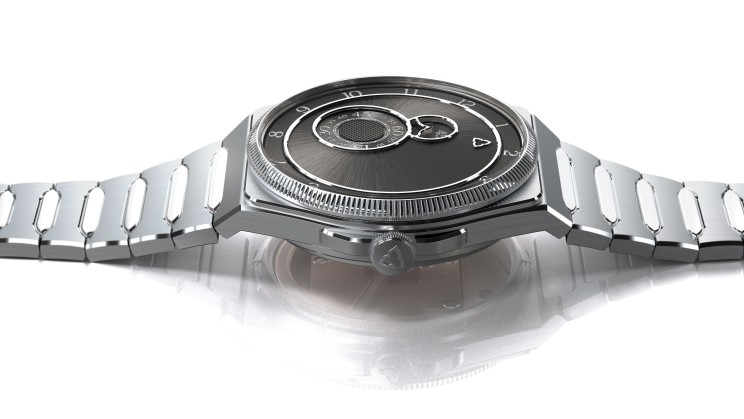
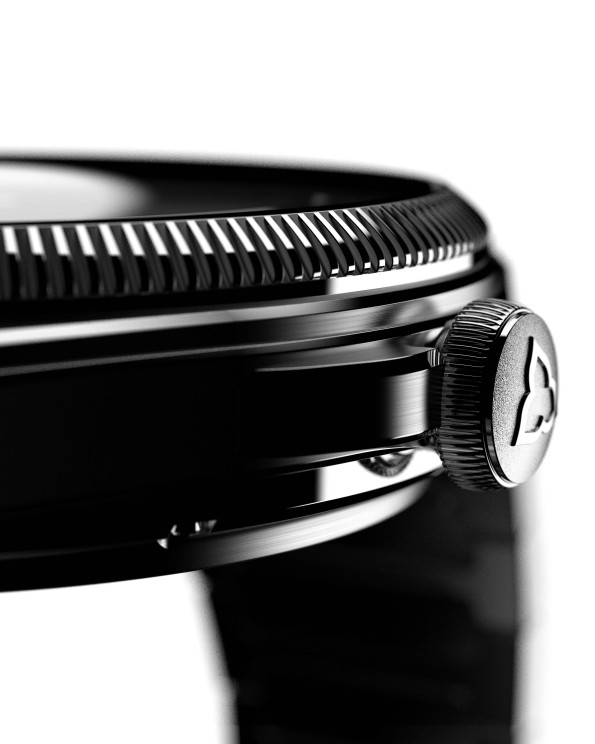
The 32 is the first fruit of this endeavor. It retains the brand’s emblematic display, rotating, but without hands and off-centered. This composition is now set in a new case of rare elegance. Made of steel, it features an integrated strap - Trilobe's first, equipped with spring blades for absolute comfort. The proportions are right, coherent. Attention to detail is pertinent: it’s not about imposing a finish because it’s fashionable, but because it contributes to a general aesthetic of remarkable balance. This is notably evidenced by the fluted bezel, whose "recessed" patterns are sandblasted, but with polished edges. Similarly, its seating on the box is made possible by an uncommon counter-bezel, thin but visible, ensuring aesthetic continuity between bezel and box. The process is notably found in Vacheron Constantin's 222, but at Trilobe, the component embraces the profile of the box, thus acquiring a different personality.
New Parisian movement
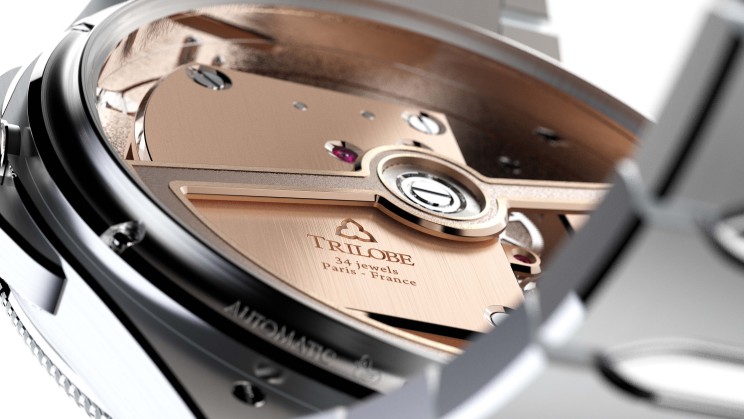
On the movement side, the 100% in-house movement asserts a unique identity. The first thing discovered is the first rotating mass at Trilobe, previously specialized in micro-rotors. The balance bridge, generously angled (a bit more than 0.4 mm), is typical of Parisian watchmaking, whose heritage Trilobe claims. The escapement stands free, in a void, within a large, finely grained watch scene. Facing it, a block. Square, generous, tall. It houses the rest - and thus the essence - of the movement: setting the time, winding, barrel, as well as the hour, minute, and second modules - which, in reality, are no longer, since they are integrated within the movement.
The mechanical composition is striking, as Trilobe knows how to do. The isolated and suspended roundness of the escapement, alone in its world, stands apart from the "engine block," which imposes its tense lines and demands its volume, uncompromisingly. Yet, it is not a confrontation. On the contrary, these two elements work together in harmony. On the right, the Parisian watchmaking tradition with its escapement. On the left, the architectural and contemporary modernity always present in Trilobe’s DNA.
At first glance, the eye resists, habits attempt to surface. But in reality, this mechanical dialogue emerges naturally, because it is right and relevant. It conveys the essence of Trilobe but actively: it brings "something more," it builds a new watchmaking grammar that considerably enriches Trilobe’s horological lexicon. A brand that, in just seven years, has written with patience and creativity an unprecedented page in contemporary watchmaking. The 32 is the most dazzling proof of this.