
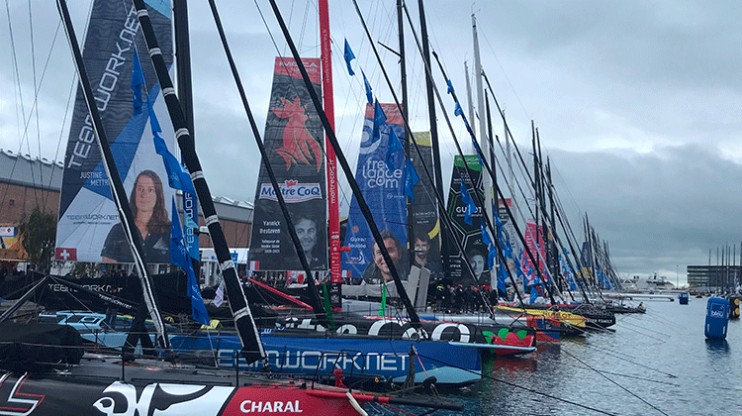
Le Havre, last week of October. After the long stretch of unseasonably warm weather that had bathed the coastal town, the prospect of seeing the Transat Jacques Vabre set sail in bright sunshine seemed very real. But Normandy has a reputation to uphold, and only certain classes left port on Sunday under strong winds. A storm forming in the Atlantic delayed the start for the Imoca class, skipper Alan Roura among them.
8 million for a new boat
The Swiss native was 8 years old when he embarked on a round-the-world voyage with his parents and siblings, returning to dry land 11 years later. His mind was made up: the sea was his home. There followed his first boat, the best he could afford (“practically a wreck”), his first Atlantic crossings, first races and the realisation that, if he were to become a pro sailor, he would need to find a boat, as well as lots and lots of money.
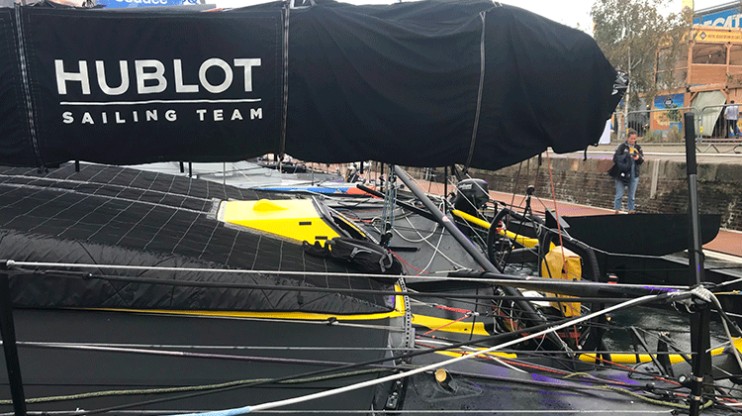
Now aged 30, Roura explains how “ten years ago, it cost two million to have a boat built. Today it’s four times that. I didn’t have that amount and I still don’t.” The solution was to hire an Imoca, a 60-foot monohull. The boat, bought by a sponsor, was rented to him “for as long as I needed.” This still left running costs, “around €1.8 million a year for race expenses and a full-time crew of eight.” It was time to go knocking on doors.
“Hublot was the obvious choice”
“My parents are from Versoix. I used to go past the Hublot factory every morning. To me it was the obvious choice but I had to convince them.” For five years, Alan Roura camped out at the brand’s headquarters in Nyon. Partnerships aren’t made overnight and Hublot receives dozens of unsolicited requests a day, from influencers with half a dozen followers to the planned and detailed proposal put forward by Alan Roura.
End 2021, Chief Executive Ricardo Guadalupe accepted the challenge. Hublot’s partnership policy is ultra-selective but, once a decision has been made, one of the most powerful in the industry. The brand’s football sponsorship is a case in point. But ocean racing is different. Why? Because it is far less high-profile than tennis, football or Formula 1. Because there aren’t many big races: three or four a year compared with football matches every week. Because single-handed racing, by nature, doesn’t lend itself to an audience. And because sailors do not a happy, smiley chat-show guest make.
Keeping a sport alive
Alan Roura knows this. He poses willingly for photo shoots, patiently explains the functioning of these ocean-going Formula 1, describes what he eats, comments on weather conditions, narrates his adventures in detail, shares his concerns as a new father. There’s a lot to be said for having Hublot as a sponsor for the past two years: when the brand commits, it does so 100%. Apart from the occasional project, the sea is not its natural environment, “but Hublot is about the experience,” notes the brand. “And embarking with Alan Roura is an unforgettable experience for our customers.”
Hublot has taken up the cause, putting its weight behind a demanding sport that gets little media attention and centres on a solo sailor. But this support of Alan Roura goes beyond a sponsorship deal. It is a reminder that, without a partnership, certain disciplines would purely and simply cease to exist. Solo sailing - among others - would disappear from the face of the Earth. And its oceans.