
Marketing speak is rarely a paragon of understatement, but when Vacheron Constantin describes its Berkley Grand Complication as "a milestone in contemporary watchmaking history", it would be hard to disagree.
"Grand complication" is not a generic term: usage has established its meaning as any timepiece that incorporates at least three complications. There are no rules as to what these complications must be, although it's understood that the more basic options, such as the day, the date or a GMT, are excluded in favour of technically complex mechanisms such as a perpetual calendar or a minute repeater.
Open to debate
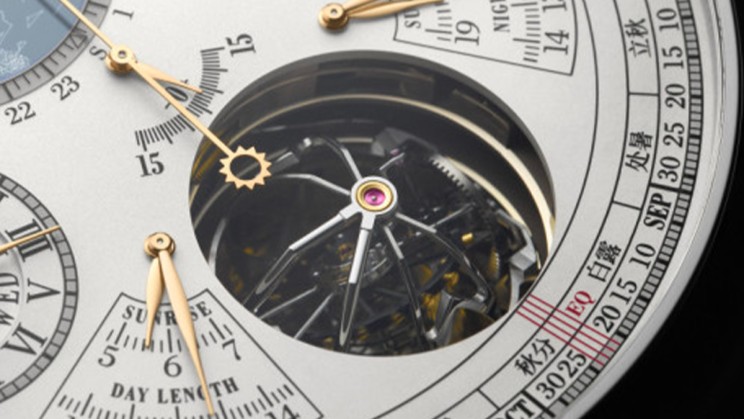
Purists continue to argue over whether, or not, to include the tourbillon, which strictly speaking is not a complication but a type of escapement. The Berkley rises above this debate. It possesses an astounding 63 complications, although several are open to discussion, such as the systems to disengage the alarm barrel and the striking barrel when fully wound, the winding system, and the concealed winding crown. In total, seven of these complications may not be considered as such by certain watchmakers.
Ever more complicated
This unique piece is one of a not very long line of grand complications. Few have been made this century or last. The first, begun in exactly 1900, was the Leroy 01. It set a precedent that the majority of later grand complications would follow: custom-made for an immensely wealthy individual, an exceptionally large size (71mm for the Leroy 01), an exponential number of components (already 975 in 1900) and an extraordinary array of complications (27 in the case of the Leroy 01).
Patek Philippe would produce a succession of these remarkably complicated timepieces, beginning with a model created for the American industrialist James Ward Packard. Delivered in 1916, it featured 16 complications. When Henry Graves Jr. received his timepiece in 1925, complete with 24 complications, this sparked a rivalry between the two men, each determined to outrank the other. Thus two years later, Packard took delivery of a second watch with 10 complications. Patek Philippe followed this, in 1989, with Calibre 89 (33 complications) then, in 2014, the Grandmaster Chime (20 complications).
Next, Vacheron Constantin entered the fray, taking grand complication watches to a whole new level with the 57 complications of Reference 57260, unveiled in 2015, the year of its 260th anniversary. The Berkley Grand Complication trumps this, with 63 complications.
Dizzying heights
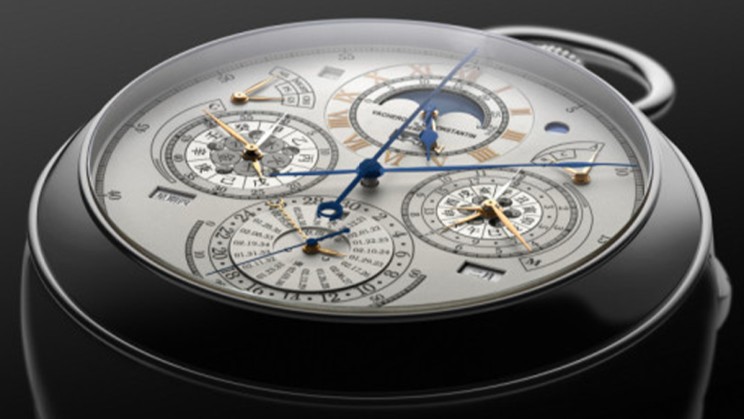
A few numbers give measure of this achievement: the Berkley was 11 years in development, comprises 2,877 components, displays information by means of 31 hands and took an entire year to assemble. It is, of course, a human endeavour, made by the same watchmakers who built the earlier Reference 57260 and for the same collector, William F. Berkley (whose name was not revealed in 2015 and who also owns the Vacheron Constantin watch that was gifted in 1946 to King Fouad 1 of Egypt). For the 57260, Mr Berkley requested a Hebraic perpetual calendar. For this new grand complication, named after him, he asked for an infinitely more complex Chinese perpetual calendar.
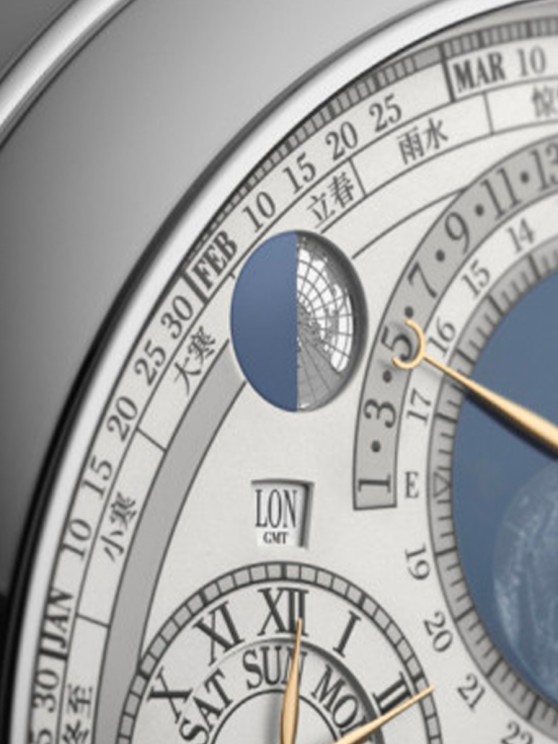
There isn't room here to detail every one of the 63 complications. We can note that the two perpetual calendars (Chinese and Gregorian) alone account for 20 complications. The remainder concern for the most part the chimes and the alarm (15 complications), time measurement and regulation (9) and the astronomical indications (also 9). Interestingly, the Berkley's Gregorian calendar observes ISO 8601 standard (introduced in 1988) for date formats and incorporates displays for the week numeral, from 1 to 52, and for the day, from 1 to 7.
Calibre 3752 is equipped with a Grande Sonnerie mechanism featuring a Westminster carillon, which chimes the melody sounded by the bells of Big Ben in four bars of four notes, followed by a fifth note for the hours. This chime is sounded by five hammers striking five gongs and can be activated on demand. The case of the Berkley Grand Complication, in white gold, measures 9.8cm in diameter and 5cm thick.
COMPLICATIONS LIST
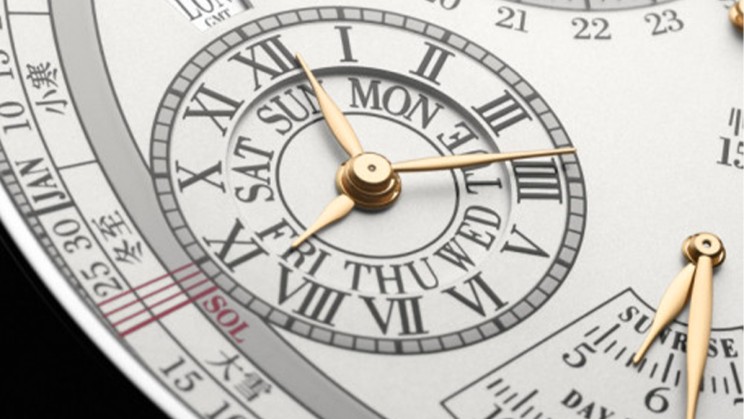
1. Regulator-type hours, minutes and seconds for mean solar time
2. Retrograde second for mean solar time
3. Day and night indication for reference city
4. Visible spherical armillary tourbillon regulator with spherical balance spring
5. Armillary sphere tourbillon
6. World time indication for 24 cities
7. Second time zone hours and minutes (on 12 hours display)
8. Second time zone day and night indication
9. System to display the second time zone for the Northern or Southern hemispheres
10. Gregorian perpetual calendar
11. Gregorian days of the week
12. Gregorian months
13. Gregorian retrograde date
14. Leap-year indication and four-year cycle
15. Number of the day of the week (ISO 8601 calendar)
16. Indication for the number of the week within the year (ISO 8601 calendar)
17. Chinese perpetual calendar
18. Chinese number of the day
19. Chinese name of the month
20. Chinese date indication
21. Chinese zodiac signs
22. 5 elements and 10 celestial stems
23. 6 energies and 12 earthly branches
24. Chinese year state (common or embolismic)
25. Month state (small or large)
26. Indication for the Golden number within the 19-year Metonic cycle
27. Indication for the date of the Chinese New Year in the Gregorian calendar
Chinese Agricultural Perpetual Calendar (2)
28. Chinese agricultural perpetual calendar
29. Indications of seasons, equinoxes and solstices with solar hand
30. Sky chart (calibrated for Shanghai)
31. Sidereal hours
32. Sidereal minutes
33. Sunrise time (calibrated for Shanghai)
34. Sunset time (calibrated for Shanghai)
35. Equation of time
36. Length of the day (calibrated for Shanghai)
37. Length of the night (calibrated for Shanghai)
38. Phases and age of the moon, one correction every 1027 years
39. Fifths of a second chronograph (1 column wheel)
40. Fifths of a second split-second chronograph (1 column wheel)
41. 12-hour counter (1 column wheel)
42. 60-minute counter
43. Progressive alarm with single gong and hammer striking
44. Alarm strike / silence indicator
45. Choice of normal alarm or carillon striking alarm indicator
46. Alarm mechanism coupled to the carillon striking mechanism
47. Alarm striking with choice of grande or petite sonnerie
48. Alarm power-reserve indication
49. System to disengage the alarm barrel when fully wound
50. Carillon Westminster chiming with 5 gongs and 5 hammers
51. Grande sonnerie passing strike
52. Petite sonnerie passing strike
53. Minute repeating
54. Night silence feature (between 22.00 and 08.00 hours – hours chosen by the owner)
55. System to disengage the striking barrel when fully wound
56. Indication for grande or petite sonnerie modes
57. Indication for silence / striking / night modes
58. Power-reserve indication for the going train
59. Power-reserve indication for the striking train
60. Winding crown position indicator
61. Winding system for the double barrels
62. Hand-setting system with two positions and two directions
63. Concealed flush-fit winding crown for the alarm mechanism