
What do Napoleon Bonaparte, Marie-Antoinette, Winston Churchill and Pierre Niney, also known as the Count of Monte Cristo, have in common? They all wore a Breguet on their wrist. The brand, born in 1775, has survived wars, stock market crashes, technological revolutions and the quartz threat, without ever leaving the stage. Better yet: it has accompanied the most influential personalities of their time.
A story in motions
We know the essential story. In 1775, Abraham-Louis Breguet left Neuchâtel at 16 to train in Paris, where he soon founded his workshop on the Quai de l’Horloge, on the Île de la Cité. Innovations followed one after another: the “perpetual” automatic watch, the gong spring, the ratchet key… In 1784, he was officially named master watchmaker. His name spread throughout Europe, his company grew, became a manufacture, then a true epic.

Perpetual tact watch from 1827, featuring a date display and power reserve indicator, specially created for King George IV.
Sotheby’s sale, November 2025

Tourbillon watch from 1809, featuring a natural escapement, a winding-state indicator, a small seconds and an observation seconds activated by a piston.
Sotheby’s sale, November 2025
The Breguet style
To this technical virtuosity is quickly added a lesson in style. The “apple” hands, the refined Arabic numerals, the subtly slimmed cases: everything contributes to a visual signature that has become mythical. Paired with large enamel dials, these codes establish an aesthetic language that will have a lasting influence on watchmaking. Visionary, Breguet understood better than anyone the importance of craftsmanship. In 1786, he introduced guilloché work into watchmaking, a cult detail still at the heart of the Maison’s DNA, which has even rebuilt around thirty guilloché lathes. Engraving, bevelling: so many skills that could have disappeared without relentless transmission, trained generations, and modernized tools. Such a history deserved a tribute. But indulging in nostalgia? Very little for Breguet. Here, they prefer to celebrate


Jeweler’s double
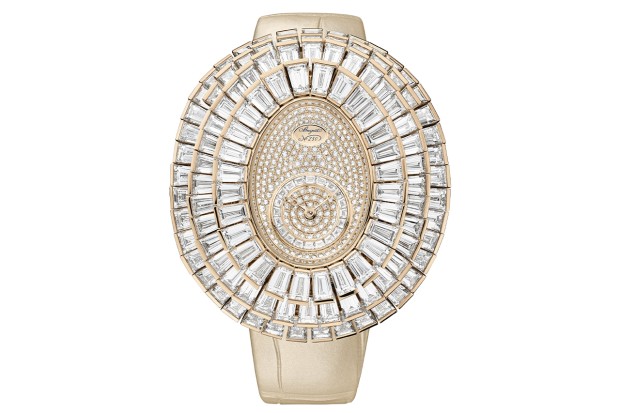
Honor to women with the house’s only specifically feminine collection: the Reine de Naples. The first model was created for Caroline Murat, Napoleon’s younger sister. Ordered in 1810, delivered in 1812, the original piece has disappeared… but it gave birth to a lineage that has become mythical. In the anniversary year, Breguet does not just celebrate: it reinvents.
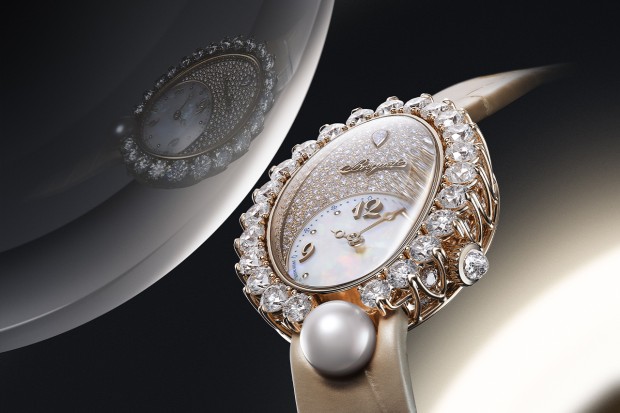
In 2025, two new High Jewelry models are unveiled: Crazy Flowers and Perles Impériales. It is difficult to be exhaustive as the details abound: mobile baguette diamonds for one, Akoya pearl and snow setting for the other. Two sumptuous interpretations, two jewelry personalities, the same level of intensity. At the heart of these creations, caliber 586/1 offers 38 hours of power reserve: the discreet yet essential mechanical signature.
The watchmaking of tomorrow
On the men’s collections side, 2025 is equally spectacular. After the Classique Souscription 2025, awarded the Aiguille d’Or at the GPHG, Breguet follows with iconic pieces: Classique Régulateur à Pivot Magnétique 7225, Marine Hora Mundi 5555, Classique Répétition Minutes 7365, Classique Grande Sonnerie Métiers d’Art 1905, and more recently, L’Expérimentale 1. The latter opens a new chapter: a line entirely dedicated to cutting-edge research, an open-air laboratory where the boldest ideas move from concept to wrist. Proof that innovation has been in Breguet’s DNA for 250 years. But beyond the technique, it is the visionary spirit of the Maison that endures: its artisans who dream, who shape, and who, tomorrow, will transform each watch into a timeless masterpiece.

L’Expérimentale 1, featuring the very first tourbillon with a high-frequency (10 Hz) magnetic escapement and constant force transmitted to the balance.


On June 26, 1801, Abraham-Louis Breguet obtained a patent from the competent authority for a new type of regulator called the “tourbillon”.

Filing of the constant-force escapement patent, 1798.