
In early 2022, Leica made an impressive debut into the world of watchmaking with the release of the ZM 1 and ZM 2. Known for its precision in optics and photography, the German brand turned its attention to time, crafting a pair of watches that immediately garnered praise for their minimalist design and functional innovation.
“ZM,” short for Zeitmesser – a German term for time measuring instrument – has not just been another product in the company’s portfolio; it has been a bold venture into the intersection of design, engineering and heritage.
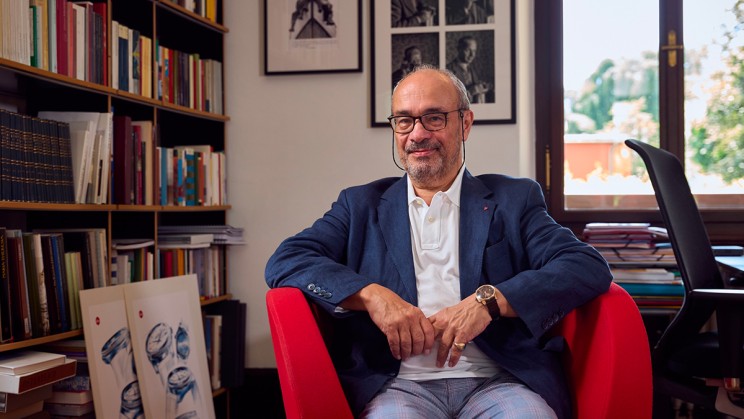
The decision for Leica producing its own watches wasn’t taken spontaneously. The seeds had been planted years earlier, as Dr Andreas Kaufmann, Chairman of Leica’s Supervisory Board, explains: “The trigger was this [collaborative] watch that we made from 2013 to 2014 with Valbray, a small atelier in Geneva. This watch led us to say: ‘We have to do it ourselves.’”
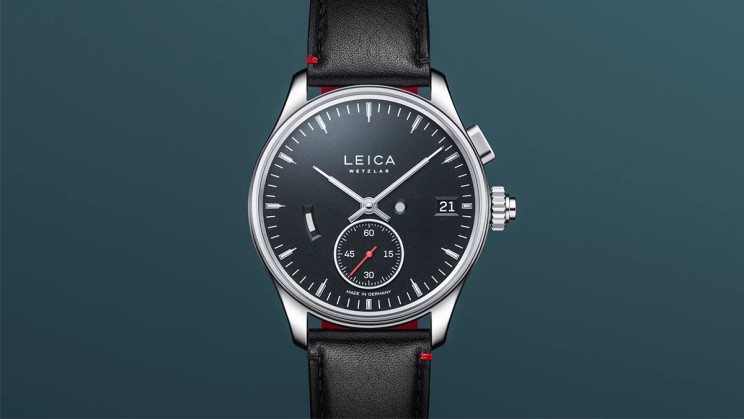
From that moment, the vision was clear: Leica would design and build a timepiece that would be as meticulously crafted as its cameras.
Assembling a Dream Team
Leica’s journey into horology began with the assembly of a dream team that included its longtime designer Achim Heine and the late Reinhard Meis, former chief product developer at A. Lange & Söhne. Swiss watchmaker and engineer Andreas Strehler was also brought on board to help develop Meis’ ideas, while Markus Lehmann – of Black Forest-based precision mechanics manufacture Lehmann Präzision – played a crucial role in bringing the final “Made in Germany” watches to life.
As Kaufmann reflects: “Various people came together and this resulted in the ZM 1 and ZM 2. With Lehmann Präzision and Andreas Strehler, we covered a few more themes based on the motto ‘German Engineering’.”
Designing Leica’s First Watch
Achim Heine, the designer behind many of Leica’s celebrated cameras, took on the considerable task of designing the brand’s first wristwatch. “Andreas Kaufmann asked me whether I could imagine developing a basic design for the first models. Of course, I found this extremely interesting. On the other hand, it was clearly a huge responsibility!” Heine says.
But it wasn’t just about creating another watch – it had to be a Leica watch, one that spoke the same visual language as the brand’s cameras without mimicking them directly.
“Leica’s history is rich in various design languages,” Heine explains. “The question was: based on this strong Leica language – which is not so much a design language but rather an engineering language – how can we succeed in making watches?”
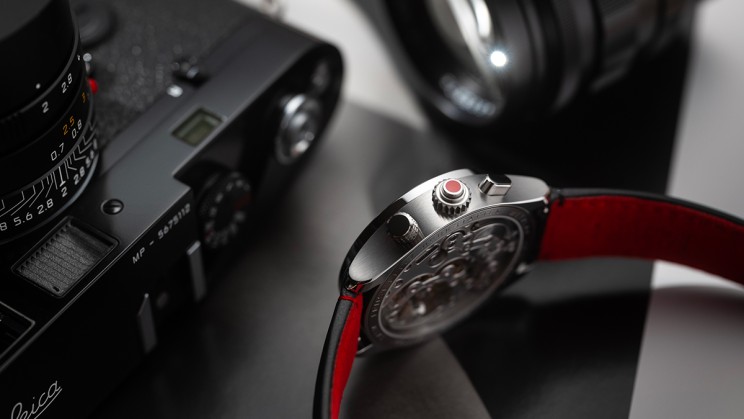
Heine’s solution was to avoid direct imitation of the camera design. He says: “Like the camera, the watch should be an instrument to a certain degree with a simple, modular design language that is perfectly executed.”
Heine focused on two levels: functionality and design. On the functional side, he elaborated its stop-seconds push-crown system that with a simple press resets the small seconds hand to zero while activating a red circular indicator on the dial to show the watch is in time-setting mode.
Heine describes it as having “many parallels to the classic camera. Pushing the shutter is the same movement as pushing the crown.”
Precision Production
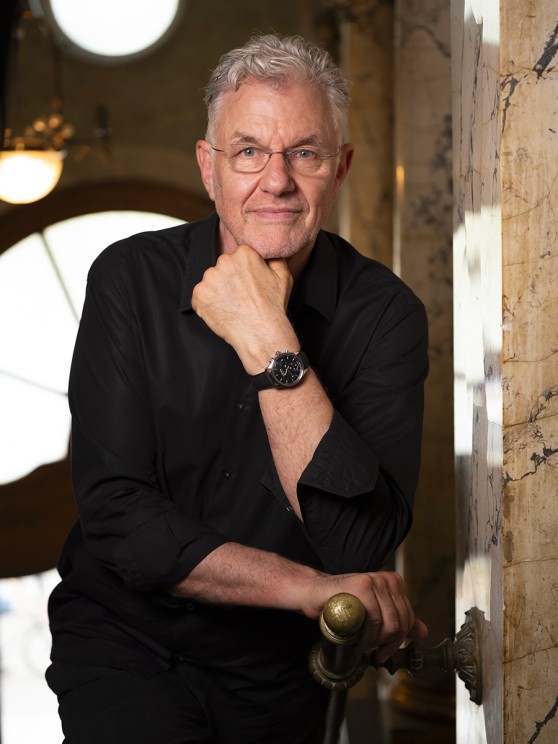
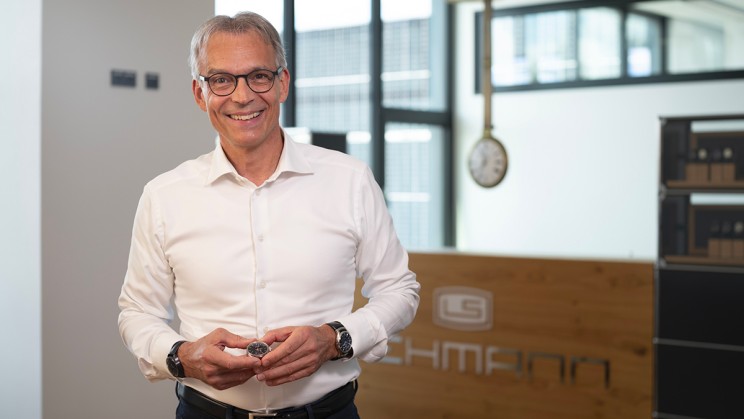
When it came to the production, Leica partnered with Lehmann Präzision. As Managing Director Markus Lehmann notes: “We made sure to put as much so-called DNA from the camera into the watch.”
Besides the patented push-crown, the 60-hour power reserve indicator was inspired by a camera aperture, while the gears and ratchet wheel of the resulting – and fine-looking – manually-wound LH-01 and LH-02 calibres resemble the architecture of Leitz Park, Leica’s headquarters in Wetzlar.
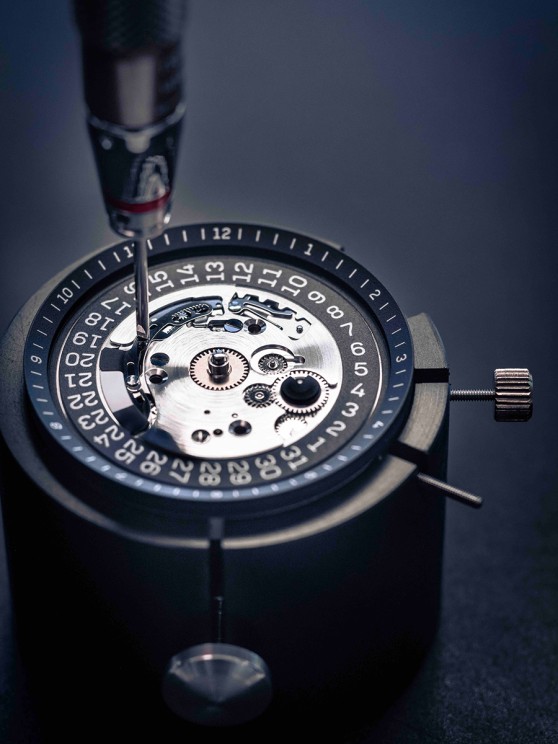
Lehmann emphasises the intricacies involved: “For this watch, we have more than 220 parts in it. There are parts that have a diameter of perhaps 0.4 mm and a length of 0.8 mm. You can almost not see them with the naked eye. All of these parts have to be assembled and work together. You have a tolerance of +/- a hundredth of a millimetre. We often have to work within a thousandth of a millimetre to ensure that this complex watch works.”
He adds: “We produce almost all of the parts ourselves. This is an advantage, but it can also be exhausting!”
Fusion of Form and Function
The final product is a reflection of the collaborative genius involved. The ZM 1 also features a quick-set date pusher at 2 o’clock, while the ZM 2 has the added dimension of a 12-hour internal bezel for tracking a second time zone, set using a pull-out GMT crown at 4 o’clock. The latter is synchronised with a day/night display that sits next to the mode indicator.
Kaufmann says: “One of the simplest yet not quite so simple things is the pusher for the date. What bothered us in many movements was that adjusting the date via the crown was hard to understand. We solved this very simply. And simple engineering solutions are what Leica stands for.”
Indeed, the 41mm watches, while technically complex, remain functionally simple – true to Leica’s philosophy of focusing on Das Wesentliche – the basics, the essentials or the essence. Heine emphasises the importance of this user-friendly ethos, saying: “We focused on the essential: simplicity, minimalism and relatability.”
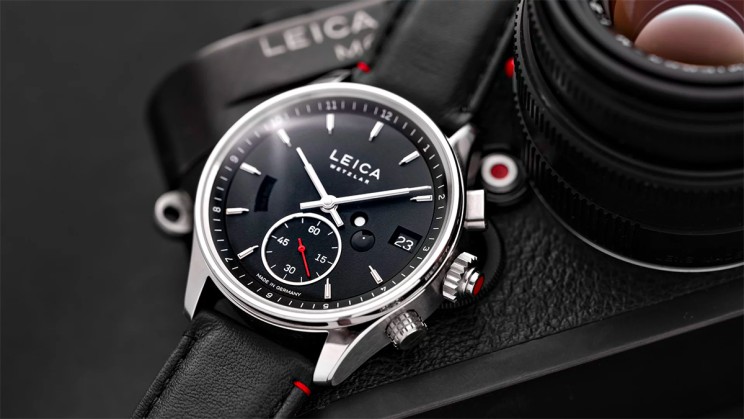
The Leica ZM 1 and ZM 2 may have had their roots in camera design, but they have managed to stand out as timepieces in their own right. As Kaufmann points out: “For me personally, with the ZM 1 and ZM 2, when I look at them, I say to myself: ‘Yes, it’s a Leica watch.’ Especially the proportions: we fought a year and a half about proportions, about a tenth of a millimetre, until we said: ‘That’s right, that’s the Leica proportion.'”
A New Adventure in Leica’s Story
The ZM 1 and ZM 2 are more than just watches; they represent a new era for Leica in its now 155-year history. An era where the brand’s values of craftsmanship, engineering and human endeavour are translated into horology.
As Lehmann notes: “This watch was not only built with Leica DNA; I put my heart and soul into it. I was there from the first second, from the first brushstroke to the last screw.”
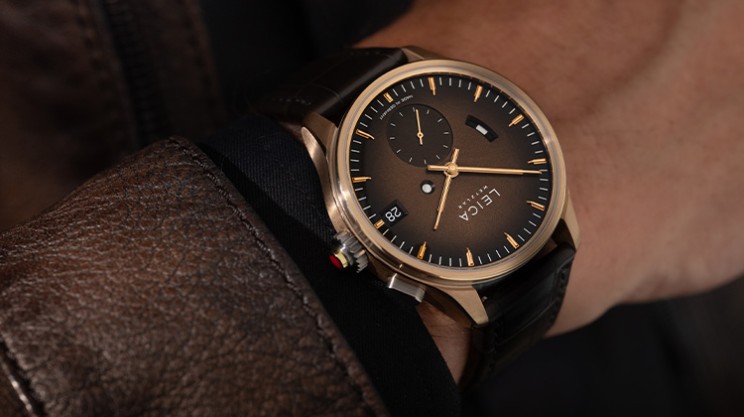
With the success of these timepieces and the launch of further models, including the all-black Monochrom LM 1 and LM 2 and red gold LM 1 – plus the introduction of a second collection, the LM 11 – it’s clear that Leica’s foray into watchmaking is more than a passing experiment; it’s a commitment to excellence in a new domain.
For more information, visit the Leica website.