
Almost no one knows Blanche Châtelain Degoumois. And yet, without her and the case-polishing workshop she founded in 1936, there probably would never have been a J12. The artisan is, in fact, better known through her sons, who took over the business after the war in 1947. Their names: Georges and Francis Chatelain. Today, they are better known by their abbreviated surname, G&F Chatelain. For 40 years, it was one of the main suppliers to the watchmaking industry. And it was another family, the Wertheimers—also the owners of Chanel—who acquired them in 1993.
Full Ceramic
The house on rue Cambon had big ambitions for its new entity. After acquiring the Chatelain workshop, Chanel launched the J12 in the year 2000. The piece, entirely made of ceramic, was a resounding success. Chanel then decided to steer G&F Chatelain toward the construction of these unprecedented cases, providing it with a dedicated 8,000-square-meter site. Gradually, it became a ceramic specialist. All the pieces of the puzzle fell into place: creative impetus in Paris, Swiss Made know-how in La Chaux-de-Fonds for manufacturing the J12 watches.
Their uniqueness lies in their refusal to compromise. Until the J12, watchmaking used ceramic mainly for bezels. Why? Because the bezel is one of the most exposed components, and ceramic is almost unbreakable and scratch-resistant. But Chanel pushed the concept further by building almost the entire J12 in ceramic: case, bezel, and bracelet.

Ceramic in 6 Steps
Timeless
Certainly, ceramic use was already present in watchmaking. The first flexible ceramic bracelets were imagined by Rado in 1986. Their first entirely ceramic watch, the Ceramica, dates back to 1990. But Chanel, in 2000, arrived with a different proposal. The J12 was unisex. Initially available in just two colors, black (2000) and then white (2003). Above all, its design was timeless. While Rado’s pieces carried the clear style of the 1990s, the J12, designed in 2000, has crossed its first quarter-century without major modifications. Beautiful, simple, fluid, the J12 is a true wristwatch, an accessory, a jewel, a Haute Couture creation. Time seems to have no hold over it.
Earth, air, water, and fire all play a role in the development of its watchmaking ceramic. Earth, for the natural minerals that make up the zirconium dioxide and yttrium “powder.” Water, to bind, form, and filter these components. Air, to dry them and give them structure. And finally, fire, to fuse them and bring to the material the strength and beauty that have made the reputation of the J12 cases and bracelets.

Beyond Black & White
Ten years after the black and white J12s, Chanel invented the perfect middle ground: between black and white now lies gray. This was the purpose of the J12 Chromatic. In 2011, it ushered in the era of titanium ceramic. For this, Chanel developed polishing techniques inspired by processes used for sapphire, carried out with diamond powder. Beyond the J12, the Code Coco also entered the scene in 2018, likewise crafted in ceramic.
The latest step in this journey: the J12 in blue ceramic. The piece appeared at Watches and Wonders 2025, as a tribute to its first quarter-century. In itself, blue ceramic is nothing revolutionary—Hublot, in the meantime, has developed a vast chromatic palette of ceramics. But Chanel’s possesses the astonishing ability to change shade depending on the lighting. The J12 blue can literally shift from cloud blue to midnight blue depending on the incidence of light. A rare property, called metamerism, that must be seen to be believed. As Arnaud Chastaingt, Director of the House’s Watch Creation Studio, simply sums it up: “In 25 years, Chanel has elevated ceramic to the rank of a precious material.”

Did You Know?
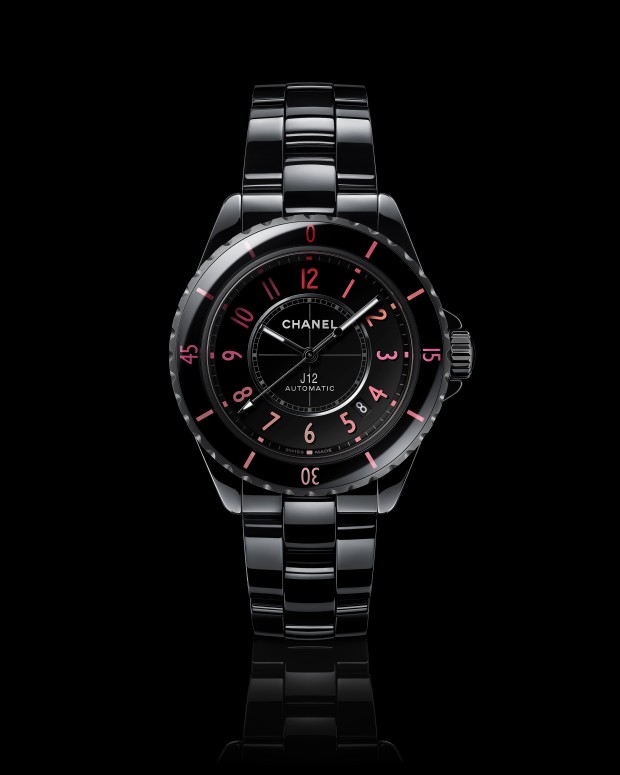
The J12 in 4 Movements
The first manufacture movement designed by Chanel dates back to 2016. It initially equipped the Monsieur model. The J12, meanwhile, benefits from Chanel’s fourth manufacture movement, the Caliber 12.1 (derived from the Tudor MT5600 movement), following the Caliber 1 of the Monsieur, the Caliber 2 of the Première Camélia Skeleton, and the Caliber 3 of the BOY.FRIEND Skeleton. Today, the Caliber 12.2 is chronometer-certified by the COSC (Official Swiss Chronometer Testing Institute) and offers a power reserve of around 50 hours. Miniaturized, it can be housed in a 33 mm case.