
While it can sometimes be difficult to imagine, now resplendent in its orange-toned glory as a multi-threat luxury retailer, Hermès is, at its heart, a high-end harness-maker. Peel away the sumptuous Avalon blankets, delicate scarves and breathtakingly expensive fashions, and what underpins it all? The scent of horseflesh, saddle soap and stables, dating back to 1837. Beyond its ultra-curated boutiques and the notorious ‘quota bags’, equestrian and outdoor lifestyle remain the centre of a Maison that knows itself – but how does that translate to watchmaking?
Horology is no stranger to the beat of galloping hooves. From Jaeger-LeCoultre’s Reverso and Piaget’s Polo to Rolex and Longines in international show jumping – and Cartier, Richard Mille and Hublot supporting polo events worldwide – watchmaking has long crossed paths with equestrianism. But Hermès’s approach is much more intimate: less pomp and pageantry, more shared flasks in the tack room. And the Cut is a masterclass in how equine spirit can be transmitted in the most subtle of ways.

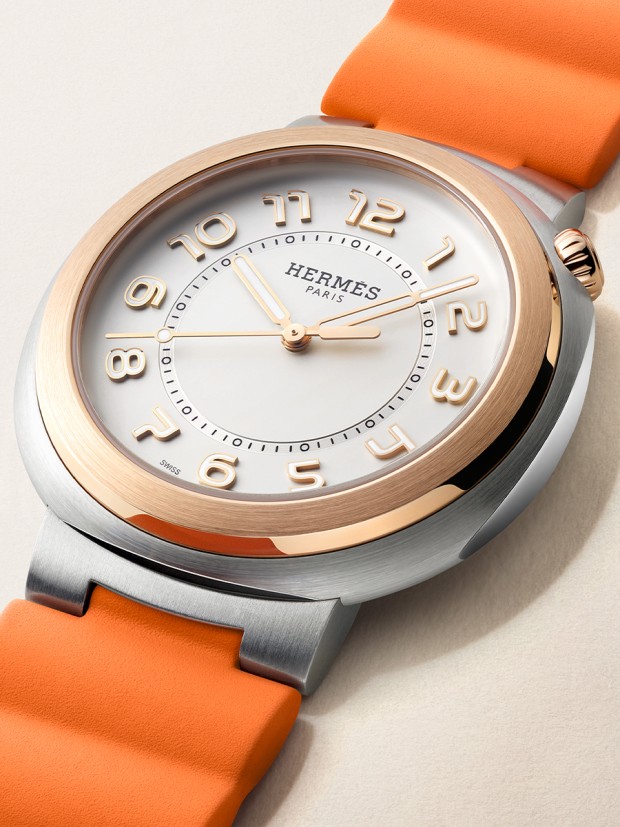
Launched in 2024 as a versatile, sporty-chic and unisex timepiece at a demure 36mm diameter, its tactile profile and slickly interchangeable straps made it a hit. And its latest edition, with a buoyantly blue-toned dial and tonal strap, continues its youthful appeal. A refinement of the bold 42mm H08, the case speaks a language of motion – taut but not sharp – with a flow that feels natural on the wrist. Hermès has a particular way with rounded forms: soft yet purposeful, like the smooth tension of a leather strap pulled through a buckle. The Cut’s asymmetric bezel captures that gesture exactly, an oblique ‘slice’ reminiscent of the angled finishing of saddle leather or the slight twist of a rein under load. It’s a playful moment of disruption that prevents the watch from becoming just another exercise in minimalism.
Hermès has always insisted that comfort is a form of luxury, a belief rooted in its equestrian origins, where ergonomics and durability are non-negotiable. The Cut sits low, wears light and feels more like a piece of jewelry engineered for agility than a traditional sport watch. Versatility is another of its strengths. If presented on leather, the Cut would lean into Hermès’s heritage. But on its colour-saturated rubber? It becomes modern and athletic. On steel, crisp and architectural. The interchangeable design encourages personal expression, a hallmark of Hermès across categories. Notably, it avoids overt gendering, its proportions speaking a universal language of refinement and ease.

Even the most design-led Hermès watches increasingly rest on solid mechanical foundations. The original Cut is powered by an automatic movement made for Hermès by Vaucher Manufacture Fleurier, chosen for reliability and clarity rather than technical bravado. Hermès understands that a watch built for movement doesn’t need to shout. And an evolution of the model was released in 2025, with the 39mm rose gold Le Temps Suspendu edition – a complication first seen in the Arceau collection in 2011 – which allows the wearer to ‘pause’ the watch’s time-telling by flicking the hour and minute hands to a slim V either side of 12 o’ clock at the push of a button.
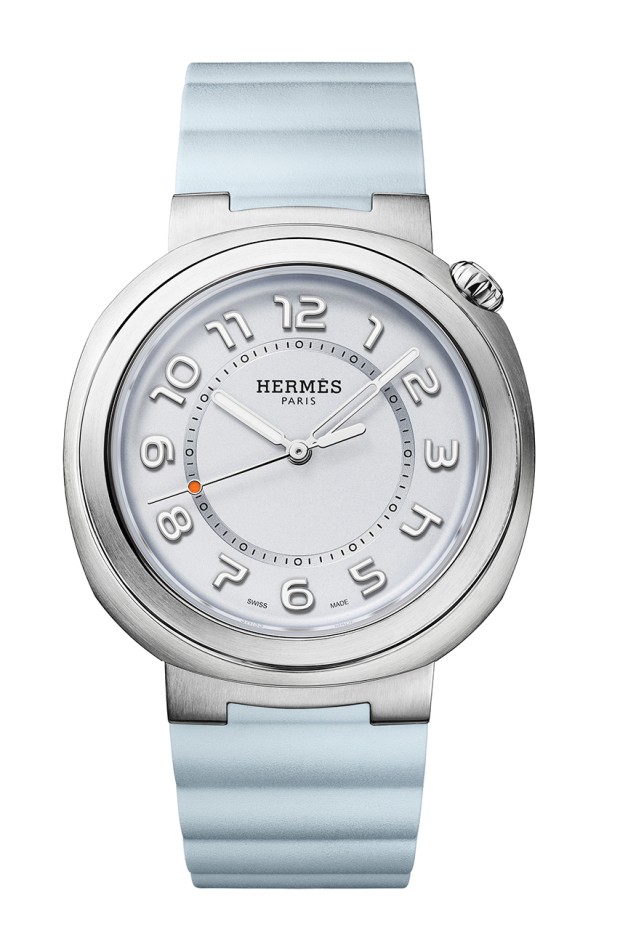
Placed alongside the Arceau, Cape Cod and H08, the Cut feels like the next chapter in Hermès horology. Each interprets the Maison’s sporting DNA differently, and the Cut adds a clean, confident and slightly mischievous modernity – especially with its newly launched, blue-tinged dial.

Hermès is a house defined by motion, and the Cut is the latest expression of that lineage: a sculptural everyday watch shaped by the equestrian spirit that has moulded the Maison’s identity. Design, not complication, creates icons – and with the Cut, Hermès romps home once more.