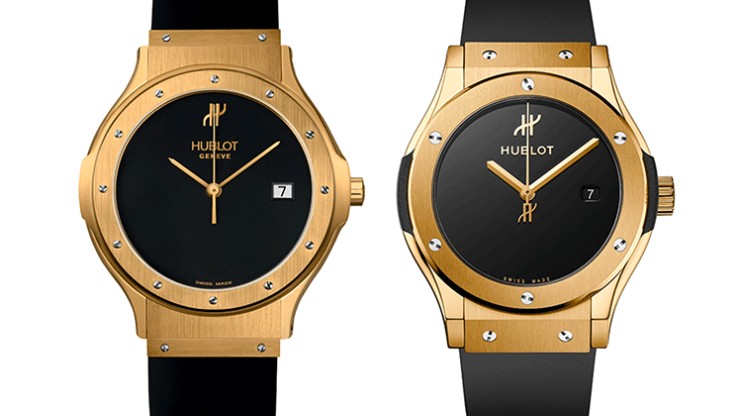
A watch that will withstand the test of time, that will become the prized possession of successive generations, must demonstrate three qualities: simplicity, functionality and innovation. This is something the history of modern watchmaking has repeatedly shown, starting with the creation, in 1904, of the first wristwatch, the Santos, designed by Louis Cartier for his friend and pioneer Alberto Santos-Dumont. Perfectly legible, it is the epitome of refinement, but also revolutionary as it allowed the aviator to check the time while keeping his hands firmly on the controls of his plane. Over a century later, aircraft fly at supersonic speed and the Santos is still one of Cartier’s most enduring designs.
A few years later, in January 1927 to be exact, Rolex founder Hans Wilsdorf addressed an audience of retailers. “Gentlemen,” he told them, “we make the best wristwatch in the world.” He was referring to the Oyster – nothing less than the first ever waterproof and dustproof wristwatch. Launched a few months earlier, the Oyster was “the most important invention” of its day and is now second only to the Apple Watch in terms of global sales.

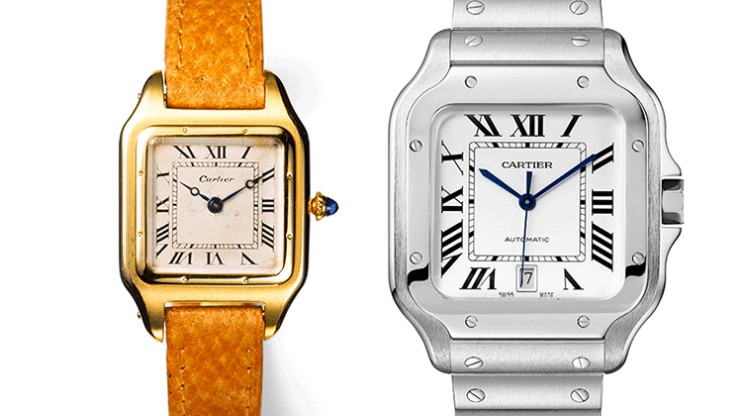
Another demonstration of quintessential watch design followed in 1931, with the introduction of the Reverso by Jaeger-LeCoultre. Inspired by the Art Deco movement, its rectangular case pivots so as to protect the dial. This construction of a case that slides in a cradle and can be turned over was a marvel of engineering. A legend was born, its remarkable longevity matched only by its indisputable modernity.
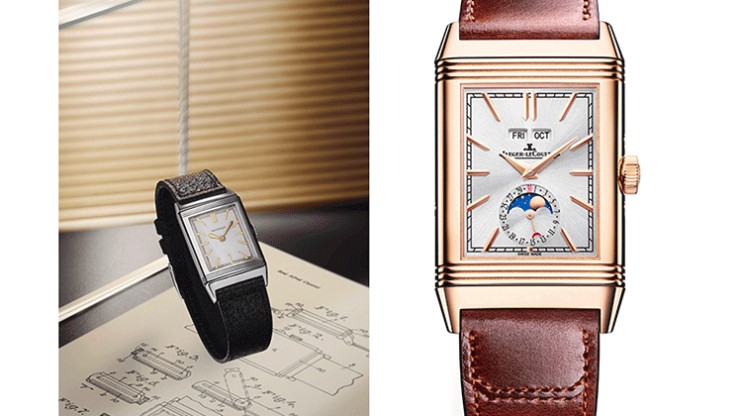
The first ripples of Seventies extravagance descended on Planet Watch as early as 1968, courtesy of one of its most venerable representatives, Patek Philippe. The Ellipse d’Or is neither round nor square but ovoid. Egg-shaped! This unusual geometry is inspired by the Golden Ratio, a divine proportion discovered by Ancient Greek mathematicians and the basis of some of humanity’s greatest architectural and artistic works. Not only does the Ellipse d’Or have the honour of being Patek Philippe’s second oldest collection, preceded by the Calatrava that saw daylight in 1932; it is one of the Manufacture’s most iconic designs and a cult model that has transcended fashion for more than five decades.
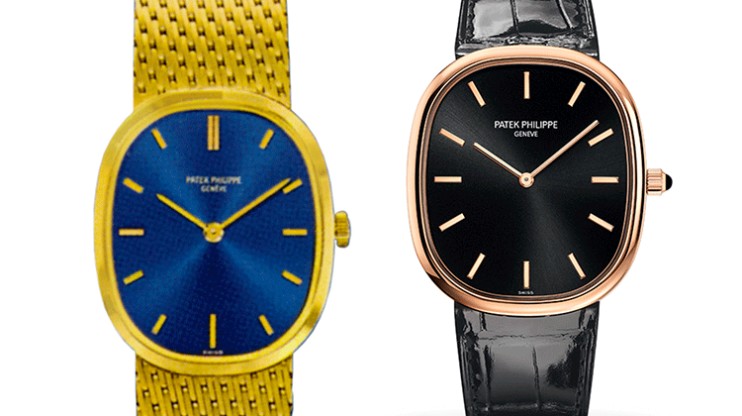
Just a year later, in 1969, a water-resistant square chronograph joined the collections at Heuer. The Monaco was designed by Jack Heuer, known for his love of minimalist design and an admirer of its leading proponents, Le Corbusier and Mies van der Rohe. To describe the Monaco as recognisable would be an understatement. It is unique. It too broke the mould of watch design. Water-resistant despite its angular case, it gives precedence to functionality while the dial layout is a lesson in legibility. With such a winning formula, the Monaco has earned classic status and is still pole position among TAG Heuer’s collections.

Audemars Piguet is another brand to have embraced Seventies exuberance. In 1972 it gave carte blanche to Gérald Genta, who responded with a design and a concept that left much of the industry agog: a steel watch priced at more than a gold watch, equally at home on a sports field as at a gala dinner, and octagonal. The seminal luxury sports watch, the Royal Oak may have divided opinion at the time of its launch, it is now an icon that last year celebrated 50 years of success.

Channelling a classic vibe does not mean slavishly copying the past, as Hublot proved with the launch of the Classic Fusion Original, a reissue of its 1980 debut watch. The new releases capture an Eighties spirit with a case that is identical to that of the original, a rubber strap and a black dial. So far, so same? Not at all. Gold is joined by titanium and ceramic while movements trade quartz for mechanical automatic. Simplicity, functionality and innovation: need we say more?