
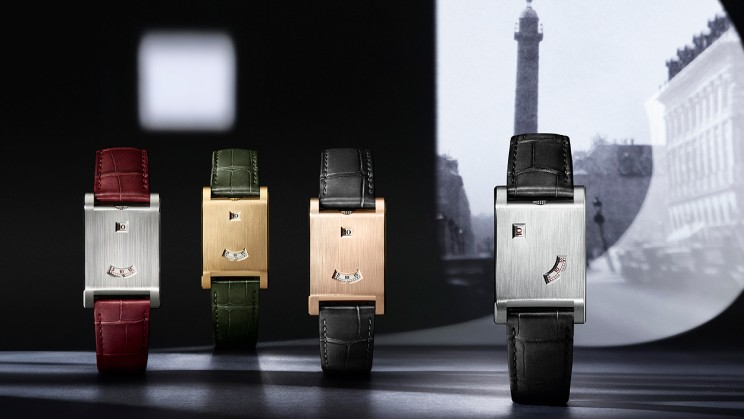
This iconic watch, unveiled this spring, is distinguished by its mechanical digital display with jumping hours and dragging minutes visible through two apertures. Cartier offers four new variations: yellow gold, pink gold, and platinum, which remain faithful to the original design, and a limited edition of 200 pieces in platinum, featuring a diagonal arrangement of the apertures. All are powered by the manual 9755 MC caliber, derived from the Piaget 430P, and have a crown positioned at 12 o'clock.
Here, we address this piece from a technical angle, focusing particularly on the functioning of the jumping hour.
How does it jump, exactly?
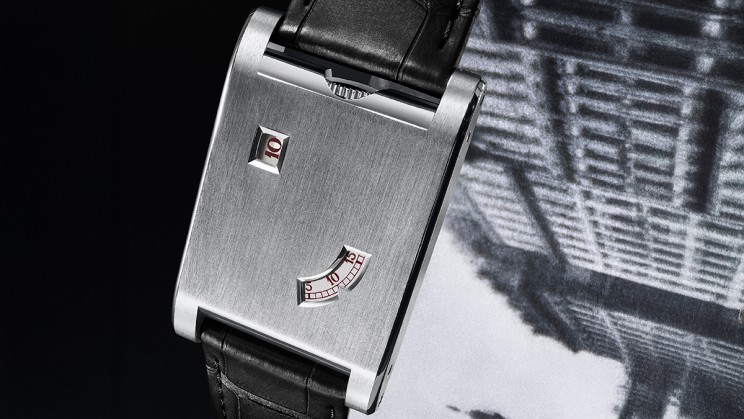
In the Tank à Guichets, traditional hands give way to numbered discs, visible only through small openings in the dial. The hour disc works like a calendar wheel, revealing each number sharply and instantaneously. This type of display relies on a so-called jumping mechanism: the discs do not turn continuously but make a sudden jump at the end of each hour.
This sudden movement is made possible by a star wheel maintained in position by a ratchet. When a sufficient amount of energy has been accumulated, a lever releases the wheel abruptly, thus triggering the jump of the disc. This ingenious system transforms a fluid motion into a perfectly controlled jerky display.
Continuous versus Discrete
In physics, a quantity is said to be continuous when it evolves without interruption: one could draw its evolution on a sheet without lifting the pencil. In contrast, a discrete quantity is characterized by successive steps or jumps, like steps on a staircase.
This logic exactly distinguishes a classic display watch from a jumping hour mechanism. On a conventional watch, the hands glide constantly, reflecting a smooth progression of time. In a watch with apertures, nothing happens... until the precise moment when everything changes. The hour jumps in one block, in a fraction of a second, every 60 minutes. This constitutes a good example of a discrete energy release system, where the change pace is much slower but far more intense than in traditional movements.
Accumulating to Better Leap
The heart of the mechanism rests on the idea of deferred energy accumulation. A star wheel is coupled with a tension spring, which charges slowly over the current hour. The barrel communicates its energy to the tension spring, which is gradually compressed. Then, at the precise moment of the hour change, all the stored energy is released at once to rotate the disc.
This jump requires a much higher torque than that needed to drive a simple hand: the disc is heavier, wider, and thus offers significantly more inertia. This is why a classic spiral spring, used in the traditional manner, would not suffice. It would be impossible for it to deliver such power so suddenly. Hence the necessity for an extended energy accumulation phase. The management of much greater energy in an extremely short time requires high-level mechanical mastery, both in design and regulation. The sharpness, speed, and precision of the jump then become markers of horological excellence.
Cycle of Energy Accumulation and Release in a Jumping Display
The cycle of energy accumulation and regulation is summarized in the graph below:
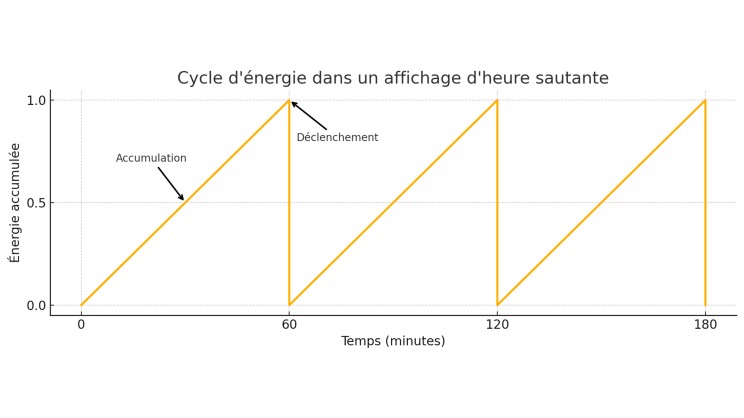
1-Accumulation (0 to 59 minutes): the spring gradually tightens, storing energy.
2-Release (minute 60): the cam or lever triggers, and all the energy is instantly transferred to rotate the disc.
3-Start of a new cycle.
The principle of the jumping hour offers another reading of time: a discrete time, made up of sharp breaks, based on the accumulation and sudden release of energy. This mechanism demands extreme precision in the management of forces, far superior to that of continuous movement. Between controlled tension and instantaneous jump, it reveals a form of watchmaking where technical complexity is hidden behind apparent simplicity. The Tank à Guichets by Cartier offers a perfect expression of this.