
Born in 1925, the Duoplan by Jaeger-LeCoultre is among the rare category of calibers that have revolutionized watchmaking. An innovation both technical, aesthetic, and symbolic. A hundred years later, the maison chooses to celebrate it through the fourth capsule of its "The Collectibles" program by highlighting women's pieces. With awe, we discover ten rare and elegant pieces, ten faces of the same boldness that is as revolutionary as it is discreet. Welcome to the heart of the Duoplan.
"The Collectibles", a dive into the extraordinary heritage of Jaeger-LeCoultre
Launched in 2022, the "The Collectibles" program is not merely intended to fill showcases with meticulously selected vintage pieces. Far from a mere marketing operation, it represents a strong identity and museum approach from the most French of Swiss houses: reissuing its history and reviving 17 iconic watches from the "golden age" of watchmaking (1920–1970), chosen for their technical, stylistic, and symbolic relevance. Each piece offered for sale is authenticated and carefully restored in the manufacture's workshops by specialist watchmakers. The house's archives - sketches, period molds, original components - allow for faithful restoration. When a piece is missing, it is recreated identically. To preserve authenticity, aesthetic interventions are kept to a minimum: no dials replaced by reissues, no excessive polishing. The goal? To offer collectors timepieces as close as possible to their original state, with the patina that tells their story. Following the Memovox, Geophysic, Futurematic, and other Reverso, Jaeger-LeCoultre shines the spotlight of the fourth capsule of its "The Collectibles" program on women's watchmaking. A series of ten watches, all powered by Duoplan calibers, including the legendary Caliber 101, are highlighted. A first that makes sense in light of the 100th anniversary of this movement that redefined the rules of what is possible and equipped, in addition to the House's models, timepieces from the greatest watch houses.

The Duoplan: when miniaturization becomes a counter-current manifesto
To understand the importance of the Duoplan, one must return to its origins, in the context of the interwar period. Art Deco is at its peak, women are emancipating themselves in their attire, wearing dresses with dropped waists and wanting timepieces to match this newfound freedom without losing femininity. The desire of these ladies to wear small-sized wristwatches clashed with the traditional calibers of the time which, once reduced to the scale of a jewel, lost precision, robustness, and reliability. This is where Jaeger-LeCoultre responded with a major, brilliant, and radical innovation: not reducing the components to the extreme, but superposing them. The Duoplan was born: a two-level caliber - hence its name - allowing the essential components (balance wheel, barrel…) to be housed while remaining in an ultra-compact rectangular format that could fit into a small case. A technical feat that sacrifices nothing in terms of the precision or power reserve of the caliber. Patented from its creation, this Duoplan movement would be produced in several versions (calibers 5, 7, 9, and 101). The latter, launched in 1929, still holds the title of the smallest mechanical movement in the world - and remains, still to this day, in production. Its lightness, slimness, reliability... everything was designed to reconcile aesthetics, comfort, and performance. A functional miniaturization pushed to its peak well ahead of its time, which enabled, and still enables today, to show that women's watchmaking is both technical and avant-garde as well as ornamental, precious, and desirable.
Ten watches, ten expressions of the Duoplan
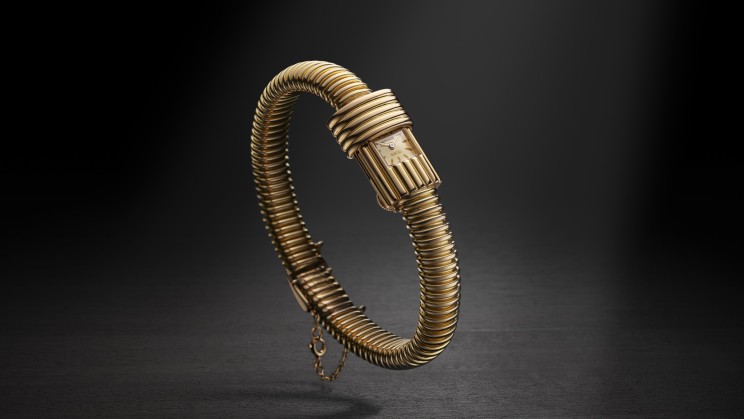
The ten models brought together in this capsule reflect the stylistic evolution of women's watchmaking through the decades, of which here are a few examples. The "Driver" (1930s) is a steel watch with a black dial with white hands and numerals, designed for drivers: its inclined case allowed the time to be read without taking one's eyes off the road. Functional above all, and already so modern. The "Tile" (1939) is particularly atypical with a convex glass evoking the roof tiles of Mediterranean houses, topped with a rectangular case and a dial oriented perpendicularly to the wrist. A particularly fascinating object due to its atypical design. Mounted on a large-link yellow gold bracelet, the "Chain" (circa 1941) illustrates the precious elegance of the creations of these years while maintaining a mechanical precision unusual for the time. The "Tubogas" secret watch (circa 1950) in yellow gold is characterized by its tubular bracelet with articulated vertical and horizontal ribs evoking the pipes used for gas transportation in architecture, notably. The last marvel we will present, a high jewelry piece dating from the 1960s which is a river bracelet in white gold, set with diamonds and sapphires, and whose dial conceals a secret watch equipped with caliber 101. A true horological jewel hidden under the sparkle of precious stones. From the geometric rigor of the 1930s to the softer, more precious lines of the 1950s, through enameled dials and chiseled cases, each watch tells a chapter of the history of style and technique.
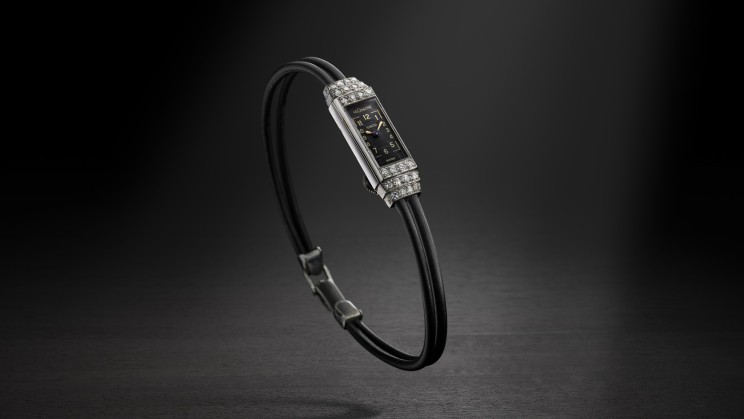
Each of these pieces embodies an era, a taste, a technical challenge. But all share the discreet signature of the Duoplan, sometimes even inscribed on the dial in superimposed letters, a typographic nod to its two-stage mechanical architecture. By resurrecting these ten watches, Jaeger-LeCoultre demonstrates part of its expertise, its history, and all its legitimacy in miniaturization as a field of innovation. As the house celebrates the centenary of the Duoplan, this "The Collectibles" capsule reminds us that a timepiece can combine performance, refinement, and boldness. And that some horological revolutions are written in reduced format, but with immense ambition!