Lange 1 Tourbillon: Arts and Crafts

Image
1815 Tourbillon 2025 © A. Lange & Söhne
Centuries-old techniques, contemporary innovation, superlative performance: A. Lange & Söhne’s rule of three is elevated by a comprehensive aesthetic language. Review.

While the Richard Lange Jumping Seconds variation unveiled at the Hampton Court Concours of Elegance in England still draws inspiration from the principles of purity and functionality inherited from Bauhaus, the 1815 Tourbillon echoes the refined lines of Art Deco and also Art Nouveau. A. Lange & Söhne orchestrates this encounter between aesthetics and mechanics by combining the sobriety of a clean design with the nobility of a rare craft: grand feu enamel. To this is added the precision of a tourbillon, the visionary invention of Abraham-Louis Breguet created more than two centuries ago, today a symbol of fine watchmaking and cherished by collectors.

Designed to offer contemporary technical innovations to classical watchmaking values, the 1815 collection has continued to expand with masterful pieces such as the 1815 Tourbillon, first presented in 2014. Its design responds to a delicate equation. How to find the ideal balance between the compact dimensions of its 39.5 mm case and ensuring optimal legibility? Drawing from the aesthetic movements of the early 20th century provides an answer. Then as now, modernity erases the boundaries between art and industry.

Three Distinctive Features

© A. Lange & Söhne

Precious Materials

As with many A. Lange & Söhne creations, 950 platinum and 750 pink gold naturally take pride of place on the wrist. However, another material takes center stage here: grand feu enamel, born of a complex process. Thirty layers of pigments, successively fired at temperatures exceeding 800°C, produce a dial in immaculate white or, this year, in jet black. Against these perfectly polished surfaces, the hour track stands out with intensity. This pure décor also serves as the refined setting for the one-minute tourbillon.
© A. Lange & Söhne

Tourbillon Caliber

The L102.1 caliber, which powers the 1815 Tourbillon, is composed of no fewer than 262 parts. Beyond their function, several are distinguished by the richness of their finishing. The seconds bridge, for instance, visible through the sapphire back, is adorned with hand-engraved floral arabesques inspired by Art Nouveau. More than decoration, this delicate motif embodies the artisanal excellence of the Saxon watchmakers.
© A. Lange & Söhne

Zero-Reset

Among its patents, the manufacture holds a system that makes it possible to stop the tourbillon balance wheel. The objective? To guarantee reset of the seconds hand for the most precise time setting possible. The 1815 Tourbillon incorporates this mechanism known as ZERO-RESET. Concretely, when the crown is pulled, the balance inside the cage halts and, at the same time, the seconds hand jumps back to its starting line, ready to resume its revolutions. The innovation thus fuses seamlessly with traditional métiers d’art.
Caliber L102.1, 21,600 vibrations per hour, 72-hour power reserve © A. Lange & Söhne

These aesthetic and technical choices, combined with production in limited editions, make the 1815 Tourbillon a prized piece for collectors. Their rarity and craftsmanship confirm the manufacture’s position at the pinnacle of German fine watchmaking. These timepieces are sought after as much for their mechanical excellence as for their patrimonial value.

“Why 30 layers of pigment for the enamel? To achieve perfection in imperfection!”
Anthony de Haas, Director of Product Development
© A. Lange & Söhne

This philosophy highlights the expression of human craftsmanship. Grand feu enamel, achieved through a process that is extremely difficult to master, is the most eloquent illustration. Each layer of pigment, carefully applied to the dial and fired between 800°C and 1,200°C, gives its surface unique depth and radiance. The powder metamorphoses into glass. Quasi-invisible irregularities recall the artisanal character of this technique and underscore the uniqueness of each piece. Far from constituting a defect, these nuances testify to the authenticity of the process.

Major Evolutions of the 1815 Tourbillon

1815 Tourbillon, boîtier en platine 39,5mm de diamètre, cadran émail grand feu © A. Lange & Söhne
1815 Tourbillon, platinum case 39.5 mm, grand feu enamel dial © A. Lange & Söhne

2014

The first version, unveiled at the Salon International de la Haute Horlogerie in Geneva, was limited to just 100 pieces. It combined a platinum case with a dial of great purity in white grand feu enamel. A non-limited pink gold variation entered the catalog.
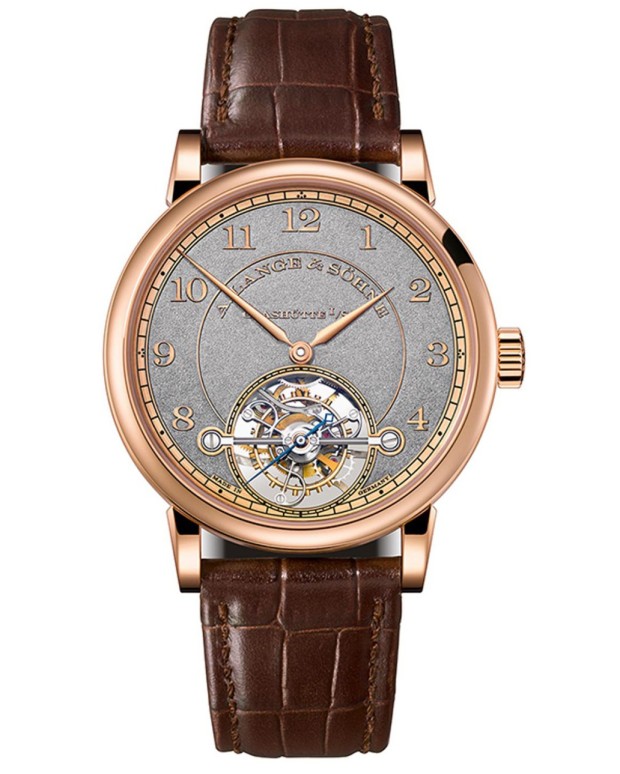
1815 Tourbillon Handwerkskunst © A. Lange & Söhne

2015

A. Lange & Söhne celebrated the bicentenary of Ferdinand Adolph Lange’s birth with a remarkable edition of the 1815 Tourbillon. The Handwerkskunst, produced in 30 pieces, was distinguished, among other things, by its rhodium-plated pink gold dial enhanced with tremblage finishing.
1815 Tourbillon 2025 © A. Lange & Söhne

2025

The 1815 Tourbillon now features a grey gold dial adorned with a brilliant black finish achieved through grand feu enamel. This series, limited to just 50 pieces, adopts the hour circle and railway-style minute track of the original model.
Featured brand
Logo A. Lange & Söhne