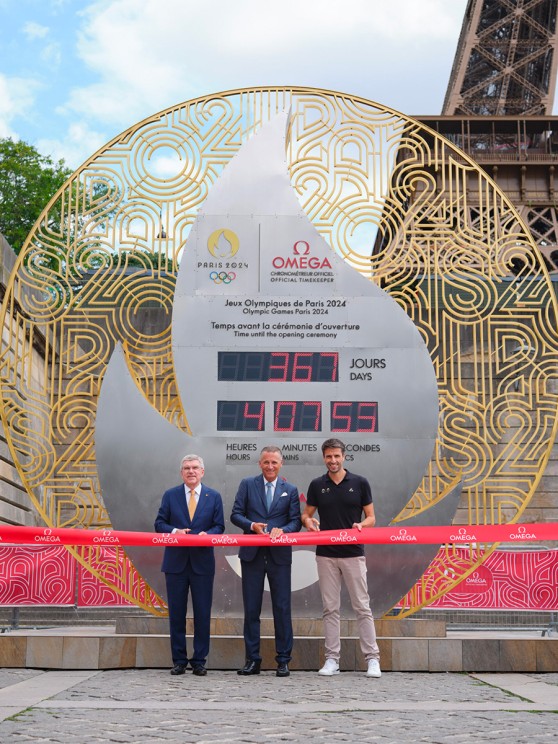
The partnership between Omega and the Olympic Games is so rich, dense and enduring that one might be tempted to measure it by current figures. Consider the 350 tonnes of timekeeping equipment, 1,450 people deployed on site and 200 km of cables and fibre optics – equivalent to the distance between Lausanne in Switzerland, where the International Olympic Committee is headquartered, and Lyon, France. But the real story lies elsewhere, hidden in the watchmaker’s archives.
30 chronographs that sealed the deal
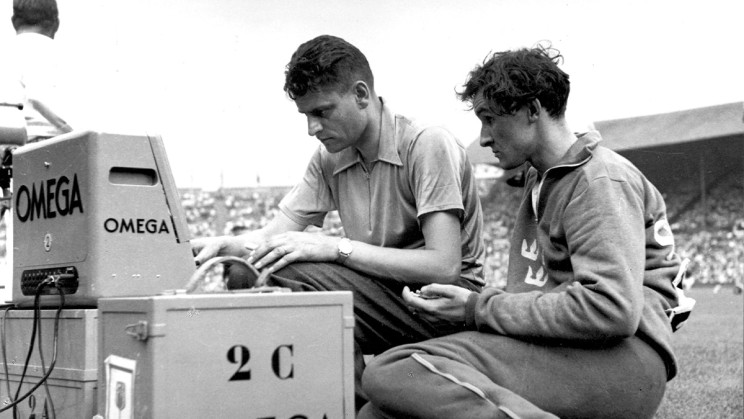
It’s from the archives we learn that 1932, when Omega entered the scene, was not the first year that Olympic timekeeping was carried out by a watchmaking firm. It was, however, the first time all official timekeeping was entrusted to a single brand. Omega’s commitment was pivotal: the Bienne-based company didn’t hesitate to send a representative to Los Angeles, armed with 30 chronographs to cover the 20 disciplines being staged (today there are 329).
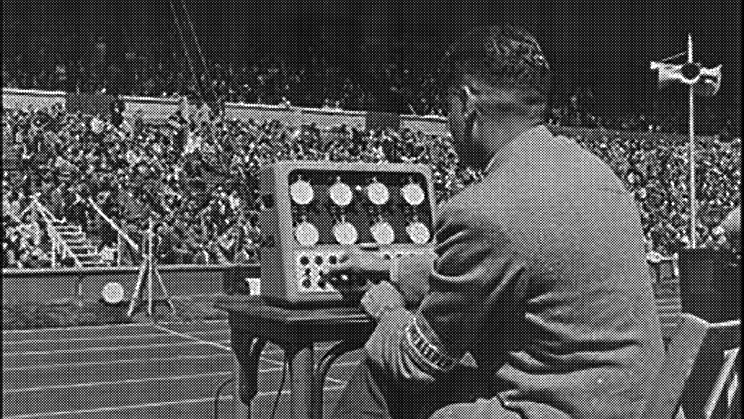
Interestingly, these weren’t the most precise instruments available. Heuer had already achieved 1/100th of a second accuracy. However, Omega was able to mass-produce reliable equipment with precision certificates, and Olympic requirements at that time were satisfied with 1/10th or even 1/5th of a second accuracy. The deal was sealed; the relationship was established. Four years later, 185 chronographs were shipped to the Berlin Olympics.
A new era
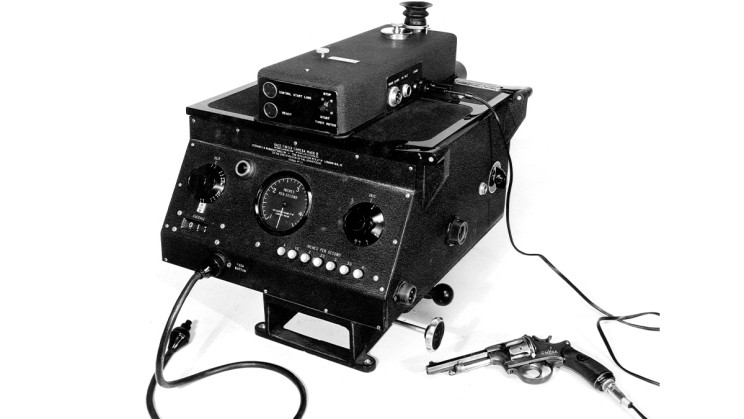
It’s a common misconception that electronic timekeeping emerged in the ‘60s and ’70s with the rise of quartz. In reality, it began much earlier: by 1948, the first finish-line photos were taken using photoelectric cells. This is what we know as the photo finish, delivered back then by an Omega device called the Magic Eye.
Progress continued in the 1950s with a practical revolution: semi-automatic timekeeping, triggered when an athlete crossed a beam (or touched a pad in swimming). This significant improvement eliminated human error, as the delay in pressing start/stop pushers could heavily influence final rankings – it takes 0.5 to 0.7 seconds for the human brain to translate a visual trigger into action. Gradually, the human factor was phased out. Television then sparked further innovation by Omega: in 1964 in Innsbruck, the Omegascope displayed real-time results during sports broadcasts via luminous figures embedded at the bottom of the television screen.
Creation of Swiss Timing
As timekeeping shifted towards electronics, a third entity of Omega’s parent company Swatch Group was set up in 1972 to specialise in this new mechanics-free discipline: Swiss Timing. Headquartered less than 20 km from Omega, it fulfils the three cardinal imperatives of sports timekeeping: recording times, managing data and rankings, and transmitting them. Swiss Timing remains at the heart of Olympic timekeeping today.
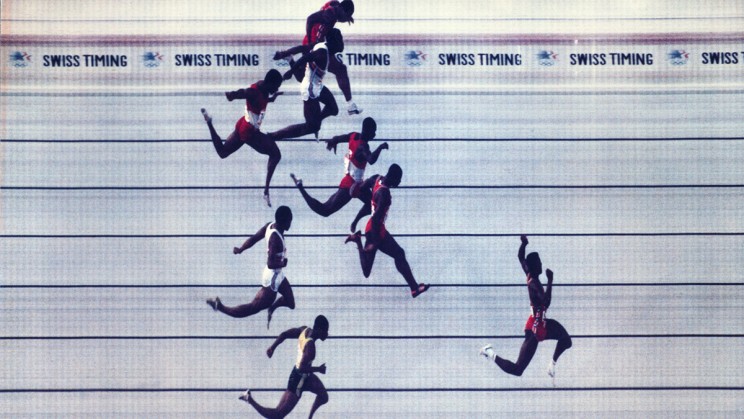
Millionth of a second
Since 2012, timekeeping sensors have been capable of measuring to the millionth of a second (10-6). Today, timekeeping goes beyond mere time measurement. The term now encompasses performance calculation, postural analysis and consideration of all the spatial variables that affect athletes. AI is also entering the fray to process the resulting big data.
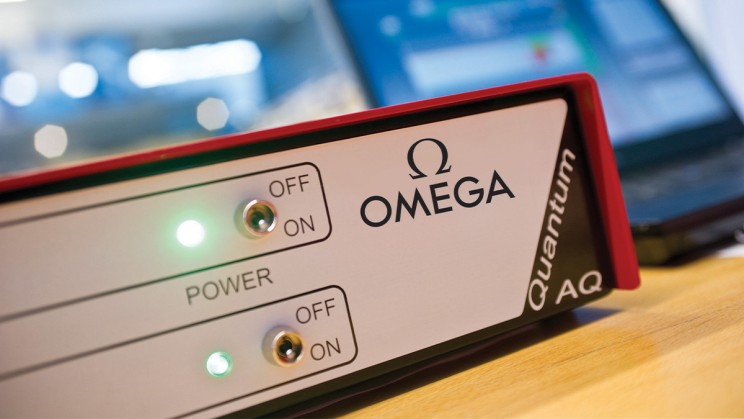
Omega’s Olympic sponsorship is currently guaranteed until the Brisbane Olympics in 2032 – a century after the 1932 Los Angeles Games that marked the Bienne manufacture’s Olympic debut. It’s undoubtedly the longest watchmaking-sport partnership, and perhaps even the longest sports sponsorship of all time.