It is impossible to use my kitchen table at the moment. Piles of UEFA Euro football cards are organized in piles. We have the English players, the Swiss, the French, all meticulously organized by country and jersey number, ready to be stuck into the competition’s album or swapped with friends. Any suggestion of moving them in favour of eating is met with extreme adolescent disdain.
As my son’s school has a “no swapsies” policy (apparently things got a bit out of hand during the last World Cup), I have been tasked with finding missing members of the UEFA Euro teams on Facebook. Each evening, I sit on the sofa, laptop open, and converse with random parents online, surrounded by envelopes of my son’s doubles to be swapped for new players. My husband was entertaining all of this until he saw my Excel table of players and has now expressed serious concern. “How is this different from you and your watches?” I retort, to which he says nothing, nonchalantly changing the channel on the television.
The whole thing has got me thinking about our love for collecting things, whether it is watches, cars, stamps, or art. What is it about collecting that brings us so much pleasure? If you dig deep into the psychoanalytic theory – which I won’t because I am not sure I really want to know – there are surely many different reasons behind our desire to collect things.
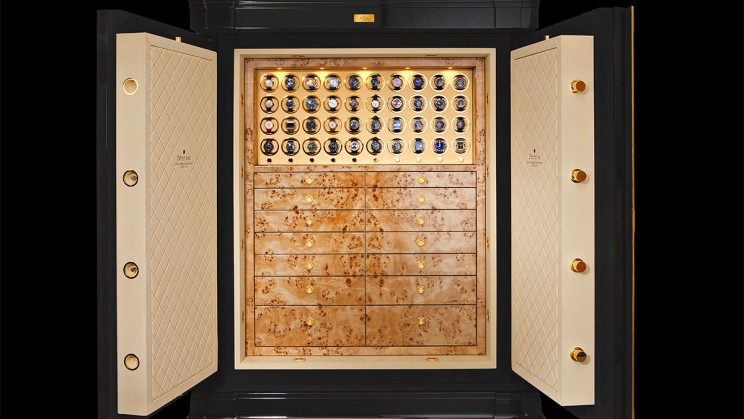
Famous psychiatrist and psychoanalyst Carl Jung traced collecting back to pre-agricultural times when humans survived by gathering and storing food. Those who were particularly good at it were more likely to survive, allowing them to pass on their superior genes to future generations. So accumulating is basically an evolutionary advantage. I like this theory and I think I am going to stick with it.
Joking aside, there are numerous advantages to collecting. Curiosity is one. The love for collecting things is often paired with a curiosity to learn and acquire knowledge about the collectible item. It is this curiosity that also leads us to like-minded people, promoting social connections that are important for our mental health. I am not sure my Facebook football parent groups really do this, but think of all the forums and groups that have sprung up around watchmaking that unite watch lovers the world over.

Collecting can also be a great stress reliever. Working on your collection can take your focus away from other things that are burdening you and provide an escape from your daily life. For watches, there is often an element of nostalgia too as we collect timekeepers from a bygone era, taking us back to times when life was less hectic.
We cannot talk about watch collecting without talking about investment either. Rare and valuable items usually grow in value over time, generating interesting returns and providing an extremely fun way of investing your disposable income.
But perhaps, most importantly, there is the thrill of the hunt. That missing piece in a collection, whether it is a rare Patek Philippe perpetual calendar, a Rolex chronograph, or an early F. P. Journe, the seeking and finding is at the heart of it all, making collecting extremely exciting and satisfying when you complete a set.
As for my UEFA Euro football set, I’m still desperately seeking Harry Kane…if anyone out there has one!