Are certain wrist “machines” that belong to “new Fine Watchmaking” not simply “bachelor” objects in which the timekeeping function is merely secondary to the insane machinery installed inside them?
One has the fantasies one can! And fantasies don’t just come from nowhere. They are rooted in the farthest recesses of our intimacy and the latter is composed as much of our own substance as of the fabric of the world around us, the society in which we grew up. Our fantasies are different depending on whether we live in the tropics or around Lake Geneva. Our obsessions, when they are based on fantasies, take on the shape of our souls and of our environment.
It is not for nothing that Swiss fantasies are often moulded by that which constitutes one of the strongest identities in the country and which occupies the thoughts of many of its inhabitants: the gear-trains, sets of levers and clutches of complex little machines called “watches”. Mechanics lie at the core of the subconscious of all Swiss natives.
One need only recall that one of Switzerland’s most famous artists is none other than Jean Tinguely, that prodigious mechanic of the useless and monumental assembler of gears and creaking mechanisms. Nor is he an isolated case, since one might also mention Bernard Luginbühl and his gigantic mechanical sculptures. Both were profoundly influenced by one particular “artist”, who did not in any way consider himself as such. His name was Heinrich-Anton Müller.
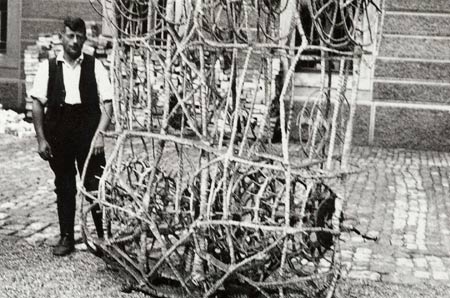
In 1903, when he was a winegrower in the Canton of Vaud, Müller invented and perfected a machine to “prune vines with the aim of grafting them”. He registered the patent but omitted to pay the dues. His idea was pinched and exploited by other people. Müller couldn’t bear it and totally “lost the plot” as we would say today. Prey to delusions of grandeur and to an intense persecution complex, he was admitted to Münsingen psychiatric hospital in the state of Bern. He was 37 years old and remained there to the end of his days in 1930.
Obsessed with the insurmountable problem of perpetual motion (somewhat as if a so-called “perpetual” calendar were simply one of the gears in a train with no beginning or end), he began to create huge machines made not of brass but of branches, cloths and wire that he lubricated with his own excrement. Complex structures composed of large gear-trains and differentials, stacked more than two metres high, which turn and drive each other in the void, producing nothing other than their own motion. What one might term “bachelor” machines, serving no particular function and celebrating only their own solitary state of mechanical intoxication.
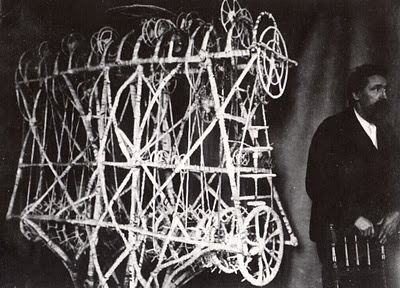
Sadly, there is nothing left of these machines. Some say that Müller destroyed them himself, others that the hospital management ordered that they were dismantled and their wooden parts burned.
But even though they have disappeared (his amazing drawings, which bear no trace of mechanics, have survived), the machines of this “naïve” artist have continued to command an extraordinary degree of fascination, to the point of influencing a portion of contemporary art. And perhaps a portion of contemporary watchmaking?
When one sees certain creations stemming from “new Fine Watchmaking”, one may well dream of Heinrich-Anton Müller’s legacy. Are not some of these “wrist machines” purely “bachelor” objects in which the timekeeping function is merely a subsidiary effect of the insane machinery? A machinery that might be viewed as the real issue at stake in such “fantasies”?
What would happen if one of our “new watchmakers” were in turn to lose the plot (which I naturally would not wish on anyone)? In Müller’s time, medication was neither as subtle nor powerful as that prescribed today. But the corollary effect is that being force-fed with neuroleptics virtually stifles any creative spirit. Today, it is definitely better that our watchmakers remain sane. Insanity has swapped sides.
Pierre Maillard is editor of EuropaStar magazine