GMT- Printemps-Eté 2010
Marie de Pimodan-Bugnon
Either deliberately or because of its traditionally cautious attitude, the industry that claims to be on the cutting edge of technology does not always keep pace with the new media. Little by little, in typically prudent fashion, hesitations are being swallowed up by the inevitable internet wave on which watch brands find themselves obliged to surf.
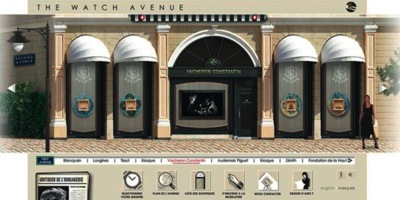
They took it slowly, with all the mistrust one would expect from longstanding traditions. The first decade of the new millennium witnessed watch brands taking an initially very conventional approach to the web by creating sites exclusively dedicated to corporate communication according to an extremely conventional pattern, organised around themes such as company history and product presentations. The evolution of information technologies, but also and above all of consumer attitudes and habits, has nonetheless advanced at a phenomenal speed, to the extent that many experts consider the watch industry – that is so keen to remain ahead of its time – to be lagging behind others. From its initial approach as a mere observer, the sector now appears to be playing catch-up and is more prepared to explore the virtual world – and particularly that of online sales.
Online sales: keen enthusiasts... and all the others
While online sales are now commonplace, the watch industry immediately showed a definite reluctance to adopt this increasingly widespread phenomenon. In the wake of a number of luxury brands that have succumbed to the siren song of e-shopping, a few rare watch brands have recently taken the step by offering net surfers the opportunity to buy the watch of their dreams using the shopping cart and online payment system. While prestigious brands such as Boucheron, Cartier, Hermès, TAG Heuer – and a few maverick figures such as Yvan Arpa and his new Black Belt watch product – are currently spearheading this trend that appears to be gaining momentum, others still categorically avoid online sales out of loyalty to their overall commercial and marketing strategy. The first major argument is that opening an online boutique might upset the traditional network of retailers and prove detrimental to the exclusive image that watch companies are determined to cultivate. The second reason often mentioned by those most reticent to engage in this path is that the very essence of the product does not lend itself to such a distribution channel.
How can one indeed hope to grasp all the technical complexity and the specific aesthetic characteristics of a watch based on a simple virtual picture accompanied by a short description? How can one convey the emotional watchmaking message to which the brands are so strongly attached? Even Maximilian Büsser, the visionary founder of MB&F and co-share-holder of the horlogerie-suisse.com website, would not take that particular risk. While he has certainly not missed out on the internet phenomenon, which he has used to great advantage to promote his ‘confidential' brand without setting aside a communication budget, including by running a blog that welcomes 1,000 visits a day, he refuses to even consider online sales: “People may see a picture of one of our watches, but when they discover it for real, they all say they didn't imagine it at all that way. That's the problem with a product that polarises opinion as strongly as ours.”
The image-damage risk
Some brands nonetheless seem prepared to move ahead in the area of online distribution by means of occasional one-off discounted sales operations on the web. In 2009, Baume & Mercier and de Grisogono undertook this type of operation on ventesprives.com. This move was doubtless motivated by the stock problems engendered by the economic crisis, but may be detrimental to the image of watchmaking. Isn't it contradictory to advocate exclusivity while selling products on a site that offers everything from vacuum cleaners to street-wear T-shirts or Euro Disney tickets? Currently surfing this wave while making the most of the excess stock issues facing a number of brands, Claudio Zampini, co-founder of TheTime.tv and now co-founder of the Zacosta company, has recently launched the 4selectedpeople.com website. The latter has been active for several weeks and organises private online watch sales at preferential rates on behalf of various partner brands. “We devote particular attention to appropriate presentation of the products and to showing them to the best advantage”, explains Claudio Zampini. “Customers are rigorously selected and the brand can customise its sale by choosing not only the products but also the markets on which it wishes to sell them.” In order to guarantee brands the exclusivity they demand, 4selectedpeople.com makes only one sale at a time. Access is not free and would-be members must be introduced by a sponsor.
According to a study conducted by the PPR group Strategies Division, annual online sales of luxury products are expected to reach 27 billion dollars in 2010. Does that mean internet has become a distribution channel that the watch industry can no longer afford to ignore? One can safely bet that the first year of this new decade should bring some answers to this question...
Protecting oneself on the net
The phenomenon is not exclusively positive – far from it. A favourite distribution channel for counterfeiters and home to all manner of industrial espionage networks, the net is full of weaknesses that ill-intentioned people can easily exploit, whether by pirating online sales websites, operating operating grey market sites, creating fake brand websites, or hacking into a company's computer system. To enhance protection from such practices, the Geneva-based Ilion Security company created in 2003 specialises in the fight against computer crime and the management of information system risks. “Tomorrow's war will be industrial and electronic; it will relate to information” points out Lorin Voutat, co-founder of the company with a customer portfolio mainly composed of banks. He regrets working only occasionally with watch-makers: “Unfortunately, not many of them has grasped the point of our services.” Only a handful of brands have expressed a desire to have a risk audit of their computer system or requested strategic surveillance (such as to monitor the use of their logo or of anything liable to compromise the brand).
In the same field of activity, WiSeKey, a company also based in Geneva, provides a platform for issuing digital certificates serving to authenticate a product, a service or a personal identity. This effective system named WiseAuthentic has been chosen by the Federation of the Swiss Watch Industry as one of the good practices to be implemented in the fight against counterfeits, and has been used in particular by Hublot since last year.