All this was to change when Jaquet shared with MB&F that he would like to do more. An initial conversation led to a brainstorming session that turned into the creation of a series of eight unique pieces illustrating the novels and short stories of 19th-century French author Jules Verne. The timepiece that was chosen was the Legacy Machine Split Escapement as it had the largest surface available for engraving and exploring Jules Verne’s literary works.
In his preliminary research for the series, Jaquet devoured close to 60 novels and short stories, selecting some of Jules Verne’s best-loved works such as Twenty Thousand Leagues Under the Sea but also some of the lesser-known stories such as The Adventures of Captain Hatteras. The resulting eight LM Split Escapement ‘Eddy Jaquet’ pieces were snapped up in a heartbeat, with the 'Around the World in Eighty Days' edition winning the GPHG’s Artistic Crafts Award in 2021. The last piece in the series was delivered to its owner in 2022, which naturally raised the question “What next?”
EIGHT NEW LITERARY INSPIRED CREATIONS
MB&F decided to continue with the literary inspiration for a second series and presented Eddy with a list of 15 famous novels in the young fiction category, of which he was to choose eight works. Rediscovering the pages of each story over the following weeks and months, he finally made his selection, as follows:
Robinson Crusoe by Daniel Defoe
The Three Musketeers by Alexandre Dumas
The Last of the Mohicans by James Fenimore Cooper
The Jungle Book by Rudyard Kipling
The Call of the Wild by Jack London
Moby Dick by Herman Melville
Treasure Island by Robert Louis Stevenson
Robin Hood (anonymous)
Like the first Jules Verne series, none of the illustrations imagined by Jaquet are drawn from existing works of art. They are entirely conceived by the artist after reading the source books and viewing other creative works, such as films and comic books.

Each engraving is an intricate tableau of scenes and key moments from the stories, synthesised in the imagination of Jaquet and expressly designed to be interpreted through the medium of the LM SE movement. Beyond the list of 15 initial novels for consideration, MB&F has always given Jaquet complete freedom in his creative process.
Not only did Jaquet have to exercise his creativity and engraving skill to the utmost, he was also obliged to practise his craft within the requirements and limitations set by the LM SE engine. The designated engraving space is the dial, which is in fact the baseplate of the movement; it presents a flat upper surface but is actually of variable thickness on its reverse side in order to accommodate the different movement components. Engraving the dial plate as if it was uniformly thick throughout was not possible — careful consideration had to be made as to where the thinner areas were, so as not to inadvertently puncture the artistic canvas if a particular section required deep-relief engraving.
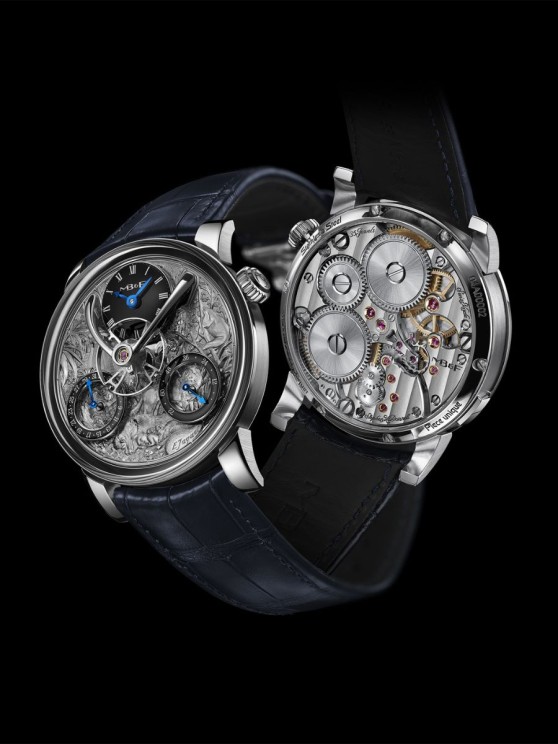
From the production side, several adjustments were made to the original LM Split Escapement as well, so as to maximise the available engraving space and allow Jaquet to exhibit his savoir-faire to the fullest. New, openworked date and power-reserve subdials were created, along with wider dial plates. The bezel was redesigned to be slimmer, and the case dimensions reworked, in order to make space for the wider dial plate. Because the bezel and case dimensions were changed, a new dial crystal had to be produced, with a less pronounced curve to the dome, since its diameter was now increased.
The timepieces in this second series come in stainless steel cases that have been paired with black subdials on a white gold base plate, framing Jaquet’s intricate engravings and bringing these treasured literary classics to life. Each timepiece is also presented with an original drawing signed by Jaquet, together with a Loupe System X6 macro lens, allowing each new owner to enter a whole new level of discovery.
ABOUT THE ENGRAVINGS
For each unique piece, Eddy Jaquet has chosen novels that brought back memories from his own childhood. After rediscovering them anew, he created his own original sketches on templates of the dial plate, each one telling a story, sometimes from a whole chapter and other times from a simple paragraph. In The Jungle Book, Jaquet has created a scene with all the main characters, centred around Mowgli curled up in Rama’s paws and Raksha, Bagheera, Baloo and Shere Khan keeping guard. In Treasure Island, however, the scene of Jim jumping from the boat and escaping from the pirates was based on just two sentences from the novel.
Even if the size of the final work can be measured in a diameter of only about 40mm, this doesn’t take away any of the detail from the story. Each picture has been created in the exact same way as an artist would paint a scene on a large canvas, the only difference being that the paintbrush has been replaced by the engraver’s chisel.
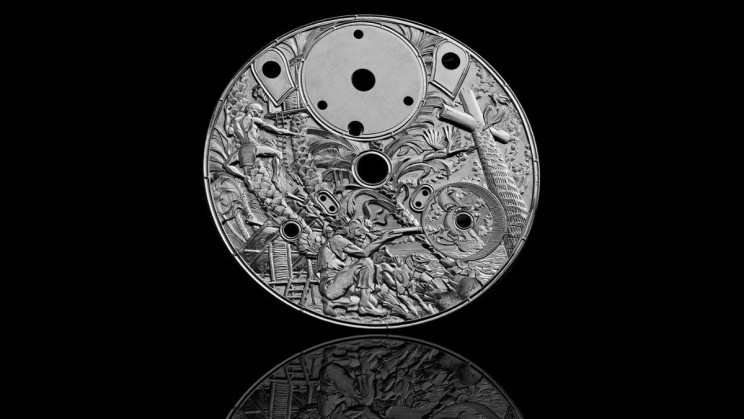
Jaquet has approached this new series slightly differently from the Jules Verne editions by making the heroes of each novel the focus of each illustration. The characters are often depicted sitting or kneeling down in the foreground of the dial at six o’clock so that the rest of the scene can be developed above them. Some of the figures are so small that Jaquet needed to include as much detail as possible to bring them to life. In The Three Musketeers, the scene reveals 10 young men in a sword fight with two tiny figures on the balcony in the most intricate detail. Another example can be discovered in The Last of the Mohicans, where three minuscule figures sit around a campfire.
These details cannot be perceived with the naked eye but reveal themselves to the viewer under a loupe, creating a whole other level of appreciation. In Robinson Crusoe, for example, the owner will discover daily tally marks on a wooden cross, which is impossible to see without magnification. Each timepiece comes with the artist’s initial drawing so that the watch’s owner can truly appreciate the complexity of transferring ideas from a large, two-dimensional piece of paper onto a watch’s dial in three-dimensional relief.
This difference can also be discovered in the ways Jaquet treats the metal to create a maximum of contrasts. Even the direction in which he works his tools will create a difference in colour and play on the light that brings texture to each picture. He also works the metal with matt and polished surfaces to reinforce the action. Moving the timepiece around also changes the scene as the light hits these meticulously worked surfaces in different ways, increasing the appreciation of Jaquet’s mastery of engraving.
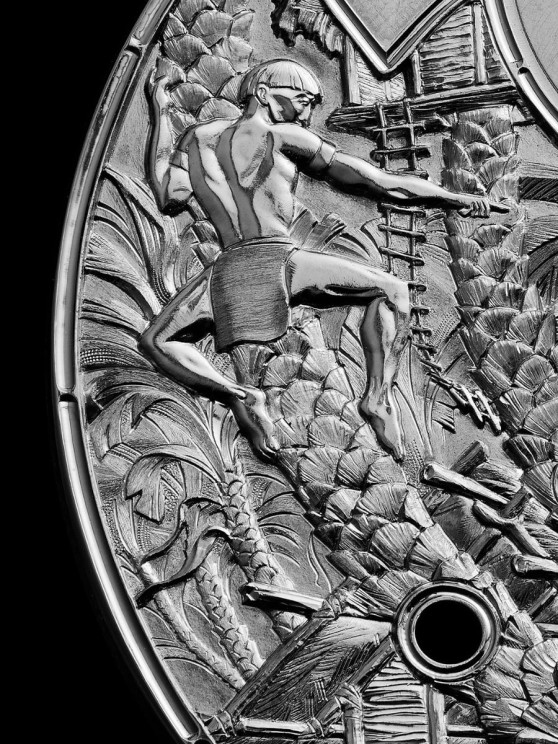
Not all the challenges can be perceived, however. In certain parts, the dial plate had a thickness of 1.15mm, which allowed Jaquet ample space to engrave even in deep relief. In three particularly vulnerable areas, the dial plate measured only 0.35mm thick, requiring him to work with an extremely light touch in those places while making sure that the overall aesthetic of the engraving, which is intricately detailed, was not compromised.
The composition of each adventure also required deep reflection as the parts of the scene that would be hidden by different elements of the watch, such as the sub dials, bridges and hairspring would not disrupt the understanding of the illustration. In certain instances, these restrictions have been used to enhance the scene. In Robinson Crusoe, one of the subdials has been used to show the view through a telescope as our main character and his companion Friday observe a ship out at sea.
This second LM Split Escapement ‘Eddy Jaquet’ series has so many levels of appreciation. Viewed from across a crowded room, the timepieces can be admired for their exterior lines and unique design, and yet while on the wrist, the outline of each scene will start to appear. But it is only when the owner plunges into the details through a magnifying glass that the magic of the adventure really starts to unfold. When you think about it, it is a little like discovering these novels themselves. It starts with the book’s cover, then continues with the blurb on the back, ending with total immersion in the pages of the story.