
1. The Sympathique Clocks
The sympathique clock is an exotic yet simple concept. It consists of a clock and a pocket watch. The two are independent, but the clock includes a cavity where the watch can be placed. Once inserted, the clock and watch connect mechanically, and the former resets the time of the latter.
The term sympathique comes from Latin roots, meaning “having similar emotions.” In this sense, someone sympathique is a person whose feelings are in harmony with ours—in resonance, to borrow from horological metaphor. The sympathique clock synchronizes the time of the watch with that of the clock.
Breguet invented it in 1795, upon returning to Paris after fleeing the Revolution. The sympathique clock was conceived to revitalize a struggling workshop with a prestigious product that might appeal to wealthy clients. But it was complex and expensive. Breguet the elder sold only five; his son, just one. It wasn’t until the third generation of Breguet watchmakers that a winding function was added, leading to around fifty more sales. In 1991, under the ownership of Investcorp, Breguet adapted the sympathique clock to reset and wind a wristwatch instead of a pocket watch.
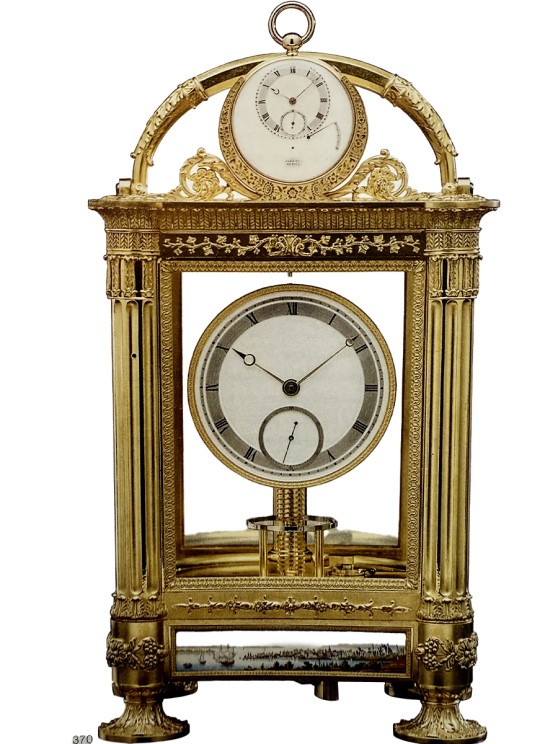
Our take – In 2025, the commercial appeal of a sympathique clock would be much the same as in Breguet’s time: virtually zero, but with undeniable legitimacy—first, because Breguet invented it, and second, because no one else knows how to make one anymore. Creating it would require developing two entirely new movements from scratch—one for the clock and one for the watch. The investment would reach into the millions of Swiss francs, for a limited series of only 5 to 10 pieces, given the object’s obscurity among collectors. A case of art for art’s sake: coherent, sumptuous, but commercially risky—likely priced in the 7-figure range.
2. The Regulator
A regulator displays hours, minutes, and possibly seconds not from a central axis, but from three separate positions on the dial. These hands are placed in different locations. Contrary to popular belief, the regulator is not inherently more accurate than a standard central-hand watch, since both have essentially the same construction. However, the regulator may offer a more precise or refined time reading.
In 1997, Breguet dedicated a regulator wristwatch to the 250th anniversary of its founder's birth—who had produced such pieces in his time. These watches have remained rare, with only a few more appearing in the 1930s, resulting in exceptional pieces that mostly flew under the radar.
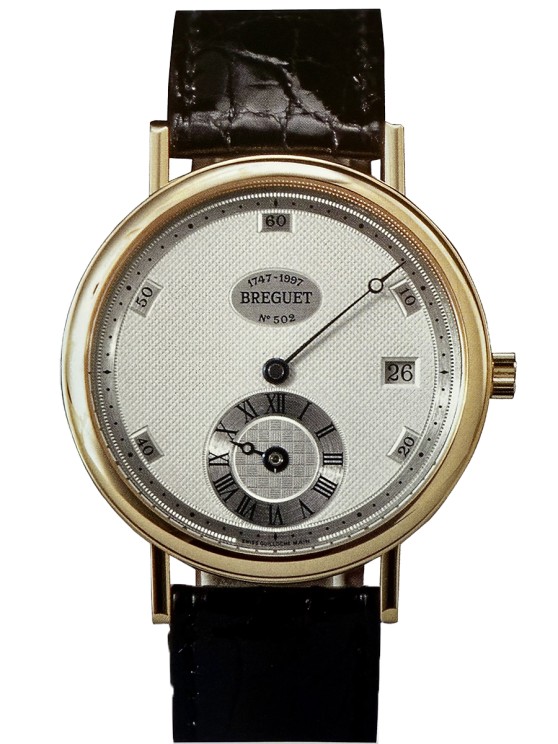
Our take – The regulator market is niche. At the entry level, it’s handled by Louis Erard and Alpina. In the mid-range, it’s dominated by Chronoswiss. At the high end—and only occasionally—you’ll find them from Patek Philippe and A. Lange & Söhne. Breguet never fully explored regulators in regular production. The late 1990s models were powered by Lemania calibres. Collector’s pieces, certainly, but not likely candidates for a new movement development today—let alone a relaunch.
3. The Rattrapante (Split-Seconds Chronograph)
A rattrapante chronograph features two seconds hands to measure different, independent durations. It’s a rare and complex complication. During Breguet’s lifetime, he never made one—though in 1820 he laid the foundation with a double-seconds system that came close. It wasn’t until the 1990s–2000s, under Investcorp ownership, that Breguet used a Lemania 2310 base (renamed 2320) to create the Breguet Ref. 3947 (pusher at 10 o’clock) and its twin 5947 (pusher at 3 o’clock). The watch hasn’t been produced in 25 years and now fetches over $60,000 USD on the secondary market.
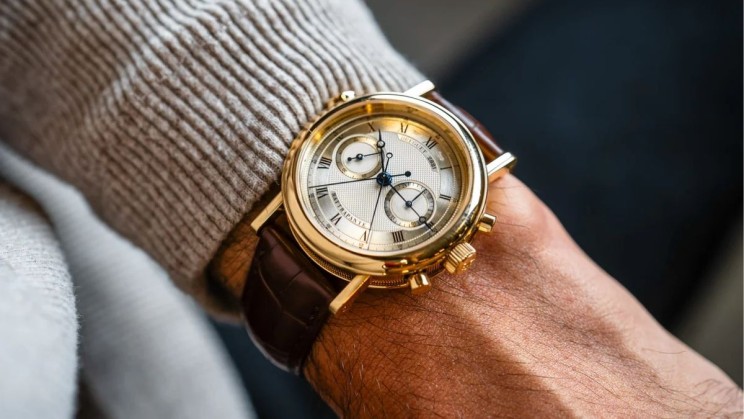
Our take – Now that Breguet has its own in-house chronograph movement—the Caliber 728, launched in 2023 with the new generation of the Type XX—it seems likely that the brand is working on a rattrapante variation. This is a typical haute horlogerie development (as seen at Patek Philippe, A. Lange & Söhne, Vacheron Constantin, Audemars Piguet), and may be unavoidable if Breguet wishes to reclaim its place in the field of traditional grand complications.