In its 140th anniversary year, Alpina has sought to provide a reminder of the contribution made by its Calibre 490 movement to contemporary watchmaking. It represents something of a crossroads: a shape and top-level finishing typical of the refined elegance befitting distinguished watches, intersecting with a number of innovations bearing witness to Alpina’s concomitant desire to launch into the world of sturdy and robust watches designed by the firm today. In sum, it’s a rare and valuable calibre, unveiled at a key moment in Alpina’s history.
Back in 1938, the Calibre 490 already embodied Alpina’s emerging vision. It features a patented crown incorporating protection against dust – an key milestone, already making the case airtight and a first step on the way to the watertight case that would later become standard.
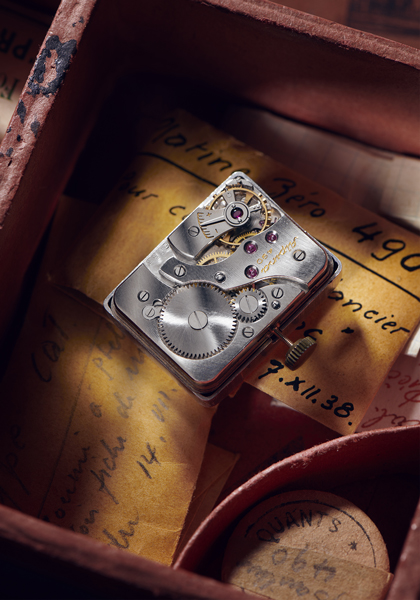
The movement, protected by Swiss registered patent no. 158882, is characterised by a simple, robust construction but no less perfectly finished for that: all of its components are bevelled, and the ratchet is sun-brushed. It’s also worth noting that this is a genuine in-house calibre, designed, assembled and finished by one of the firms in the Union Horlogère, Alpina’s original entity – a particularity seldom seen in the 1930s when generic ébauches (movement-blanks) were the market norm and manufacture movements the exception. Only a few period examples of this historic calibre have survived; Alpina has found and restored a small number of them to mark its 140th anniversary celebrations.
This exceptionally rare witness to Alpina’s golden age is thus making a comeback in its original form in 2023. It’s a shaped movement in the finest watchmaking tradition, according to which the movement should reign supreme, dictating the shape of the case rather than the other way around.
Hand-wound like almost all calibres of its day, it comprises 17 jewels and oscillates at 18,000 vibrations per hour (2,5 Hz), the standard frequency for Thirties timepieces. Its 42-hour power reserve is notably capacious for its time; another distinctive feature is the slender anchor design required to fit within the rectangular layout of the Calibre 490.
Back in the day, the case was made from steel or gold depending on the model. One steel case was itself protected by a patent (No. 207378) and described as being ‘stainless’, offering further evidence of Alpina’s obsession with making its timepieces resistant to wear and tear. The few such cases that have survived are equipped with a number of components designed to maintain two seals under pressure to achieve some degree of watertightness. Several firms went on to draw inspiration from the patent in question in pursuit of the same goal.
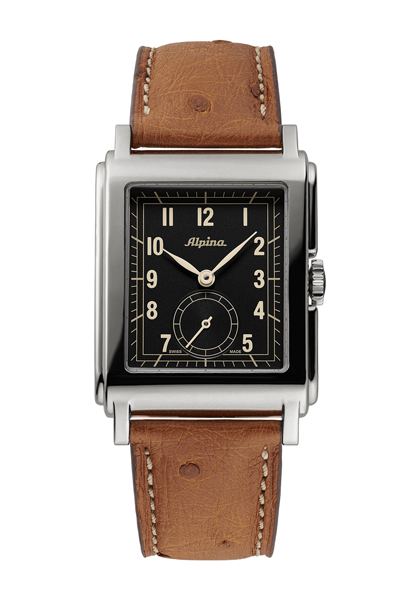
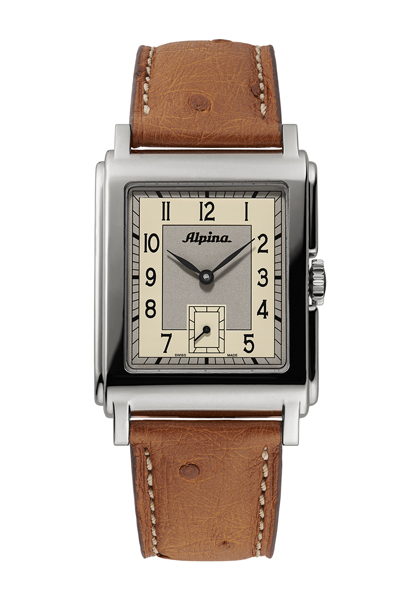
Today, Alpina has designed a new bespoke case to house its Calibre 490, naming the new model after it: Heritage Carrée Mechanical 140 Years. Made from mirror polished silver, it measures 29.5 x 35.7mm. With a thickness of just 9.71 millimetres, it features an anti-glare sapphire crystal on both front and rear, through which the venerable beauty of the period Calibre 490 can be admired. The timepiece comes on a light brown ostrich leather strap, with vintage white stitching and pin buckle.
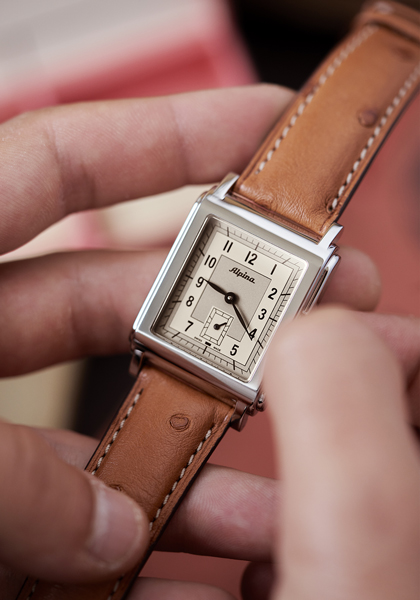
Two variations of the piece are available, each in a limited edition of 14. Both feature Alpina’s period logo, two slim central hands and the small seconds hand display at 6 o’clock so typical of the 1930s. A ‘railtrack’ minute circle, also typical of the period, runs around the dial. On one version the dial is black with solid Arabic numerals, accompanied by beige hands and a circular small seconds hand display. The other version sports a silvered dial, black hands and the squarer outline Arabic numerals favoured in the Roaring Twenties, along with a square small seconds hand display.